
The Architecture Still Looking for a Customer
September 24, 2026
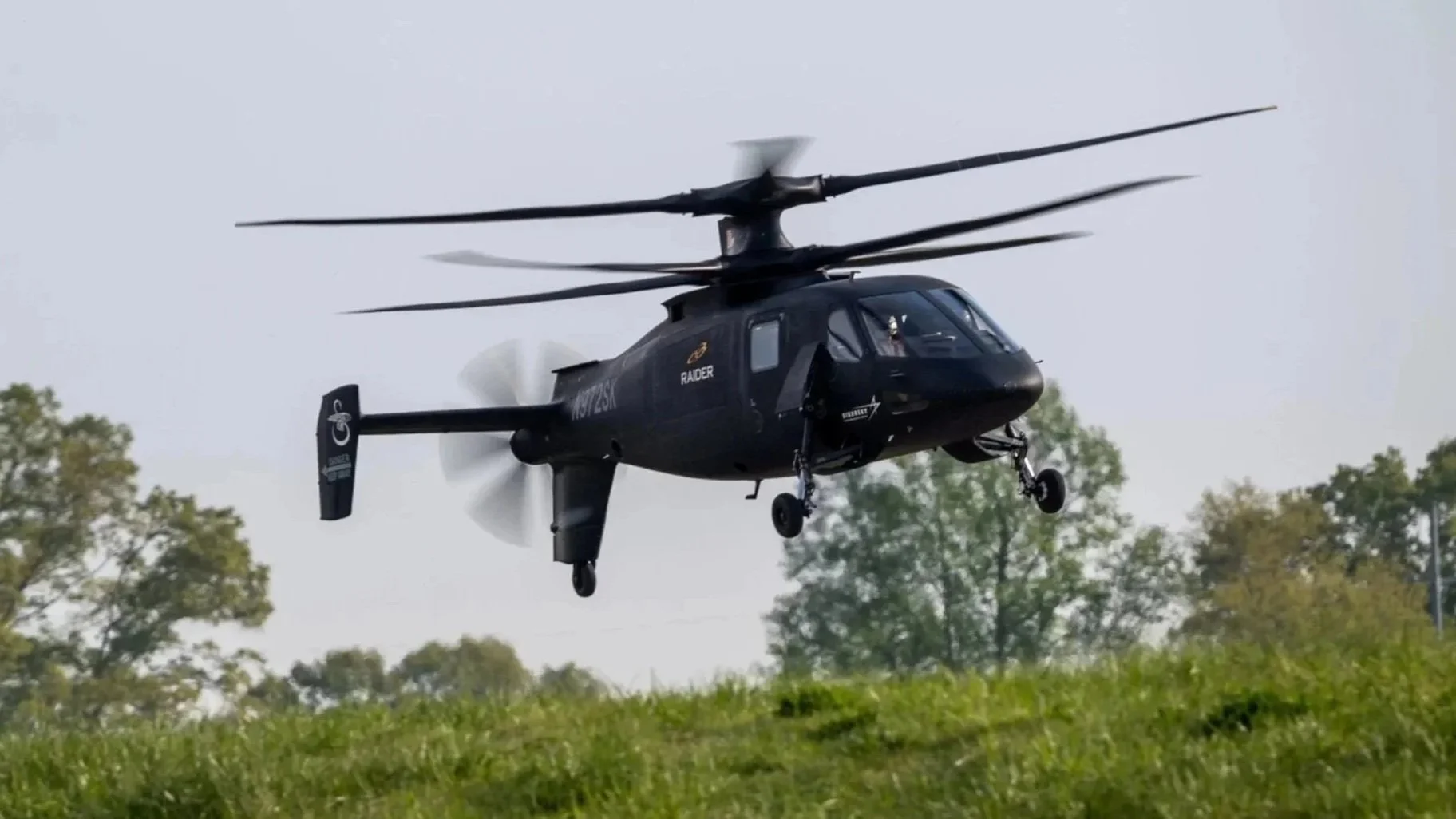
MODERN WARFIGHTER (September 24, 2026) — Military helicopters have long paid for their ability to hover and maneuver near the ground with a firm limit on speed. Sikorsky’s answer, refined across five decades of demonstrators, pairs rigid coaxial rotors with a separate source of forward thrust. Its X2 Technology Demonstrator reached 250 knots in level flight in 2010, and the S-97 Raider that followed carried the idea toward armed reconnaissance. The architecture still needs a military customer whose mission pays for that combination.
At the Farnborough International Airshow in July, S-97 Raider stood outside Lockheed Martin’s chalet with two Army futures behind it. Raider X was still unflown when the Army canceled the Future Attack Reconnaissance Aircraft program, or FARA, and the larger Defiant branch had lost the Army’s assault-aircraft competition. Sikorsky was now studying NATO’s Next Generation Rotorcraft Capability, or NGRC. “We're looking for the right customer now,” test pilot Bill Fell told Defense One.
The sequence contains a historical inversion. Sikorsky’s XH-59A carried an aerodynamic idea its supporting hardware struggled to make practical. Decades later, Raider X approached flight testing with a far more mature technology package, and the Army withdrew the requirement it had been built to meet. Operational qualification still lay ahead, but the immediate obstacle had moved from making the concept work to finding a force that needed its particular strengths.
BEFORE X2
A conventional helicopter develops an aerodynamic imbalance as it accelerates. Its advancing blades meet airflow from both rotation and forward motion, and its retreating blades meet less. Keeping lift on the retreating side demands more blade pitch until stall becomes the constraint. The advancing blades reach their own limit as local airspeeds approach compressibility effects.
Sikorsky’s Advancing Blade Concept redistributed the work. Two stiff rotors turned in opposite directions, and each developed more lift on its advancing side. Because those sides lay across from each other, their rolling moments balanced. Engineers call the displacement of each rotor’s center of lift from its shaft lift offset, and NASA’s analysis treats that loading as a performance variable in its own right. Coaxial geometry describes where the rotors sit. Lift offset describes how they share the load.
Making the displacement useful required blades and hubs stiff enough to carry the resulting moments, and that stiffness helped keep the two rotor planes apart. Auxiliary propulsion could then supply forward thrust so the rotors could concentrate on lift.
The S-69, designated XH-59A, first flew in 1973. With separate jet engines providing forward thrust, it reached 240 knots in level flight. Sikorsky’s historical record also preserves the Army’s 1981 operational evaluation at Fort Rucker, which judged its nap-of-the-earth handling capable of demanding tactical maneuvers.
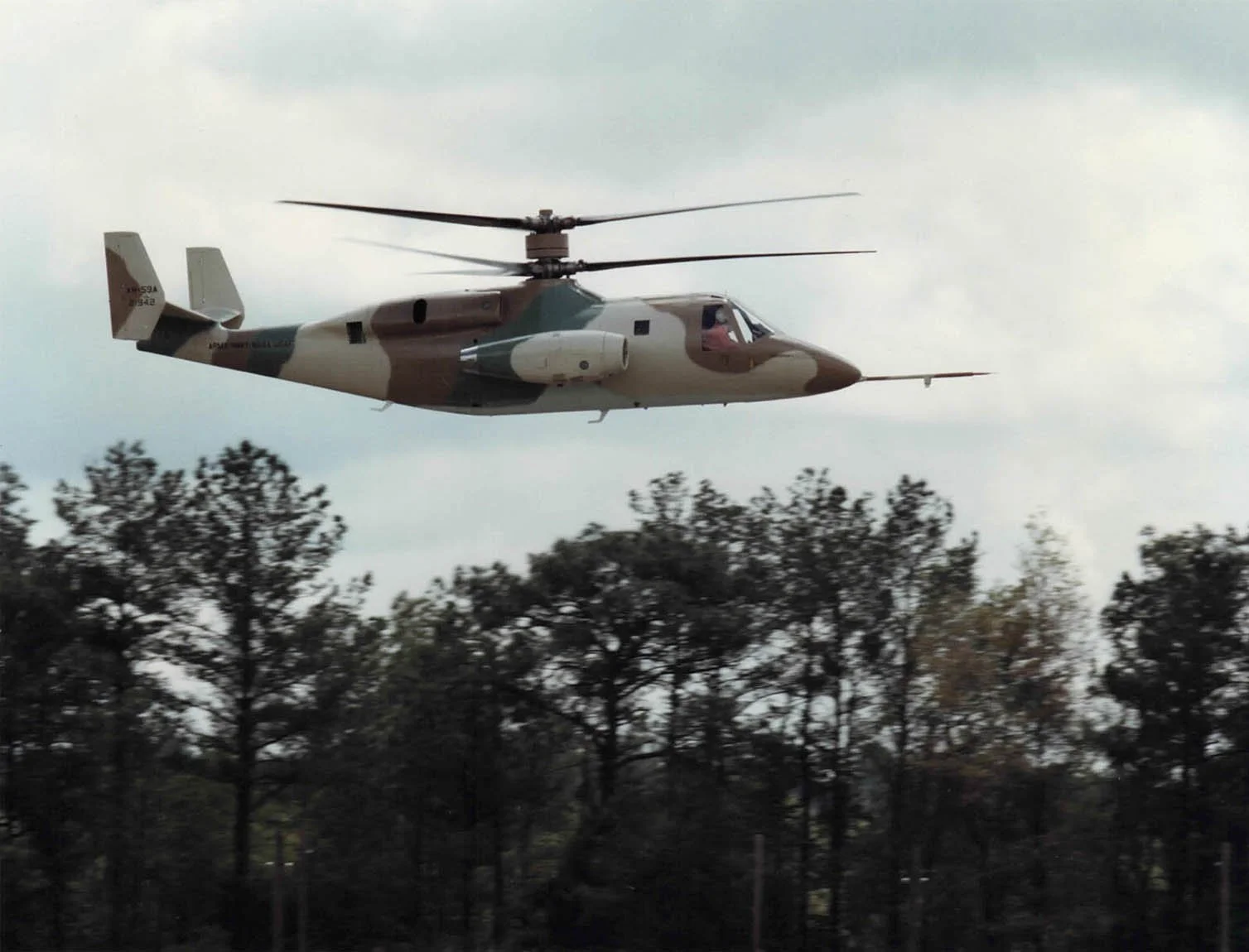
The S-69/XH-59A with the auxiliary jet engines used for high-speed testing. Its Advancing Blade Concept established the aerodynamic foundation that Sikorsky later revisited with X2.
Credit: Igor I. Sikorsky Historical Archives.
Its implementation carried serious penalties. The titanium blades were heavy and expensive, and the vibration was unacceptable for a production aircraft. The separate jet engines added weight, and the rotor hubs produced drag that grew more costly with speed. NASA’s full-scale testing examined hub fairings and measured the loads around that problem. A 1981 technical assessment credited ABC with expanding the rotor’s lift envelope, even as complete-aircraft development remained unfinished.
The propulsion compromise made the gap tangible. Sikorsky’s archive records that weight growth left the aircraft unable to hover with the auxiliary jets installed, forcing rolling takeoffs in that configuration. Integration stood between aerodynamic promise and a practical military machine.
In 1982, Sikorsky proposed an XH-59B with composite rotors and an integrated propulsion system driving a ducted propeller. The proposal went unfunded because Sikorsky and the Army had higher priorities, according to the company’s archive. Funding priorities were already shaping the concept’s future.
MAKING THE COMBINATION PRACTICAL
Sikorsky launched its privately funded X2 Technology Demonstrator in 2005 with an objective broader than speed. The program’s performance objectives paired roughly 250-knot flight with efficient hover and useful low-speed handling.
X2 kept rigid counter-rotating rotors and advancing-side loading, but an aft propeller replaced the XH-59A’s separate jets and shared an integrated drivetrain with the lifting system. Composite blades gave engineers more freedom to trade stiffness against weight. Improved airfoils and hub-drag reduction attacked the losses that would otherwise consume the benefit of auxiliary thrust. Sikorsky’s engineers tied their dynamics design work directly to XH-59A’s shortcomings.
Fly-by-wire controls coordinated the aircraft’s responses, and active vibration management reduced the disturbances reaching the fuselage. Variable rotor speed helped in the high-speed regime but gave the controls another function to manage. In a technical interview, Sikorsky engineering executive Mark Miller described coordinating rotor and propeller control as central to the design.
X2 first flew on August 27, 2008. Sikorsky announced 250 knots in level flight on September 15, 2010, then reported a peak of 253 knots in its retirement announcement. Both figures are company-reported and unofficial. The final flight came on July 14, 2011, after 23 flights and about 22 flight hours.

The X2 Technology Demonstrator on display in 2011. Its flight-test program showed how modern controls and integrated propulsion could help make an older rotor concept practical.
Credit: Valder137 / Wikimedia Commons, CC BY 2.0.
Twenty-two hours established feasibility at demonstrator scale. Fleet affordability would need evidence gathered across an operational service life, from maintenance demand to deployed availability, and production methods and mission equipment were still ahead. X2 had opened the next stage of development, in which an aircraft would have to carry a military purpose as well as its own technology.
TURNING SPEED INTO MILITARY BEHAVIOR
S-97 Raider moved that work toward armed reconnaissance. Sikorsky and its industry partners launched the effort in 2010 with weapons carriage and a small troop compartment in mind. Its first flight on May 22, 2015 concentrated on hover and low-speed handling, which were central to the military proposition.
S-97 had targeted Armed Aerial Scout, which the Army abandoned before Raider’s first flight. FARA later offered the technology another route.
Reconnaissance changes what an aircraft must do near the objective. Consider a crew approaching cover after crossing exposed ground. Its transit speed has to become a controlled approach around terrain and obstacles, and the aircraft must shed that speed just as the crew needs its attention for finding threats. In Fell’s account of flying S-97, propeller thrust allowed acceleration with the fuselage level and reverse pitch helped braking. Rate-command and attitude-hold control laws reduced the coordination the pilot performed directly. The payoff was a steadier viewing attitude and a shorter transition from transit into maneuver, preserving the crew’s attention when observation matters most.
Raider’s roughly 34-foot rotor diameter made confined-space access part of the design. Sikorsky paired that compactness with an advertised high/hot objective of hot-day hover at altitudes up to 10,000 feet, where thinner, warmer air reduces the lift a rotor can produce.
An accident showed how much depended on the control layer. On August 2, 2017, S-97 was taxiing light on its wheels when its control system transitioned from ground to flight mode. According to the NTSB’s final report, a design change had increased cyclic sensitivity in roll during that transition. A nose-down response prompted a correction, and the roll responses that followed were larger than the pilot expected. As the oscillations grew, the upper and lower rotors made contact, and the aircraft landed hard after collective was lowered, sustaining substantial damage.
NTSB traced the accident to a control-system design change that magnified the pilot’s inputs. The event showed how a transition between software control modes could produce hazardous aircraft motion in about three and a half seconds.
S-97 flight testing resumed with the second prototype in June 2018, and Sikorsky reported flight beyond 200 knots that October. Army audiences watched high-speed flight and low-level maneuvering at Redstone Arsenal in April 2021. S-97 was by then feeding flight data into Raider X, and by 2022 Sikorsky was describing it as an 80-percent-scale prototype that informed design decisions and helped correlate the larger aircraft’s virtual model.
ONE ARCHITECTURE AT TWO SCALES
S-97 led toward Raider X and FARA. In parallel, Sikorsky and Boeing built SB>1 Defiant under the Army’s Joint Multi-Role technology demonstration, and it informed their proposed Defiant X for the Future Long Range Assault Aircraft, or FLRAA. That branch tested how far the architecture could grow.
Approximate gross-weight classes rose from 6,000 pounds for X2 through 11,000–12,000 pounds for S-97 to 30,000–32,000 pounds for Defiant, roughly a fivefold increase over the original demonstrator. Sikorsky’s historical summary and the program-official interview describe those design classes.
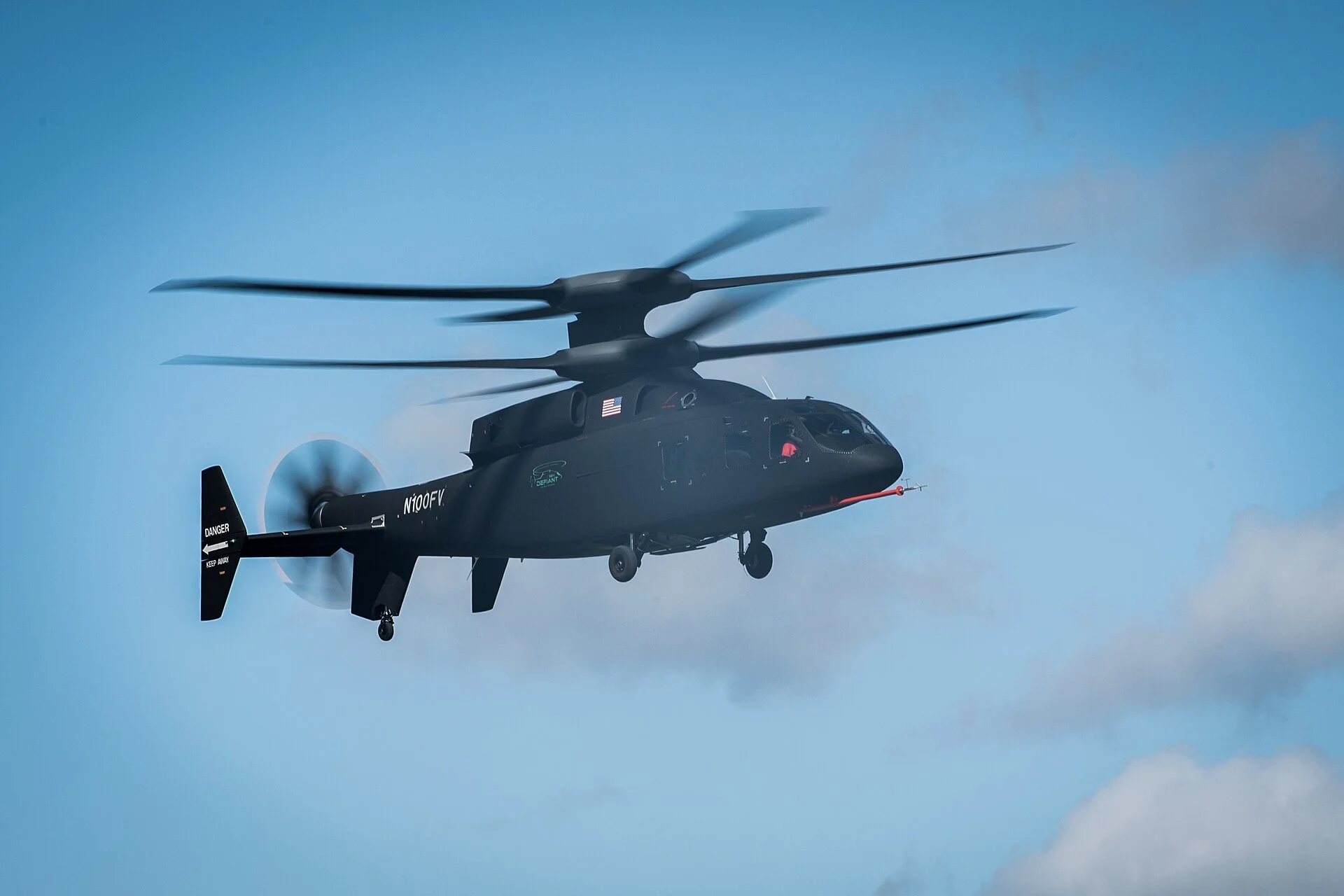
Sikorsky and Boeing’s SB>1 Defiant in February 2020. The demonstrator tested the X2 architecture at the scale of a medium assault helicopter, carrying the technology into a different weight class and mission.
Credit: U.S. Army / Sgt. Dana Clarke.
Larger rotors change the structural problem. Blades must keep their clearance as bending loads rise, and the hubs and shafts must react the larger moments. NASA’s lift-offset sizing research identifies rotor weight as a critical condition for attractive performance, because every pound committed to stiffness competes with useful load. Manufacturing added its own difficulty. In 2017, the Army’s demonstration manager cited problems producing Defiant’s large composite blades as a cause of delay.
SB>1 first flew on March 21, 2019, and Army experimental test pilots flew it in September 2021. By early 2022, Boeing reported 247-knot flight and low-level slalom maneuvers. Its test record by then included external-load carriage and approaches with one engine at idle. A separate company account described a 236-knot approach followed by deceleration into a confined landing area.
WHAT FLRAA DECIDED
In December 2022, the Army selected Bell’s V-280-derived solution for FLRAA, the aircraft now designated MV-75. Sikorsky protested, and GAO denied the protest in April 2023. Its public decision turns on a more specific issue than rotor configuration.
Sikorsky received an unacceptable rating under the architecture subfactor of the engineering design and development factor. The Army found insufficient allocation of system functions to the required subsystem detail, and the dispute extended to the modular open systems approach. Evaluators saw unacceptable risk. The rating made Sikorsky ineligible for award, and GAO found the evaluation reasonable.
“Architecture” here meant how the weapon system’s functions and components fit together. It was a systems-engineering finding about future integration. Flying qualities could support the proposal, but a service buying an aircraft for decades required a credible account of how the complete system would develop and accept change.
THE AIRCRAFT APPROACHED FLIGHT AS THE REQUIREMENT MOVED
FARA was intended for armed reconnaissance and attack on a contested battlefield. The Army's 2020 prototype-selection announcement framed the mission as penetrating defenses to support the maneuver force, which meant finding threats and then delivering effects or cueing other systems to do so. Reach mattered, and so did agility in complex terrain and cities.
Publicly described design attributes capped gross weight at 14,000 pounds and rotor diameter at 40 feet. The speed requirement was 180 knots. Raider X’s configuration appeared to fit. Its compact rotors addressed access, and its acceleration and braking could help crews manage exposure near an objective. Sikorsky’s 2019 proposal added open mission systems and supportability to that case.
Survivability depended on the wider force. FARA already sat inside a concept that included unmanned systems, and in 2022 the Army secretary described air-launched effects as part of its ecosystem. Raider X was being built for a networked reconnaissance mission whose division of labor was still open to change.
The hardware advanced. Sikorsky reported electrical power on the aircraft from October 2021 and structural testing of a second airframe underway in 2022. In October 2023, when the T901 engine arrived for installation, the company described Raider X as approximately 98 percent complete and projected first flight for late 2024, subject to approvals.
The Army announced FARA’s cancellation on February 8, 2024, with Raider X still waiting to fly. Fell later recalled running it chained to the ground in preparation, and contemporary reporting dates its T901-powered rotor runs to April 2024, after the cancellation. Those tests went on to support Black Hawk engine integration. The competition ended with the program itself, before either FARA contender reached a flight comparison.
THE ARMY CHANGED THE UNIT OF COMPARISON
The February 2024 aviation rebalance combined battlefield assessments with pressure on the investment portfolio. Army leaders pointed to Ukraine and to the growing reach of unmanned and space-based sensing. Existing crewed aircraft would continue, supported by expanded investment in launched effects.
GAO’s 2026 review put the reasons in order, with affordability first. Army officials told GAO that buying FARA and FLRAA together would consume nearly the entire aviation budget, and that FARA’s additional reconnaissance and surveillance contribution was marginal against other capabilities in development, at substantially greater cost.
The planned fiscal 2025–29 reallocation totaled approximately $7.3 billion, of which ending FARA development accounted for about $4.4 billion. Delaying the Improved Turbine Engine Program contributed $2.2 billion, and canceling the UH-60V upgrade released about $690 million. Those were portfolio decisions reaching well beyond the scout aircraft, and Modern Warfighter’s T901 analysis follows the engine’s altered path into the enduring fleet.
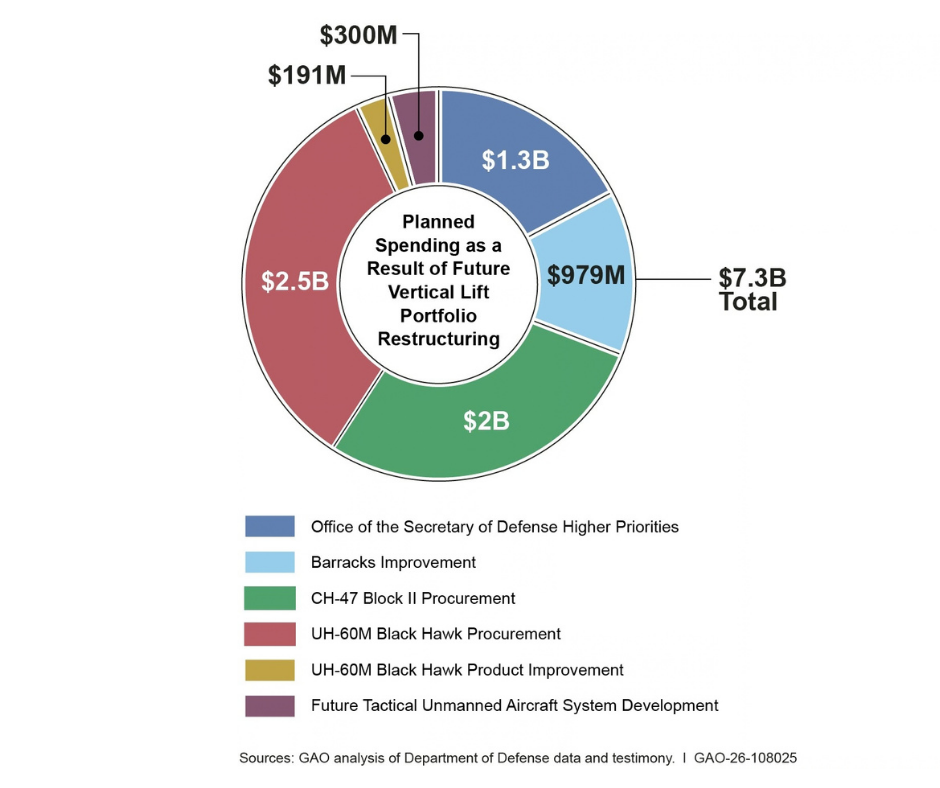
GAO’s breakdown of the Army’s planned aviation investment rebalance for fiscal years 2025–2029. FARA’s cancellation accounted for approximately $4.4 billion of the roughly $7.3 billion the Army planned to redirect.
Source: U.S. Government Accountability Office, GAO-26-108025, Figure 3.
The comparison had expanded from choosing a reconnaissance helicopter to deciding how reconnaissance should be assembled. Raider X’s designers were improving a vehicle for a mission the Army still needed performed. The Army was reconsidering whether performing that mission required the vehicle at all.
Moving parts of the mission off the aircraft carried its own development burden. GAO found that the cancellation reduced planned crewed reconnaissance and attack capability and delayed air-launched effects. It also recorded a shift toward ground-launched effects, with future air-launch work focused on Black Hawk and possibly other aircraft. The Army’s 2026 launched-effects account describes integration work still under way.
The operational implication is a different set of dependencies. A crewed scout brings observation and tactical judgment together aboard one aircraft. Distributing those tasks means connecting remote observations to someone empowered to act, the problem at the center of Modern Warfighter’s NGC2 analysis. Communications become part of reconnaissance performance, and the revised approach has to hold those connections through interference and loss before its lower-cost sensors can produce useful decisions.
WHAT THE TECHNOLOGY RETAINED
The architecture retains physical costs. Two closely spaced rotors produce interacting wakes and periodic loads, and the stiffness that preserves their clearance demands structure. Coaxial hubs add drag, and the propeller needs its own power path. Technical analysis using XH-59A data examines these coupled effects. Better controls can manage their consequences, but the costs stay in the design.
Compactness has a price as well as a benefit. A smaller rotor concentrates the lift needed for a given weight. In NASA’s sizing study, lowering that loading cut engine and fuel weight but added rotor weight, and even the preferred blade geometry compromised between hover and cruise efficiency. A good handling display answers a different question from how much useful load the aircraft can lift into a hover on a hot day.
Maintenance depends on implementation. Sikorsky argued that rigid rotors simplify some components, and officials cited fewer rotor-head parts on S-97 than on Black Hawk. That manufacturer comparison has to be weighed against an additional propulsive system and a demanding drivetrain, a balance only fleet experience can price.
Speed has a limited relationship with survivability. Faster ingress can cut time exposed along a route, and sharper deceleration changes the approach to an objective, but survival still depends on detection and the enemy’s chances to engage. Mission-system integration would have to show how the aircraft finds threats and coordinates its response.
ANOTHER CUSTOMER AND ANOTHER DESIGN SPACE
After FARA, Sikorsky kept flying S-97 and looked abroad. A February 2025 flight display in Florida showed high-speed passes and level-body maneuvering. The NATO path already had a formal footing in an NGRC concept-study contract, awarded in July 2024, to examine an X2-based application with European partners.
South Korea showed a different route and its limits. Sikorsky’s 2024 technology-transfer proposal depended on CH-53K winning a separate heavy-helicopter requirement. In October 2025, Sikorsky withdrew from that competition, telling Janes the program budget could not support acquiring and operating CH-53K. That withdrawal closed the procurement route on which the 2024 X2 technology-transfer proposal depended.
Sikorsky kept pitching X2 in Korea on its own terms, including a September 2026 proposal for joint development. By then Bell and KAI had signed an April 2026 memorandum to explore a solution based on MV-75. Korea could set the two FLRAA architectures against each other again, before a different buyer and under different industrial terms.
NGRC poses a larger translation problem. The NATO Support and Procurement Agency’s 2026 solicitation announcement moved the effort into concept design for six participating nations. Airbus, Boeing, Leonardo and Sikorsky prequalified, and European Security & Defence later reported that Boeing stepped back to concentrate on existing systems such as Chinook.
The design space spans several architectures. Eurocopter’s X3 reached a company-reported 255 knots in 2013, above X2’s reported 253, and its successor in compound research, Racer, first flew in 2024. Airbus is drawing on both for a high-speed NGRC concept with wings and lateral propellers, offered beside a conventional design. Leonardo led a Study 5 tiltrotor concept with Bell in support, under a 2024 memorandum between the two companies.
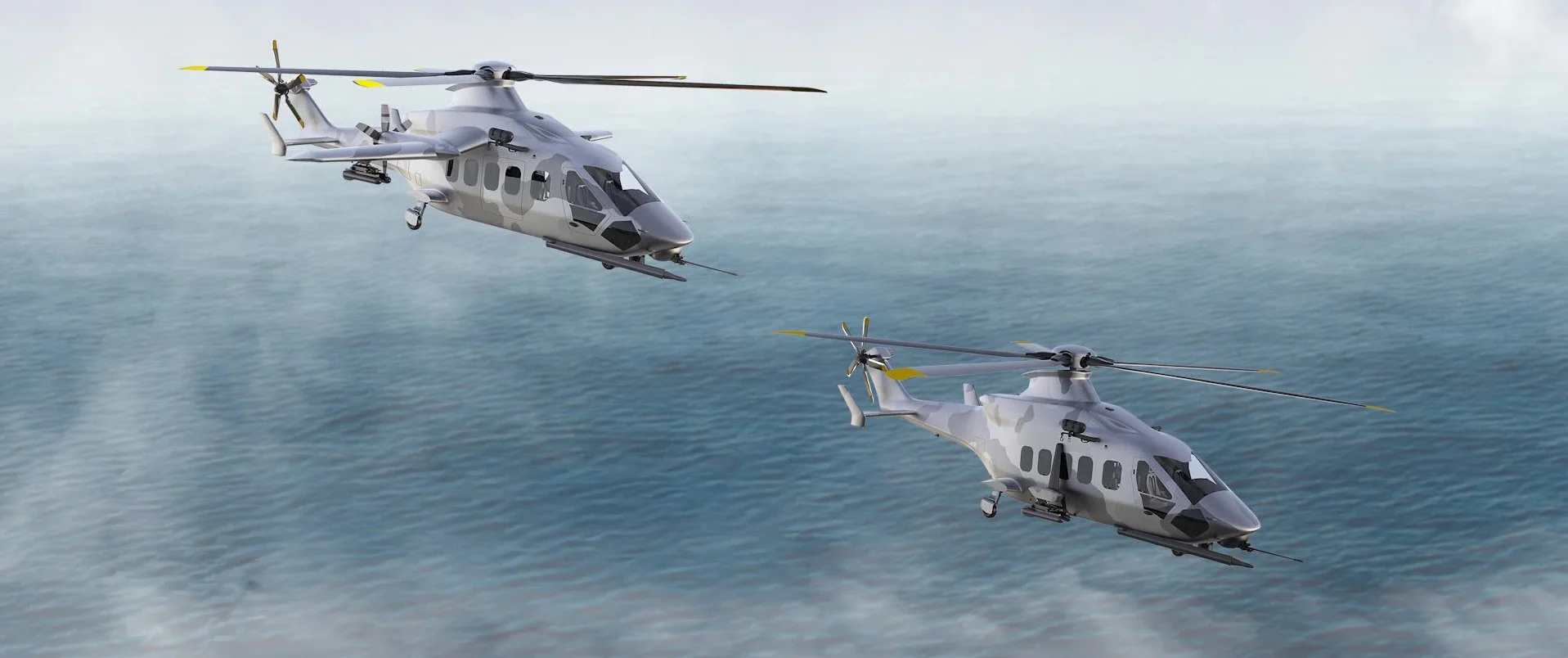
Airbus concept illustrations for NATO’s NGRC studies show a high-speed compound above a conventional helicopter configuration.
Illustration: Airbus Helicopters.
NSPA’s 2024 public attributes called for 12–16 troops and an unrefueled range beyond 900 nautical miles. Earlier requirement summaries paired that range with a mission radius above 400 nautical miles plus 30 minutes on station. Desired cruise speed exceeded 220 knots, with 180 knots as the minimum, and NSPA’s program manager has told industry audiences that the participating nations place heavy weight on speed.
The mission set extended to shipborne operations and personnel recovery. For operation at sea, the published attributes use NH90 NFH or AW101 dimensions as the footprint reference and include an optional rotor-and-tail folding capability. Across national fleets, commonality and interoperability carried weight, and an open architecture would have to accommodate changing equipment and cooperation with uncrewed systems.
Availability places those figures inside a larger obligation. Earlier published attributes listed more than 75 percent forward-fleet availability and over four tonnes of combined payload, and NSPA’s program material emphasizes operating and lifecycle cost. These dated public targets show the competing demands a design must reconcile. Compliance will be judged against the current requirement.
For a multinational fleet, maintainability means sustaining common support across different operators. National mission equipment can pull aircraft away from a shared configuration, and open interfaces can absorb some of that drift, but each country still needs access to repair knowledge and replacement components. Availability depends on how that support system works after the demonstration team goes home.
WHERE X2 HAS ITS STRONGEST CASE
X2’s strongest case rests on repeated maneuver near the objective. Rapid braking and precise low-speed control matter most during confined approaches. Those qualities gain value as a mission spends more of its time using them. Sikorsky makes the same argument. At Farnborough, Fell pitched Raider to operators who need to arrive fast and decelerate quickly under fire, and he conceded that the technology would never match a tiltrotor’s cruise efficiency.
That concession frames the harder question, which is how NGRC weighs those strengths. A wingless design keeps asking its rotors to carry the aircraft in cruise. Over a long radius flown out and back, drag and propulsion efficiency accumulate into fuel, and every pound of fuel competes with troops and cargo. A tiltrotor moves that lift onto a wing, and Airbus’s winged compound unloads the rotor by another route.
Modern Warfighter’s assessment is that the published range attributes give cruise efficiency substantial weight. For illustration, an 800-nautical-mile round trip at a steady 220 knots in still air takes about three hours and 38 minutes before time on station. X2’s handling advantages would have to justify the fuel and payload tradeoff across that mission.
Shipboard suitability depends on the complete aircraft. A compact rotor eases deck operations, but hangars limit height as well as footprint, and stacked coaxial rotors add height. Sikorsky would have to show a naval configuration that folds and stows within those limits. On confined approaches, X2's low-speed handling is a real advantage, and its value depends on what the aircraft can carry over the required distance.
According to Aviation Week, Sikorsky’s own Study 5 team proposed a conventional helicopter beside an X2 compound slightly smaller than Defiant, drawing on European suppliers including Safran and Rheinmetall. Even the architecture’s owner entered NGRC with a second answer.
Sikorsky’s July 2026 announcement proposed European development and production, with local component manufacturing. Participating nations would still need to establish who controls the design and who can approve future modifications. The industrial agreement would determine how much authority European partners gain over an X2-derived aircraft. Any transfer of U.S.-origin flight-control technology could be subject to U.S. export controls, while Airbus enters the competition from an established European industrial base.
NGRC’s reported schedule places flight trials from 2032 and deliveries from 2035. An X2-derived aircraft fielded on that timeline would arrive 62 years after XH-59A first flew, after two Army requirements had ended and a third had gone to a tiltrotor.
At Farnborough, Sikorsky could show what decades of flight testing had produced. Its next customer will have to decide what that performance is worth across a full mission.
RELATED COVERAGE
-
![]()
The Engine That Outlived Its Own Program
August 23, 2026 · 8 min read
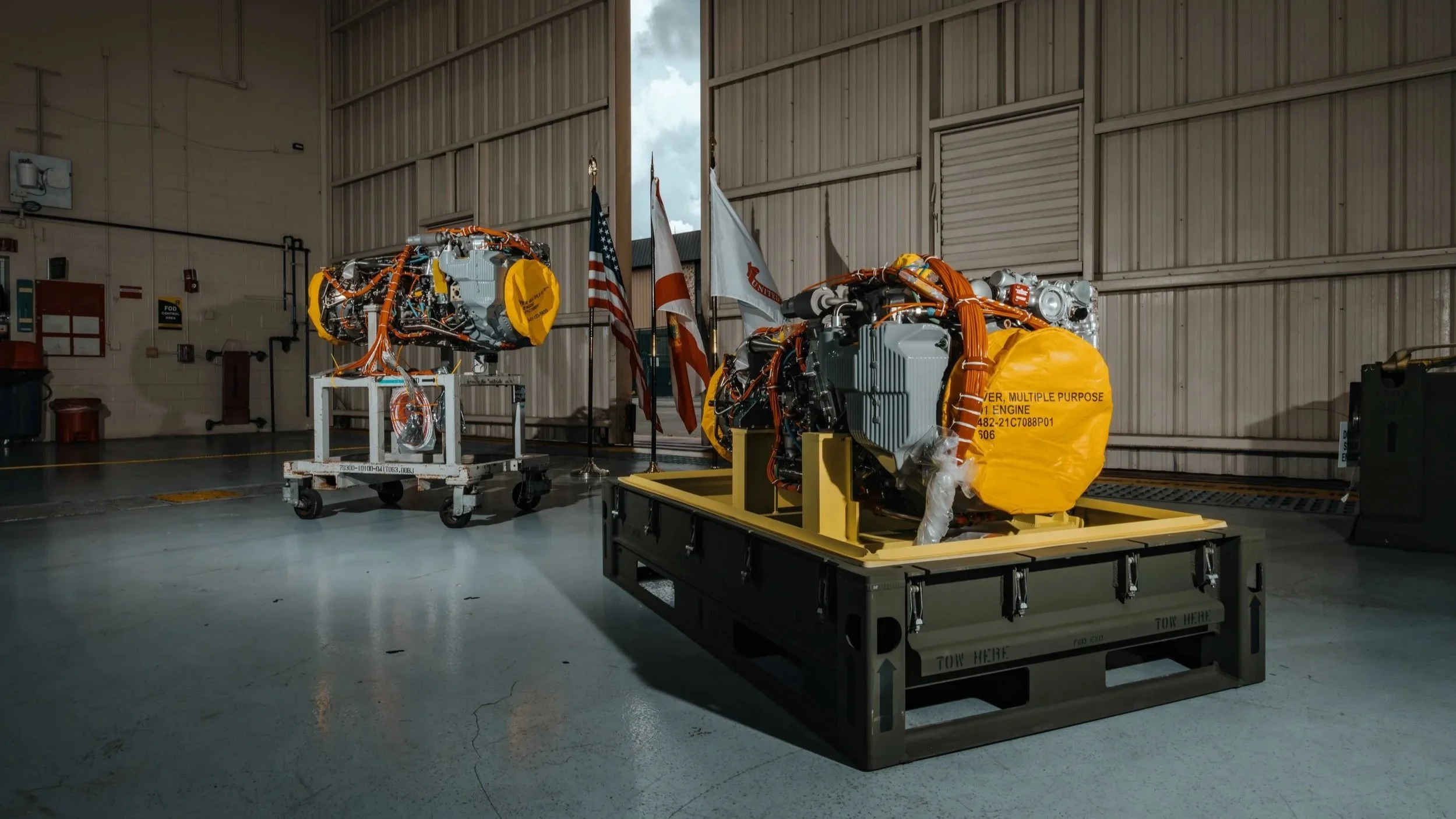
T901 outlived FARA, the aircraft it was built to power, and it now recovers the performance Black Hawk and Apache lost across decades of modernization.
VERIFICATION: The source record behind this analysis, including what could not be confirmed. VIEW VERIFICATION →
TAGGED: X2, S-97 Raider, Raider X, SB>1 Defiant, Army Aviation, FARA, FLRAA, NATO NGRC, Platform Evolution
-

ANDRES CARDENAS | Lead Analyst
Modern Warfighter Defense Publication
/ STAY CONNECTED /