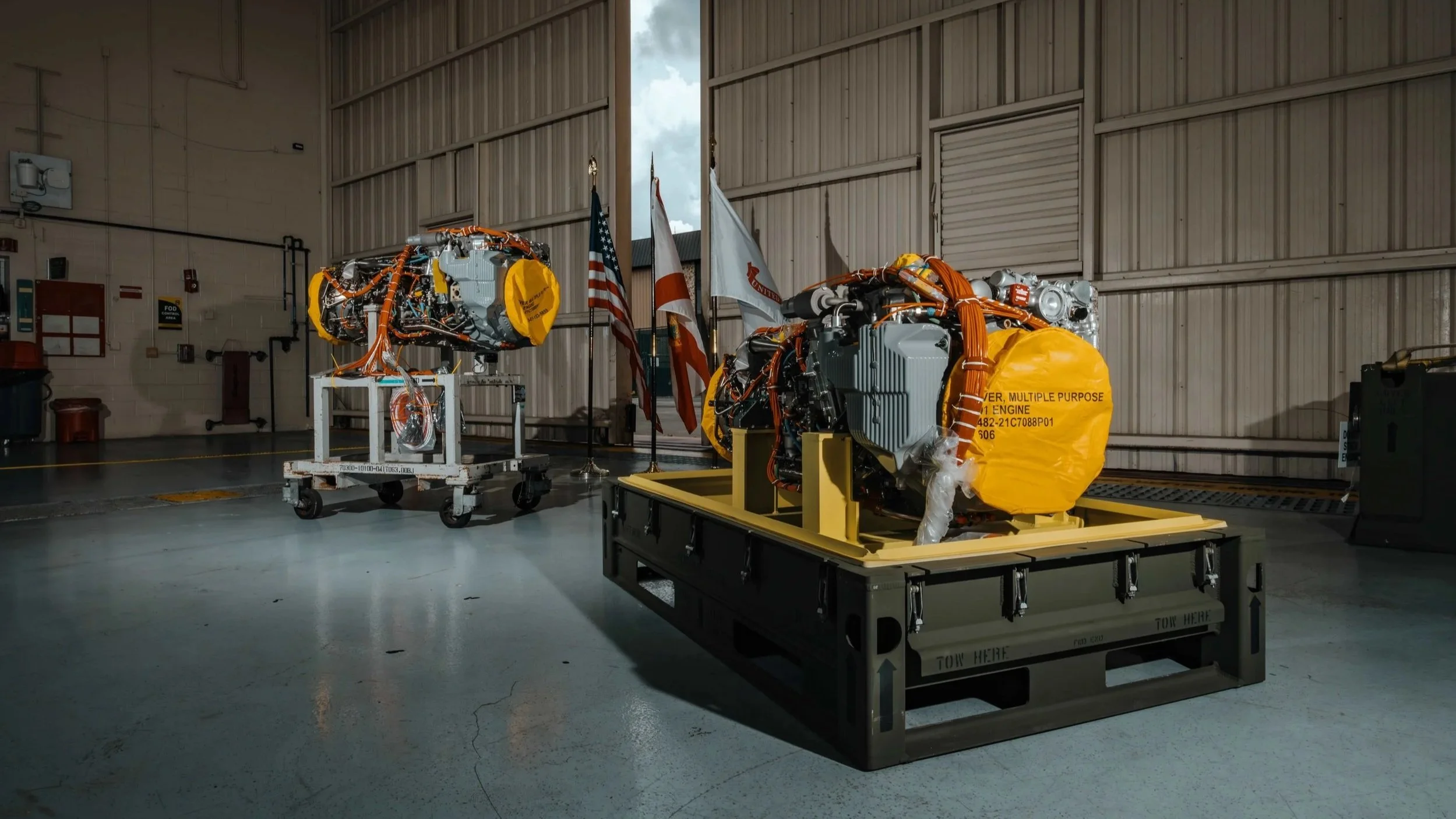

The Engine That Outlived Its Own Program
August 23, 2026 | 8 min brief
FORT EUSTIS, VA. (June 24, 2026) — A UH-60M Black Hawk climbed behind two engines its original designers could never have planned around. The aircraft belongs to a family that entered Army service in 1979. Each T901-GE-900 behind its transmission belongs to a different era. The engine produces 3,000 shaft horsepower, 50 percent more power than the T700 generation it is designed to replace, with 25 percent better specific fuel consumption at maximum power and roughly the same size and weight.
The flight closed another stage of a much longer development effort. T901 had accumulated more than 2,600 hours in test cells and more than 90 hours of aircraft ground and flight testing by the time the Army completed Preliminary Flight Rating. Test flights reached 17,000 feet and 160 knots. The milestone moved the engine deeper into qualification after years of delays, funding changes, and a major shift in Army aviation strategy.
That timing matters. The Army is developing the MV-75 Cheyenne II to carry assault forces farther and faster than the Black Hawk, and it is expanding launched effects and autonomous systems across the force at the same time. It also canceled the Future Attack Reconnaissance Aircraft in 2024 after concluding that changes in sensing, unmanned systems, and the battlefield had altered the requirement behind the program. T901 had been selected to power FARA, but when the aircraft disappeared from the portfolio, its engine survived.
T901 is now moving through Black Hawk integration as Apache waits behind it. New aircraft will enter formations over years. Existing aircraft will keep carrying combat power in the meantime, absorbing new engines, software, weapons, and mission systems as they go. The Army has to build the fleet it wants and continue fighting with the fleet it has. T901 sits between the two.
THE MARGIN PROBLEM
Forty years of Black Hawk and Apache modernization produced more capable aircraft and heavier ones. Survivability equipment, sensors, communications systems, weapons, and other mission equipment accumulated across decades of upgrades. The Army describes the effect directly. Aircraft weight increased. Payload and range suffered. T700 power increased across successive variants, eventually producing the T700-GE-701D, but continued growth kept consuming the performance available to the airframe.
Altitude and temperature make the tradeoff worse. Hot air is less dense, and density falls with altitude. Rotor performance declines as turbine engines lose available power. A mission planned near sea level can force choices among fuel, payload, and useful lift once the same helicopter moves higher or hotter. The Army built one of ITEP's defining requirements around that problem: full mission performance at 6,000 feet pressure altitude and 95 degrees Fahrenheit. 6K/95 explains T901 better than the 3,000-horsepower headline.
GE's projections show the scale of the intended recovery. In one Black Hawk scenario at 6K/95, the company models range with nine troops increasing from 100 to 261 kilometers. That figure remains a manufacturer projection, but it shows how much performance the requirement is intended to recover.
The engine adds roughly 1,000 shaft horsepower over the T700-GE-701D while retaining the T700's mounts, inlet, and exhaust interfaces. GE used ceramic matrix composites, additive manufacturing, advanced cooling, and aerodynamic improvements to extract more power from the existing installation envelope. The Army designed that increase to recover capacity lost as Black Hawk and Apache accumulated weight, pushing useful performance farther into high-and-hot conditions.
The 2026 campaign expanded the flight envelope to 17,000 feet and 160 knots and gave the Army enough confidence to complete Preliminary Flight Rating. The formal operational assessment at 6K/95 is planned for fiscal 2028. That separates what T901 has demonstrated from what the Army ultimately expects it to deliver. Modernization consumes margin. T901 is designed to give some of it back.
WHAT 3,000 HORSEPOWER BUYS
Horsepower matters when the aircraft can turn it into combat performance. For Black Hawk and Apache, recovered power can affect payload, range, endurance, and operations at altitude and temperature. Fuel efficiency attacks the problem from another direction. The ITEP requirement called for a 13-to-25-percent reduction in fuel consumption compared with the legacy engine. T901 targets a 25-percent improvement in specific fuel consumption at maximum power.
Every gallon burned in flight first has to reach the aircraft. Fuel moves through storage, transportation, distribution, and forward refueling infrastructure before becoming range or time on station. The Army has connected T901 efficiency to reduced dependence on forward arming and refueling points and the logistics and security burden supporting them. The scale of that effect depends on mission profile, configuration, and what later testing proves. Army projections describing major payload improvements at 6K/95 remain projections until operational assessment establishes performance under representative conditions.
The relationship is straightforward. Less fuel burned for a given amount of power reduces what the formation has to move. Greater available power changes what the helicopter can carry once altitude and temperature begin taking lift away. T901 is more useful as a measure of recovered choice than as a horsepower figure.
FARA DIED. ITS ENGINE SURVIVED.
The Army selected T901 in 2019 for two jobs. It would replace the T700 across Black Hawk and Apache, and it would power the Future Attack Reconnaissance Aircraft. One engine would connect an enduring fleet with a platform expected to help define the next one. That plan lasted until February 2024, when the Army canceled FARA during its aviation investment rebalance after concluding that changes in sensing, unmanned systems, and battlefield conditions demanded a different approach to armed reconnaissance. Money shifted toward Black Hawk procurement, CH-47F Block II, unmanned reconnaissance, launched effects, and other priorities. FLRAA continued. ITEP production moved farther right.
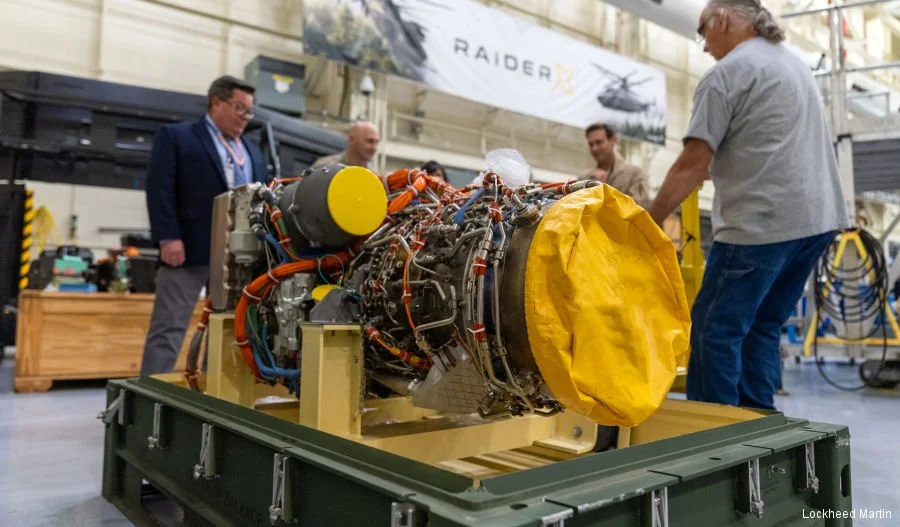
A T901 arrives at Sikorsky's West Palm Beach facility in October 2023 for integration into Raider X, months before the Army canceled FARA. The engine would continue into the enduring fleet.
Media: Sikorsky, Lockheed Martin
ITEP had already encountered schedule pressure before the rebalance. Development and integration were moving later before FARA left the portfolio. The 2024 decision then altered how T901 would reach the helicopters still waiting for it. Black Hawk and Apache integration had been planned in parallel. Reduced funding forced the Army into a sequence. GAO reported in its 2025 Major Weapon Systems Assessment that Apache integration received a stop-work order as Black Hawk testing and qualification moved first. The planned production decision shifted from the third quarter of fiscal 2026 to the third quarter of fiscal 2029, with the program planning to seek funding to resume Apache work in fiscal 2030.
The engine was already moving between those two futures. In April 2024, T901 powered Raider X during its first ground run. Two months later, the Army accepted two more T901s for Black Hawk integration and testing at Sikorsky's West Palm Beach facility. FARA was gone, but its engine was already moving into the enduring fleet.
THE APACHE WAITS
Apache still sits inside the T901 requirement. Black Hawk reaches the engine first. GAO's 2026 review found that delaying ITEP also delayed desired improvements in speed, range, agility, endurance, and sustainability across both fleets. The wider aviation restructuring shifted billions of dollars across the portfolio, including additional money toward Black Hawk procurement and product improvements.
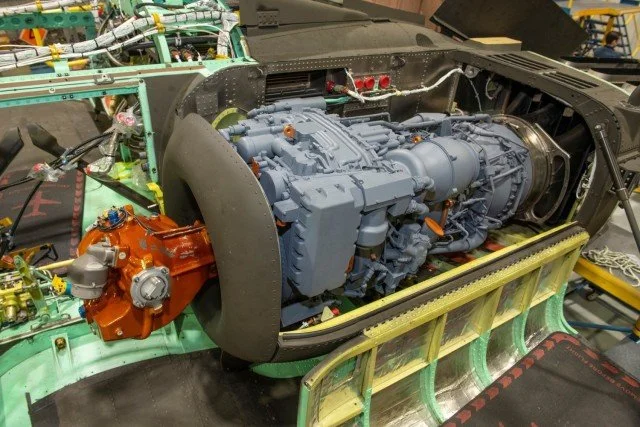
The Army conducted T901 fit testing on the AH-64E as part of ITEP integration. Apache remains part of the engine requirement, but Black Hawk qualification now moves first.
Media: U.S. Army
The sequence exposes a basic acquisition constraint. Multiple requirements can exist at the same time. Funding, engineering capacity, and test resources still determine which one moves first. Apache lost its place in line. The propulsion requirement remained. T901 production can begin with portions of Army Aviation still operating T700s. Black Hawk can move through qualification as Apache waits for its integration effort to restart. Maintainers and logisticians will eventually support both engine generations as fielding spreads across the force. Modernization reaches the fleet gradually, leaving old and new propulsion architectures operating side by side.
THE NEXT LIMIT
T901 moves one boundary. The aircraft around it imposes others. More power still leaves a conventional helicopter at helicopter speed. Improved efficiency still leaves the formation dependent on fuel. Better high-and-hot performance leaves forward refueling sites exposed to the surveillance and long-range fires changing operations across the battlefield. Propulsion recovers lift and range. Reconnaissance, fires, communications, and sustainment still depend on everything else riding on the airframe.
Those constraints helped drive the Army toward Future Vertical Lift. They also explain why T901 and MV-75 solve different problems. One recovers useful performance inside an existing architecture. The other changes the speed and reach around which part of the future force can be built.
Black Hawk and Apache will keep changing in the meantime. Sensors improve. Survivability systems evolve. Networks expand. Launched effects introduce new missions and equipment. After FARA's cancellation, GAO reported that the Army began examining existing aircraft, including Black Hawk, as potential platforms for capabilities associated with the reconnaissance mission. Every addition enters an airframe with finite physical limits. Weight still has to fly. Drag still has to be overcome. Mission equipment still has to fit.
Additional shaft horsepower also differs from electrical generation or cooling capacity, which depend on separate aircraft systems. T901 addresses propulsion. The rest of the aircraft determines how much of that recovery can be exploited. Capability growth increases demand on the airframe, gradually consuming available margin until engineers move another boundary outward. More power changes which limit arrives first.
THE TRANSITION
Black Hawk qualification moves first. Apache waits farther down the integration sequence. MV-75 approaches from the other direction. Launched effects and unmanned systems are moving into the formation around them. Army Aviation will experience those changes together.
A new aircraft can reach a milestone years before enough airframes exist to change the force. An engine can enter production as another platform waits for integration. A canceled program can leave behind missions, technologies, and requirements that migrate elsewhere. The transition becomes part of the architecture.
T901 now sits inside that architecture. Preliminary Flight Rating establishes progress. The 6K/95 operational assessment remains ahead, with production and Apache integration following on separate timelines. Each will answer another part of the engineering and acquisition question.
The Army has to generate combat power with the fleet it has. It has to build the fleet it wants at the same time. Those fleets will overlap for years. T901 creates room inside one part of that overlap, giving Black Hawk and Apache more capacity for whatever the Army asks them to carry next. T901 restores the margin required to keep changing them.
Key Takeaways
T901 restores propulsion margin consumed across decades of Black Hawk and Apache modernization, delivering 3,000 shaft horsepower within the T700 installation architecture.
The engine survived FARA's cancellation, but funding and integration changes put Black Hawk qualification first and pushed Apache farther down the timeline.
T901 extends what the current fleet can carry and where it can operate as Future Vertical Lift develops alongside it.
TAGGED: T901, ITEP, UH-60 Black Hawk, AH-64 Apache, Army Aviation, Future Vertical Lift
-

ANDRES CARDENAS | Lead Analyst
Modern Warfighter Defense Publication
/ STAY CONNECTED /