
Shield AI’s X-BAT and the Runway Problem
October 9, 2026 | 6 min brief
FRISCO, Texas (October 9, 2026) — The Navy’s strike fighters need a carrier deck or a runway to come home to. Shield AI is building X-BAT to recover from smaller ships and austere land sites. The uncrewed, jet-powered aircraft is designed for vertical takeoff and landing, or VTOL. It has yet to fly.
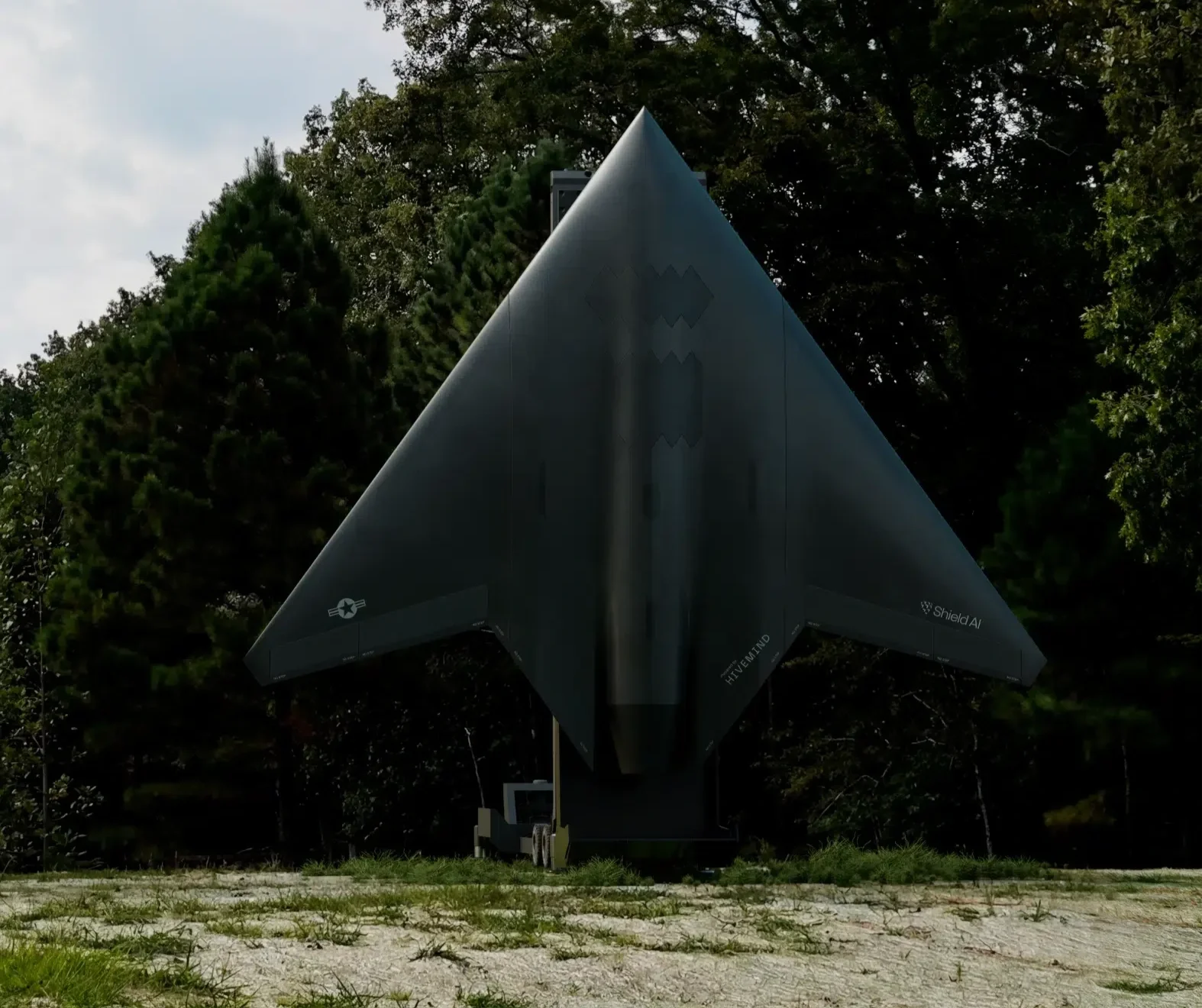
Shield AI’s design uses a tail-sitting layout. The aircraft points nose-up for launch and recovery, then flies horizontally on a broad, triangular wing. The company publishes a 39-foot wingspan. Shield AI introduced that wing in March, replacing the kinked leading edge of its original design. The company’s concept imagery shows the wings folded for transport, with the aircraft lying horizontally on a wheeled launch-and-recovery vehicle.
In the proposed sequence, the vehicle raises X-BAT upright. Its jet engine lifts it vertically before the aircraft pitches over into forward flight. Recovery reverses that change in attitude. X-BAT points its nose skyward and descends tail-first onto the vehicle. Shield AI intends Hivemind, its autonomy software, to fly the aircraft and coordinate combat missions under a commander’s tasking.
Published design figures and company targets. Performance awaits flight testing.
AN F110 MUST ALSO CONTROL THE HOVER
X-BAT pairs GE Aerospace’s F110-GE-129E with the Axisymmetric Vectoring Exhaust Nozzle, or AVEN. A single engine supplies lift during vertical flight and propulsion in forward flight. The nozzle redirects exhaust to control the aircraft’s attitude before the wing takes over the lift in cruise.
AVEN flew on an F-16 research aircraft in the 1990s to improve maneuverability. X-BAT assigns it a more demanding role during launch and recovery. Shield AI senior propulsion engineer Shiva Vallabhaneni explained the change in an August account published by GE. During vertical flight, he wrote, “the nozzle becomes the aircraft’s primary flight control system.” The engine’s thrust must closely match the aircraft’s weight during a controlled descent.
GE and Shield AI reported ground engine light-off with the integrated nozzle at Peebles, Ohio, on July 20. That test brought the engine and nozzle controls together in working hardware. Shield AI plans flight testing later in 2026. The next task is controlling the complete aircraft through vertical flight and the transition onto the wing.
Shield AI publishes more than 2,000 nautical miles of maximum range. GE’s July announcement gives a 1,000-nautical-mile combat radius. Range measures total flight distance. Combat radius describes outward reach with a return. Vallabhaneni’s account shows where the vertical mission spends extra fuel. The engine lights its afterburner for vertical launch, and landing requires thrust held close to the aircraft’s full weight. Both figures are design claims awaiting flight results, and the releases leave those launch and recovery reserves unstated.
The weapons configuration belongs in that comparison. Shield AI lists air-to-air and air-to-surface weapons in internal bays. It also lists large strike weapons on external hardpoints, bringing additional drag into that configuration. For naval planners, the meaningful result is reach with the assigned weapons and enough fuel to recover vertically.
V-BAT GIVES SHIELD AI A STARTING POINT
Shield AI already has a smaller VTOL aircraft in service. V-BAT is a ducted-fan surveillance aircraft advertised with 12-plus hours of endurance. Navy imagery records a V-BAT launch from USS Carter Hall in May 2023. The Coast Guard contracted for V-BAT services in 2024 and completed operational testing aboard cutters Midgett and Stone in July 2025. V-BAT’s home in Frisco also hosts X-BAT prototype work. That gives Shield AI experience with maritime aviation before the jet enters testing.
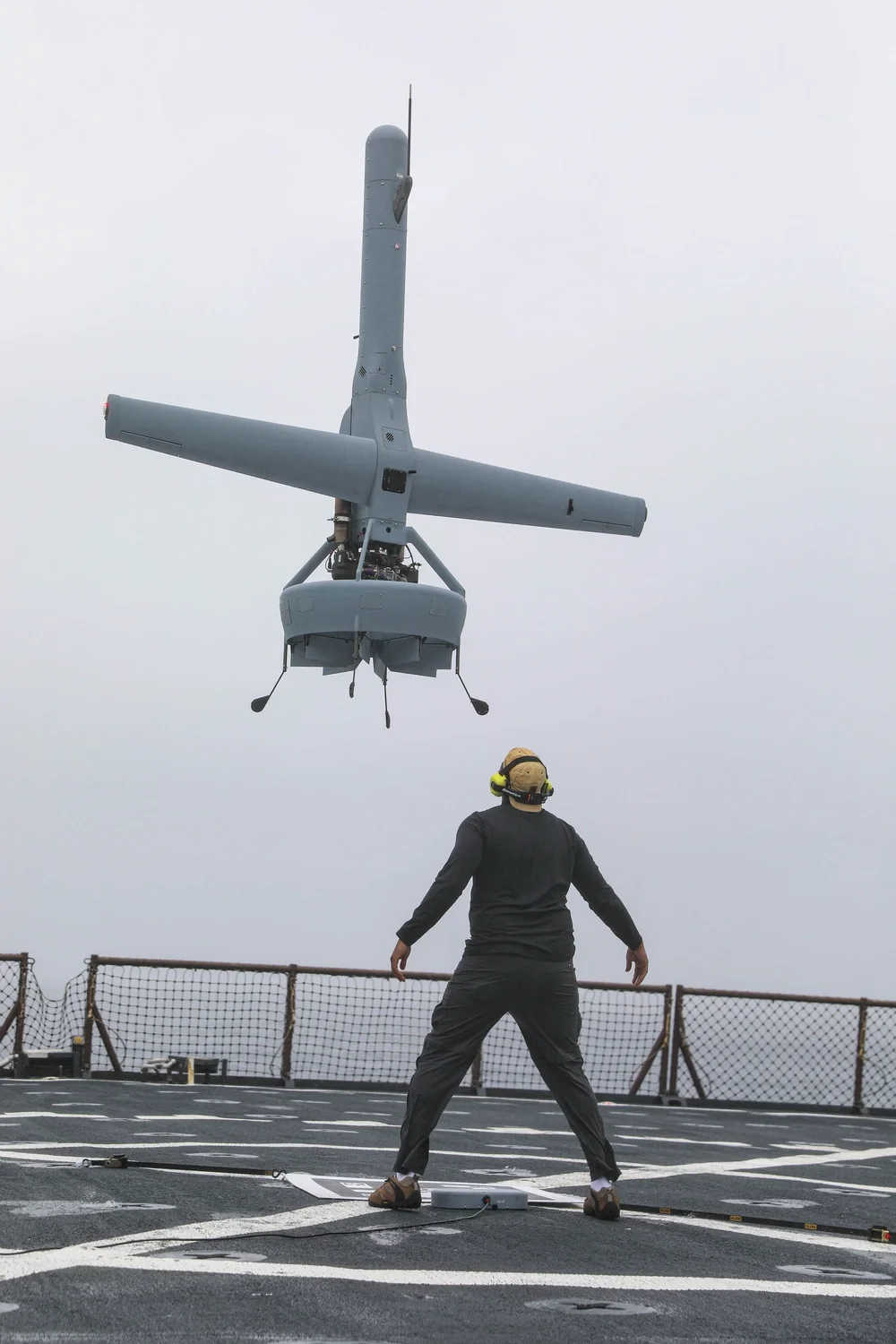
A civilian contractor prepares to recover a V-BAT after a test flight aboard USS Carter Hall on May 20, 2023.
U.S. Navy photo by Mass Communication Specialist 3rd Class Moises Sandoval.
Reuters’ June investigation reported more than 50 V-BATs destroyed in crashes within Shield AI’s internal fleet over 18 months of testing or training. Shield AI defended its safety record and reported 10 customer operational mishaps since early 2025.
The Navy has also flown Hivemind. On December 11, 2025, two BQM-177A surrogate jets flew with Hivemind at Point Mugu. A virtual F/A-18 mission lead tasked them to defend an area against simulated adversaries. The test put autonomous jets under a mission lead’s tasking, the relationship X-BAT is designed around. Neither V-BAT’s record nor the surrogate flights demonstrate X-BAT’s own vertical flight controls.
RIMES FUNDS MORE THAN ONE APPROACH
The Navy’s August 13 announcement put $50 million into expanded Shield AI risk reduction for Runway Independent Maritime Expeditionary Strike, or RIMES, with the Defense Innovation Unit. The government release names Shield AI and the mission area. Shield AI identifies X-BAT as its aircraft for that work. Its October 8 announcement adds a $150 million Pentagon-funded modification to the Navy agreement for exportability work and an equal company match. Shield AI puts announced commitments at $400 million, with $200 million from the government and $200 million in company capital.
Mach Industries announced its own DIU RIMES award on June 16. Mach is developing Atlas with Whisper Aero, using hybrid-electric propulsion and Whisper’s JetFoil powered-lift technology. The company advertises a 1,000-pound payload and 1,400 nautical miles of range. Those are development claims, but they give X-BAT a concrete competitor pursuing strike from ships without large flight decks.
RIMES is putting different propulsion architectures against the same basing problem. Atlas emphasizes hybrid-electric powered lift. X-BAT brings a fighter-class jet engine and a thrust-vectoring recovery system. Mach leaves open whether its 1,400 nautical miles is one-way or a round trip, so the figures cannot yet be ranked.
DECK SPACE IS ONLY THE FIRST NUMBER
Shield AI says three X-BATs fit in the deck space of one legacy fighter and links that footprint directly to higher sortie generation. That is a storage claim. Shield AI also publishes a storage envelope of 40 by 14 by 6 feet. More aircraft parked aboard a ship increase potential capacity. Crews still have to recover each aircraft and prepare it for the next flight. A deck drawing supplies no measured turnaround time.
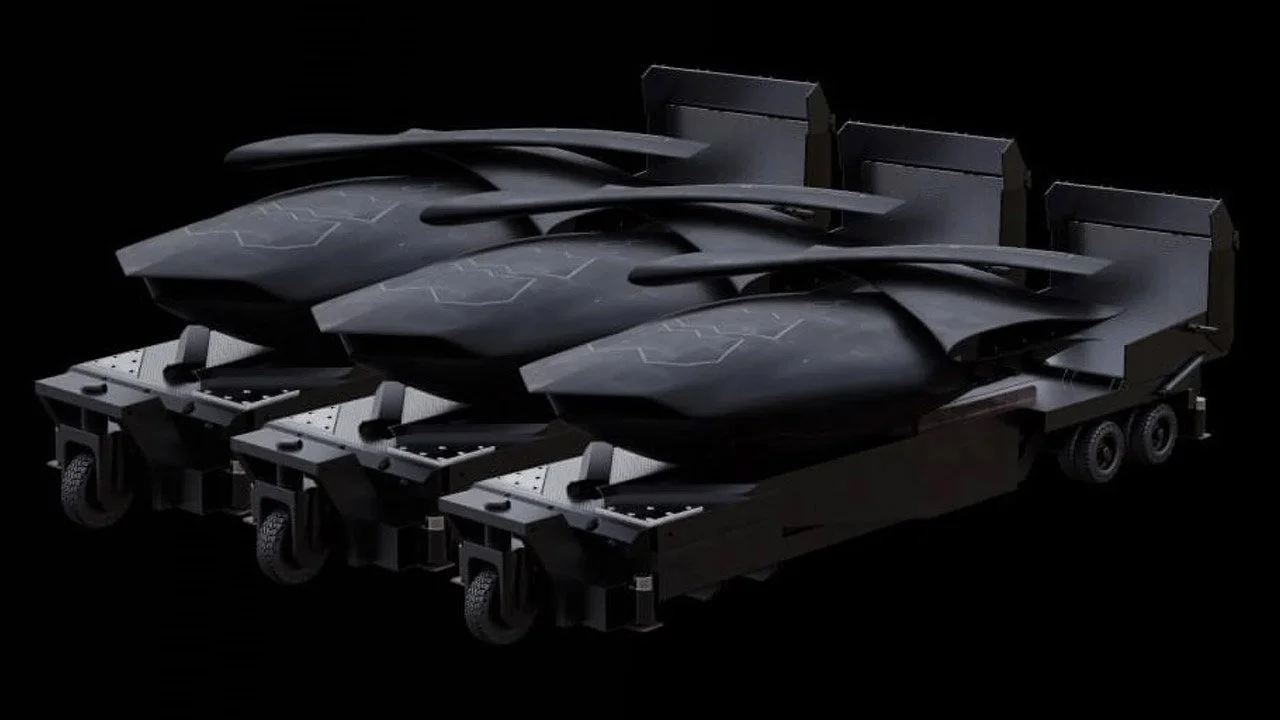
Shield AI concept rendering of three X-BAT aircraft on launch and recovery trailers.
Image: Shield AI.
Recovery itself carries a separate test burden. NAVAIR’s ship-airwake work documents how airflow around a ship complicates precise positioning near the deck. X-BAT’s proposed recovery puts its thrust-vectoring controls into that disturbed airflow above a moving landing surface. Launch adds exhaust heat to that list. An afterburning vertical launch sends the engine’s hottest exhaust down at the launcher and the deck beneath it. At-sea trials must define the conditions in which the aircraft can launch and return safely. Those conditions set the limits of the maritime basing claim.
Fuel and weapons still have to reach the aircraft. During NAWDC 25.3 in October 2025, Marines established and moved forward arming and refueling points for rotary-wing aircraft. Navy personnel trained alongside them in the ground-support work. The exercise put the dispersed aviation concept into practice by sending the people and supplies needed to keep aircraft flying. X-BAT’s austere-site pitch carries the same requirement.
VERIFICATION: The source record behind this analysis, including what could not be confirmed. VIEW VERIFICATION →
TAGGED: Army Aviation, Autonomous Systems, Military Aircraft, Force Modernization, Defense Industry
-

ANDRES CARDENAS | Lead Analyst
Modern Warfighter Defense Publication
/ STAY CONNECTED /