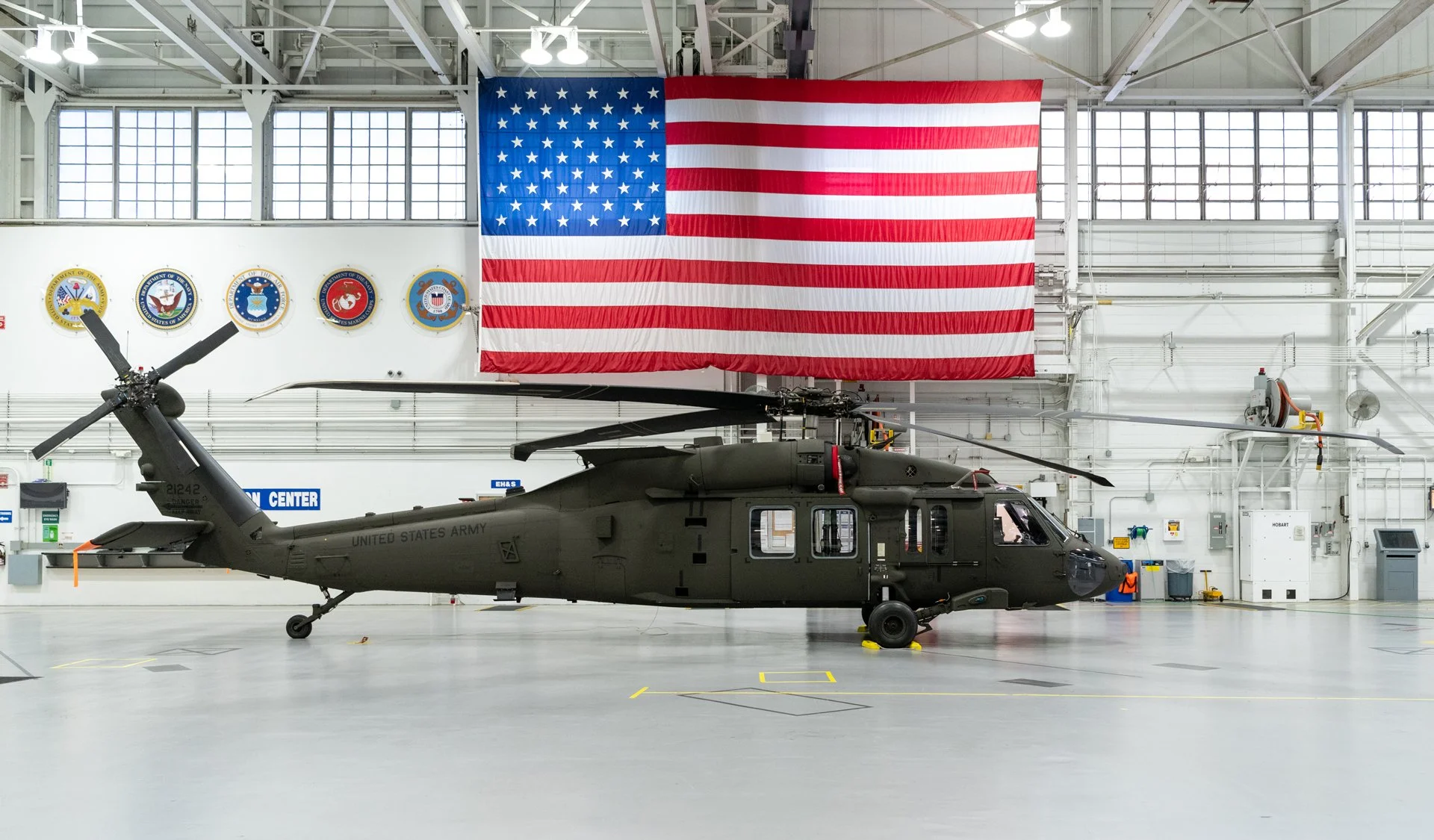

16 Black Hawks in FY2026, One Requested for FY2027
The Army put 16 UH-60Ms on contract in September and requested one for FY2027. The follow-on agreement will set how many it buys after that.
September 25, 2026 | 4 min brief
STRATFORD, Connecticut (September 25, 2026) — The Army’s September 18 award for 16 UH-60M Black Hawks puts $234.46 million toward aircraft Sikorsky schedules for delivery in FY2028. The lot carries work at Sikorsky’s Stratford plant into mid-2028, after the current multiyear’s deliveries end in 2027, buying continuity as the Army prepares to field MV-75.
The next budget presents a different scale. The Army’s FY2027 request is for one UH-60M. The House-passed authorization bill proposes six additional aircraft. Sikorsky projects potential demand for as many as 150 over three to four years across Army and foreign customers. Those figures cover different buying periods and customer groups. Together, they expose the gap between keeping the line working and settling how much of its future output the Army will buy.
That is Clock Two in Modern Warfighter’s earlier Black Hawk analysis, the timeline for new UH-60M production and the contract structure behind it. September puts an initial aircraft lot under the emerging follow-on agreement. The larger decision concerns the annual commitment that follows it.
CONTINUITY BEFORE FINAL PRICING
Army Contracting Command at Redstone Arsenal awarded modification P00004 to W58RGZ-26-C-0008, using $234,460,582 in FY2026 Aircraft Procurement, Army funds. The September 17 announcement, corrected September 22 to the actual award date, identifies a fixed-price-incentive, undefinitized action. Work is in Stratford, Connecticut, with estimated completion on June 30, 2028.
The contract began with April’s $65 million advance-procurement award, using FY2024 money for long-lead work supporting the first 10 aircraft. July added $56,789,419 from FY2025 funds. September’s 16-aircraft action uses that same contract and raises its cumulative face value to $356,250,001.
Rich Benton, vice president and general manager of Sikorsky, said the company has already ordered long-lead hardware and begun subassembly work to maintain production. The lot gives Stratford and its suppliers work to schedule beyond the current agreement’s deliveries. It also lets material purchases feed into aircraft assembly before the longer agreement is complete.
The tradeoff sits in the undefinitized status. The Army gets performance started before final pricing is settled, then negotiates with work already underway. DFARS requires negotiators to account for reduced contractor cost risk in setting profit when substantial performance precedes final pricing. The coming definitization will set the final price of work the Army has already authorized.
WHAT BUY 11 HAS TO SETTLE
Benton calls the next arrangement “Buy 11” and expects definitization in the first half of 2027. Army leaders declined to commit to another traditional multiyear in 2025. By April 2026, acquisition officials were discussing a flexible multiple-year approach that could accommodate changing annual quantities.
Congress has authorized statutory UH-60M multiyear procurement beginning with FY2027. That mechanism purchases multiple program years without annual option exercises. Greater annual flexibility could give up some of the efficiencies associated with stable multiyear quantities. Buy 11 remains Sikorsky’s label for the follow-on buy, with its binding quantities and final structure awaiting definitization.
Annual flexibility would let the Army adjust Black Hawk purchases as MV-75 matures. The industrial tradeoff is less certainty about future workload. Foreign demand could help sustain throughput if Army orders fall, but the domestic share of Sikorsky’s 150-aircraft projection remains unspecified. The final agreement’s minimum quantities and options will determine how much planning certainty accompanies that flexibility.
The numbers show why those terms matter. The FY2027 budget requests $39.257 million in new funding, after crediting $65 million in prior-year advance procurement against $104.257 million gross. The P-1’s $65 million credit is FY2026 advance-procurement funding. April’s $65 million contract action is a separate transaction that obligated FY2024 funds.
The House authorization proposal adds $250 million for six aircraft, for a $289.257 million total. The House appropriations report adds $493 million, for $532.257 million. Each figure is a separate House action built on the same $39.257 million request. Final appropriations and negotiated pricing will set the funded FY2027 quantity.
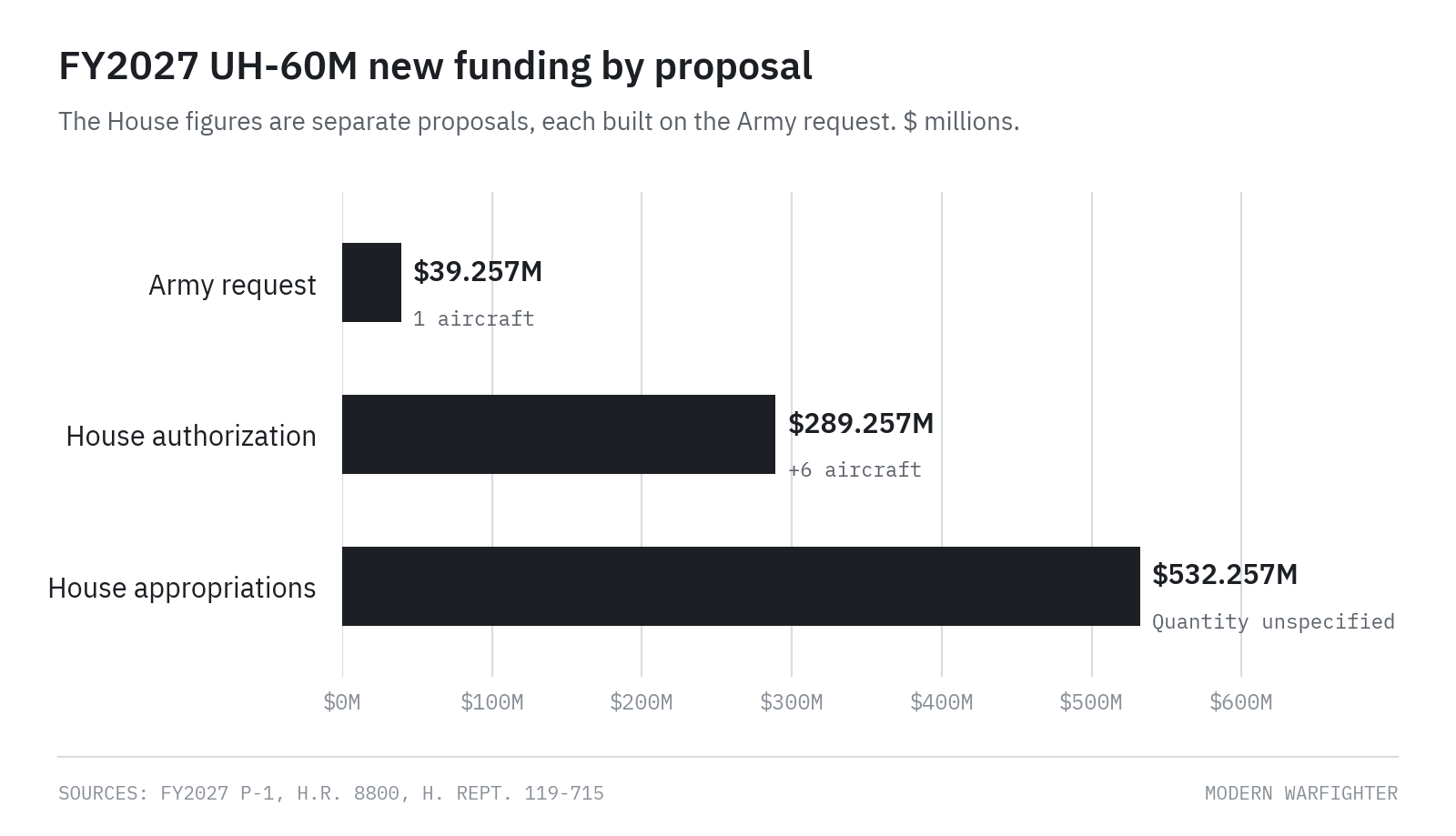
FY2027 UH-60M funding under the Army request and the two House proposals.
Source: Modern Warfighter analysis of the FY2027 P-1, H.R. 8800 and H. Rept. 119-715
A PRODUCTION BRIDGE INTO THE MV-75 FORCE
The 2028 Black Hawk lot arrives during MV-75’s transition from development toward production. The Army has described prototype delivery at end-2026 and testing in early 2027. Its early-production decision objective is FY2028, with a first 24-aircraft unit targeted for FY2030. Acquisition officials have kept first-flight timing conditional as they work to accelerate the supply chain. Textron expects long-lead low-rate production work in late 2026 or early 2027.
Army officials describe MV-75 as complementary or supplemental to Black Hawk. The service expects UH-60M operations well beyond 2050. New Black Hawks entering in 2028 will therefore join a force built around both aircraft. Their production rate will remain a separate acquisition decision as MV-75 fielding progresses.
The Army has committed funding to keep its production options open into 2028. The next agreement will show the price of that flexibility.
TAGGED: Black Hawk, UH-60M, Sikorsky, MV-75, Army Aviation, Acquisition, Multiyear Procurement
-

ANDRES CARDENAS | Lead Analyst
Modern Warfighter Defense Publication
/ STAY CONNECTED /