
Marines Fund the H-1’s Electrical Backbone. Its Weapons and Data Links Are Bought Separately
A $114.7 million Bell option funds electrical upgrades for the Viper and Venom and structural changes to the Venom. Link 16 kits and the PASM weapon are on separate contracts and schedules, and Bell’s package is capped at 49 aircraft.
November 4, 2026 | 5 min brief
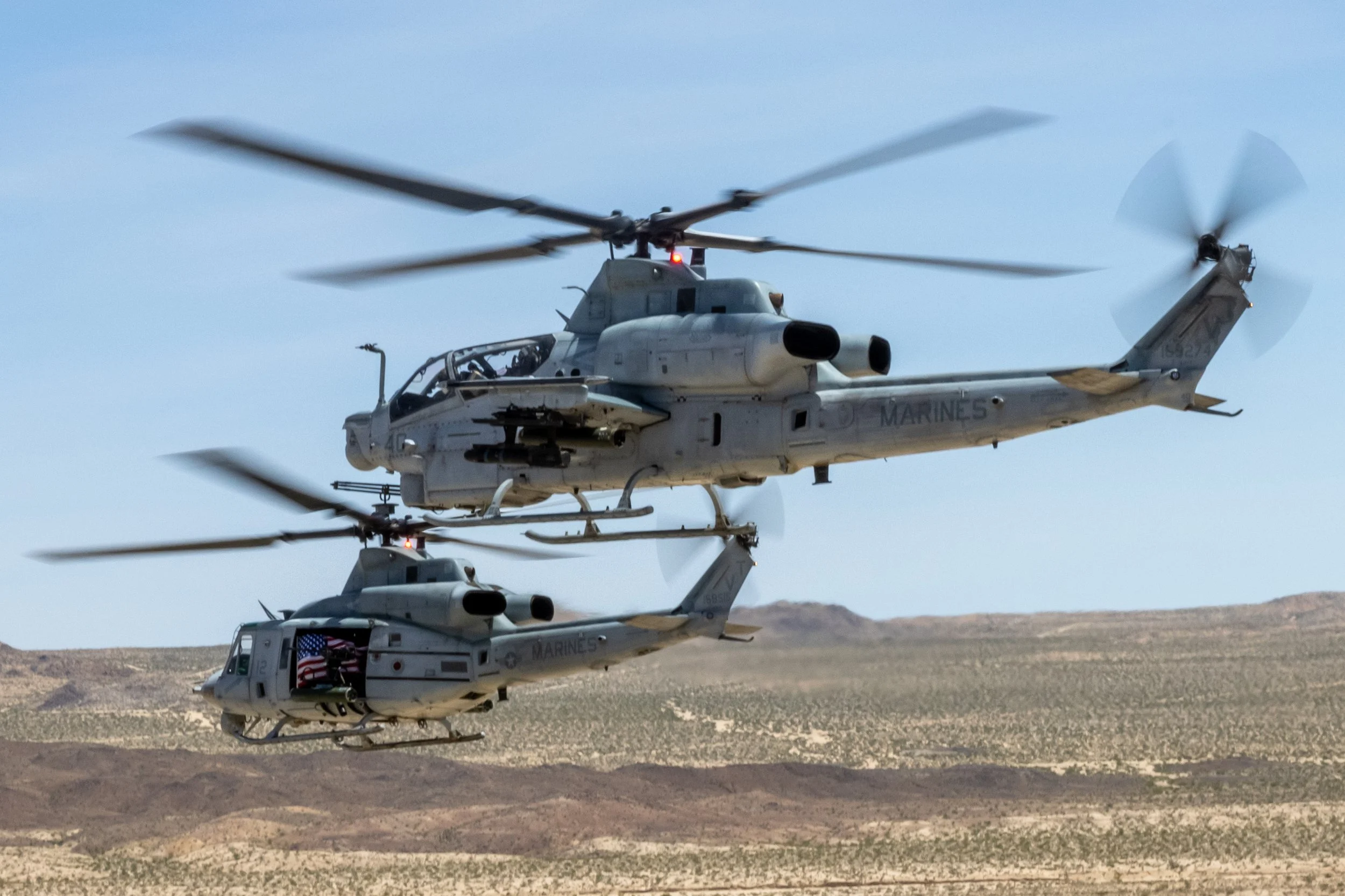
PATUXENT RIVER, Md. (November 4, 2026) — The Navy is committing $114.7 million to electrical upgrades for the Marine Corps’ AH-1Z Viper and UH-1Y Venom helicopters and structural changes to the Venom. The October 30 option buys 15 A-kits and four mission kits. It also funds nine aircraft installations, with long-lead components and spares.
Bell places the work within an estimated $300 million optioned package for up to 49 aircraft, with first SPINE deliveries expected in 2028. Northrop has held H-1 Link 16 production contracts since 2022 and received more kit capacity in September. A Precision Attack Strike Munition (PASM) award targets delivery of a longer-range weapon by the end of fiscal 2027, and L3Harris identifies that weapon as Red Wolf. The acquisition question is which aircraft return with the required equipment and how the Corps preserves availability during modification.
WHAT THE BELL OPTION FUNDS
The exact October option value is $114,692,840 under modification P00001 to contract N0001926C0140. The announcement assigns that amount to fiscal 2027 Aircraft Procurement, Navy funds for obligation at award and expects the work to finish in June 2028. The SPINE actions combine fixed-price arrangements with cost-plus-fixed-fee work. Naval Air Systems Command (NAVAIR) is the contracting activity.
The July 24 base award was $33,642,332 and covered kits and long-lead hardware. Together the two announced obligations total $148,335,172. October exercises an option within the package Bell announced in July, and the rest of Bell’s $300 million estimate depends on future option exercises and funding.
The public option summary leaves the nine installations unallocated between variants and its four mission kits undefined. Buying a kit is the first milestone. Installing it and accepting the modified aircraft come later.
The July and October actions were awarded without competition. An August NAVAIR presolicitation for proposed security and production-readiness work said the government held SIEPU technical-data-package rights but lacked licenses for Bell process specifications and standards. It estimated eight years to qualify another source for that requirement. The estimate is specific to the described work.
ELECTRICAL CAPACITY AND VENOM CABIN CHANGES
SPINE stands for Structural and Power Improvements for Next Generation Effects. It continues the effort previously called Structural Improvement and Electrical Power Upgrade, or SIEPU. The Navy’s fiscal 2026 budget justification assigns new AC generators and electrical distribution changes to both helicopter variants. It also lists new wiring and harnesses, along with a redesigned combining-gearbox accessory drive quill to support electrical growth.
The listed structural work applies to the UH-1Y. It redesigns the ammunition cans and makes the roof-mounted fast-rope and hoist system removable. The package also adds improved aircrew restraints and a crash-attenuating gunner seat. Litter-mount safety changes complete the list. Those changes are aimed at the people the Venom carries on utility and recovery missions.
Bell describes a 1760 data bus for network-enabled weapons. More electrical capacity and a standard weapons interface could let the aircraft carry additional mission equipment. What each helicopter can use will depend on its installed configuration and weapon-specific clearances.
ESTABLISHED DATA LINKS AND A NEW WEAPON
Link 16 work on the H-1 predates this SPINE package. In a November 2021 test, a mixed AH-1Z and UH-1Y section shared data with a ground station, according to a Marine Corps account. Northrop announced a $65 million full-rate-production contract for the H-1 fleet in March 2022, and the Navy announced the current kit contract, N0001924D0123, on August 29, 2024.
September’s $34,388,301 modification raises that contract’s ceiling for eight more UH-1Y A-kits and nine AH-1Z A-kits. It also covers 17 B-kits. An A-kit is the permanent wiring and mounting an aircraft needs, and a B-kit is the equipment that installs into it. Funding comes through individual orders, and the announced work-completion target is March 2027.
PASM is a separate L3Harris award that NAVAIR announced on January 30, 2026, at $86.2 million under an Other Transaction Agreement. NAVAIR’s release presents a longer-range weapon for land and sea-based AH-1Z missions, with units and associated training and support equipment due by the end of fiscal 2027. L3Harris identifies Red Wolf as the selected vehicle and claims “proven distances of 200 nautical miles,” a figure the Navy’s release leaves out.
The weapon brings aircraft work of its own. NAVAIR’s September account calls PASM the Marine Corps’ top-priority air-to-ground weapon system and lists seven simultaneous contracting efforts, including aircraft modifications and a new launch system, against a September 2027 critical need date. SPINE sits with the H-1 program office, PMA-276, and PASM with the weapons office, PMA-242. Fielding the Viper’s next weapon runs through both offices, on a delivery target that falls before the first SPINE aircraft return.
The Viper has taken on a new missile before. The Marine Corps declared initial operational capability for the Joint Air-to-Ground Missile (JAGM) on the AH-1Z on March 1, 2022, years before the first SPINE aircraft were modified.
USNI News reports that the PASM package also includes Green Wolf, which L3Harris lists as an electronic warfare vehicle. Navy releases have yet to give Green Wolf quantities or delivery dates.
THE OPERATING CONCEPT BEHIND THE WORK
The Marine Corps’ 2026 aviation plan places H-1 modernization within Distributed Aviation Operations, which disperses aircraft among expeditionary sites in contested maritime areas. Shared targeting data and a weapon with more reach would widen the Viper’s strike options there, provided the aircraft carries an approved configuration.
The Venom’s cabin changes serve the troop movement and casualty recovery those sites need. Sustaining either helicopter there also depends on getting fuel and ordnance to small sites. SPINE changes the aircraft, and the aviation plan treats that ground support as central to distributed operations.
AIRCRAFT AVAILABILITY AND FOLLOW-ON FUNDING
Bell says the first modified aircraft, one of each variant, were completed in fall 2025 after a 19-month modification effort. In March 2026 the company reported both at Patuxent River for continued testing to determine the final SPINE configuration. Bell forecasts fleet modification work at Amarillo beginning in mid-2027, with first upgraded deliveries in 2028.
That 19-month figure covers the first two aircraft. NAVAIR’s public summaries leave production turnaround and annual induction rates unspecified, and those two numbers will help determine how many Vipers and Venoms are out of service at once.
GAO’s March 2026 testimony shows each H-1 variant missed its annual mission-capable-rate goal in all eight years from fiscal 2015 through 2022. GAO says the Marine Corps then shifted to counting mission-capable aircraft, and the Corps’ 2026 aviation plan reports strong performance against its required-aircraft measures. The plan says the inventory leaves room for modernization. The induction schedule will test that claim.
Bell’s maximum package covers 28 Vipers and 21 Venoms, about 16 percent of the 301-aircraft inventory in the February aviation plan. The plan seeks essential modernization capabilities in every active and reserve H-1 squadron by 2035. Col. Jason Duke, the PMA-276 program manager, said in Bell’s July announcement that SPINE would “ensure the H-1 fleet will continue to be relevant into the 2040s.” No public contract announcement extends SPINE beyond Bell’s 49-aircraft package.
Bell’s contract builds the backbone. What plugs into it runs on other contracts and other schedules.
VERIFICATION: The source record behind this analysis, including what could not be confirmed. VIEW VERIFICATION →
TAGGED: Marine Corps Aviation, Rotorcraft Modernization, Acquisition, Bell, Weapons Integration
-

ANDRES CARDENAS | Lead Analyst
Modern Warfighter Defense Publication
/ STAY CONNECTED /