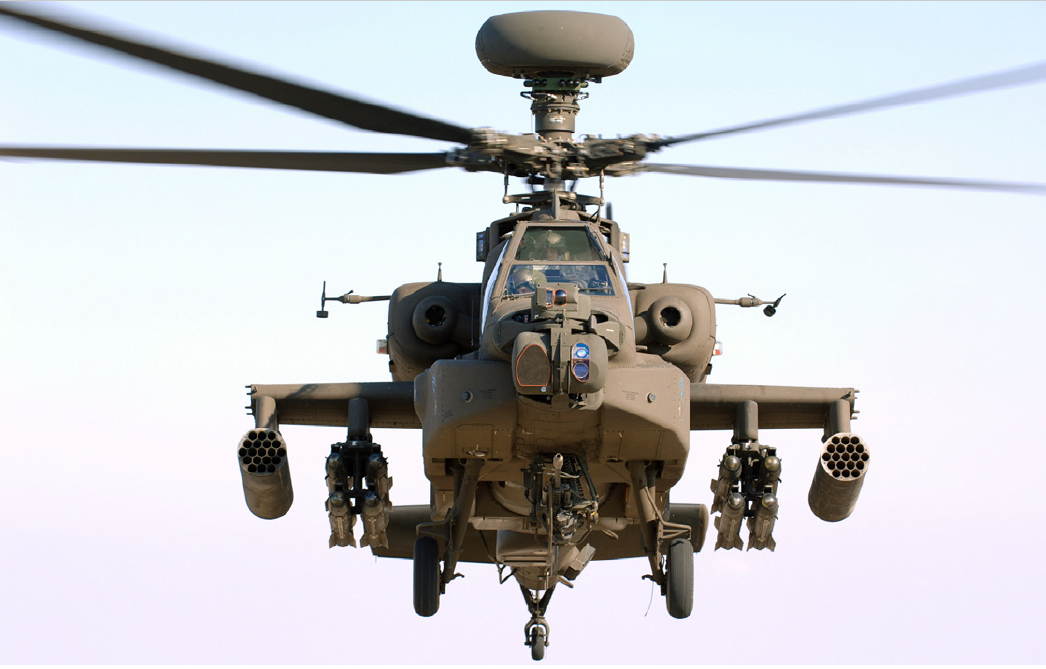

Apache Budgets Narrow the Factory Path for the Army’s Next Radar-Detection Sensor
The Army requested no remanufactured aircraft in FY2026 or FY2027. Congress added funding for a small buy as Lockheed develops Generation III.
October 17, 2026 | 6 min brief
REDSTONE ARSENAL, Ala. (October 16, 2026) — The Army’s last two budget requests asked for no remanufactured Apaches. Alongside those requests, a reported $117.1 million contract extends Generation II radar frequency interferometer support toward October 2031. Lockheed Martin is developing Generation III as the fielded system’s long-term replacement.
That budget pattern points toward retrofit as the larger U.S. transition task if the Army continues requesting few aircraft. Existing orders and congressional additions can still deliver helicopters. The equipment fitted to the remaining remanufactured aircraft would provide a concrete test of which RFI generation reaches U.S. Apaches through the factory.
CONGRESS KEPT A REMAN BUY ALIVE
The budget sequence shows how sharply the buying plan has narrowed. FY2025 carried government-furnished equipment for 31 aircraft, totaling $101.186 million. The June 2025 FY2026 request carried $1.669 million in other costs and a dash for aircraft quantity. The April 2026 FY2027 book retained the same pattern for its new request, with $1.552 million in other costs.
Congress intervened between those requests. The final FY2026 defense appropriations explanatory statement added $360 million for AH-64E reman aircraft. That increased the Reman line from $1.669 million to $361.669 million. The FY2027 book’s FY2026 column carries seven aircraft, with $360 million under contractor-furnished equipment. Congressional funding therefore explains the money added to that column.
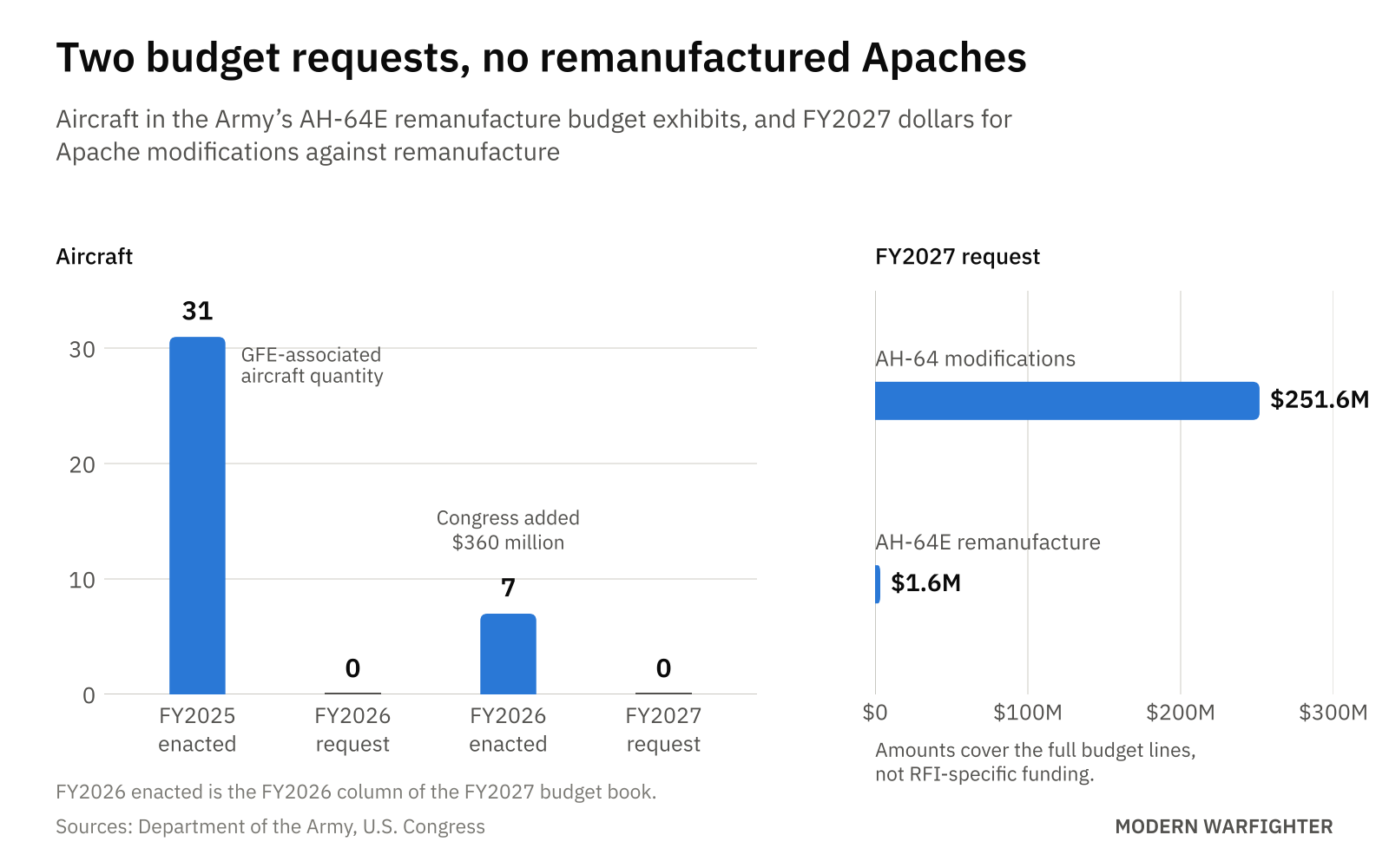
The Army requested no remanufactured AH-64Es for FY2026 or FY2027. Congress funded seven in FY2026, leaving few new airframes to carry Generation III into the fleet.
On August 4, 2026, the Army published a sources-sought notice outlining a 53-month effort to remanufacture up to twelve AH-64Es under Boeing contract W58RGZ-26-C-0002. The Army also signaled its intent to negotiate with Boeing alone. The requirement’s technical scope includes managing electronic-component obsolescence through redesign and qualification work. An approved equipment schedule would show whether that work changes the RFI.
The seven budgeted aircraft and the twelve-aircraft maximum could belong to the same procurement effort. Matching them requires the funded contract action. The August requirement provides a specific reman effort to follow but leaves its funding source and RFI configuration unstated. Together, these records support a narrowing procurement plan with a residual aircraft buy. A factory-closure date would require separate evidence.
ORDERS CARRY WORK BEYOND VEHICLE MILESTONES
Reproductions of the Pentagon’s October 13 announcement identify W58RGZ-27-D-A007 as an indefinite-delivery/indefinite-quantity contract for Generation II post-production support. The stated value is $117,118,040, using cost-no-fee, cost-plus-fixed-fee and firm-fixed-price arrangements. The estimated completion date is October 12, 2031. The reproduced paragraph says one bid was solicited with one received.
Work locations and funding will be determined with each order. That structure lets the Army place support work as requirements arise. The $117.1 million figure describes the support vehicle. The orders will show the funding assigned to particular work. The post-production label fits an acquisition picture increasingly weighted toward sustaining equipment already delivered.
The production chain began earlier. In December 2016, modification P00012 to W52P1J-16-C-0007 added 43 modernized radar frequency interferometer (MRFI) systems for $31,499,392, with completion estimated for March 31, 2020. Lockheed later dated its first MRFI production delivery to February 2018. In September 2018, the Army awarded a separate vehicle, W52P1J-18-D-0061, for $59,941,683, with work estimated to finish August 31, 2023.
The 2023 dates show how an order can carry production past an earlier vehicle milestone. On June 22, the Pentagon announced modification P00013 to the 2018 vehicle, worth $192,199,684 and again citing August 31 completion. On August 30, it awarded order W58RGZ-23-F-0435 for $60,539,401. Commercial federal-data records place that order under the same vehicle. Its completion estimate ran to October 31, 2026.
HigherGov reports that the vehicle’s ordering period was later extended to January 12, 2024. The DPA order’s completion estimate still ran years beyond those vehicle dates. It also provides a firm funding anchor. All $60,539,401 was obligated at award from FY2023 Defense Production Act Purchases funds. P00013’s vehicle-level value and the order belong to the same contracting chain.
The next vehicle is separate. Commercial records report W58RGZ-24-D-0078 with a $382,776,904 ceiling for Generation II/III RFI production and support, and identify W58RGZ-24-F-0451 as an order under it. The contracting history supports overlapping requirements across generations. The specific development work still needs to be matched to its funded order.
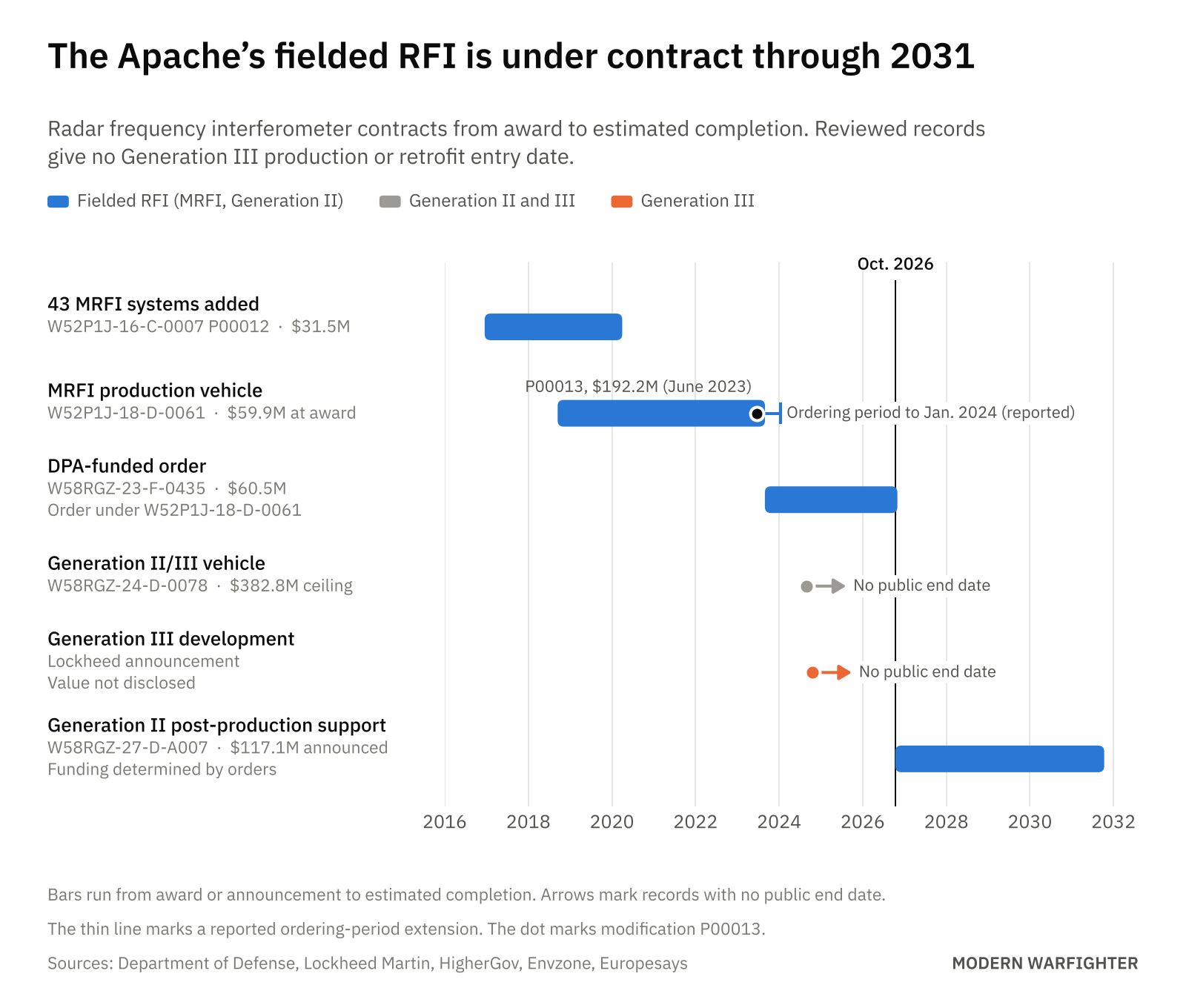
Fielded RFI work has moved through successive orders and contracts, now reaching 2031. The reviewed records place no date on Generation III's arrival.
THE UPGRADE HAS TO REACH AN AIRCRAFT
The RFI identifies radar threats and locates emitters for the crew. It cues the Apache’s fire-control radar and targeting sight. Its radar-warning function also helps crews react to radar-directed threats. The Army’s December 7, 2023 continued-production notice described Generation II as installed on domestic and international AH-64E configurations, with refresh work possible to address obsolescence.
Lockheed announced the Generation III development effort on October 15, 2024. Its plan covers building and qualifying an RFI/radar warning receiver, with eventual replacement of fielded Generation II systems across Apache aircraft. The announced design uses the MCP-2 multi-chip package and introduces radio-frequency system-on-chip technology into APR-48B. Lockheed traces the microelectronics work to the government’s SHIP and STAMP projects.
The Army’s FY2027 modification narrative continues to name Generation 2 RFI inside a broader Sensors category. The whole AH-64 Mods line requests $251.645 million, more than 160 times the $1.552 million Reman request. The Pentagon’s weapon-system summary likewise describes FY2027 Apache funding around ongoing modifications and service-life extensions.
The detailed Sensors schedules serve a broader modification effort. The FY2026 exhibit carries June 2024 contracting and August 2026 delivery dates. The FY2027 exhibit carries December 2026–2028 contract dates and December 2028–2030 deliveries, with implementation labeled Coyote Modem Modifications. Those dates describe the bundled modification effort. Generation III’s own installation window remains unresolved.
A Generation III configuration on one of the remaining reman lots would provide a production milestone. Its reach would still depend on a separate retrofit plan. That plan would identify which fielded aircraft are eligible and how installations are scheduled. It would also show whether the Army intends to introduce the sensor during existing maintenance visits or fund a distinct modification effort.
SUSTAINMENT REQUIREMENTS REACH SEVERAL BUYERS
DLA Aviation is pursuing a separate component procurement under SPRRA1-26-R-0036. Its role as buyer points toward spares replenishment. The part numbers match all six MRFI items listed in British contract records, and the June solicitation proposes to acquire 28 of each. That proposed purchase is separate from the Army’s requirement to overhaul existing units. The solicitation leaves the eventual installation purpose unstated.
The Army’s July 2026 overhaul notice covers three matching components and includes estimated FMS demand within its maximum quantities. A separate fire-control-radar requirement, W58RGZ-26-R-0004, includes stocking and issuing legacy and Generation 2 RFI components. It identifies Longbow LLC as the restricted source. These requirements show several sustainment routes being sought around the installed equipment, each with its own contracting scope.
Foreign fleets add another transition decision. Schedule A to UK contract 701760450 makes MRFI material supply FMS-only because of export-release constraints. Other support columns carry different scopes. Australia’s earlier Apache notification lists 29 AN/APR-48B MRFIs and records release authorization for its equipment. The designation APR-48B also appears in Lockheed’s Generation III announcement, so configuration matters when reading future sale records.
If Generation III requires additional release approval or an export configuration, partner fleets could retain Generation II after a U.S. transition begins. That remains a hypothesis. An export transition would involve a supply decision alongside aircraft integration.
The immediate production test sits with the reman aircraft still being pursued. Most of Generation III’s U.S. path runs through the fleet already built, and that path needs a funded retrofit. The FY2027 Apache modification budget still lists Generation II among its sensors. None of the procurement exhibits retrieved for this analysis identifies Generation III installations or the money to pay for them. Meanwhile, Generation II support is under contract through 2031.
Until Generation III installation money appears in the budget, Generation II is the sensor the Army is paying to keep.
VERIFICATION: The source record behind this analysis, including what could not be confirmed. VIEW VERIFICATION →
TAGGED: AH-64E Apache, Radar Frequency Interferometer, APR-48B, Lockheed Martin, Army Aviation, FY2027 Budget, Acquisition
-

ANDRES CARDENAS | Lead Analyst
Modern Warfighter Defense Publication
/ STAY CONNECTED /