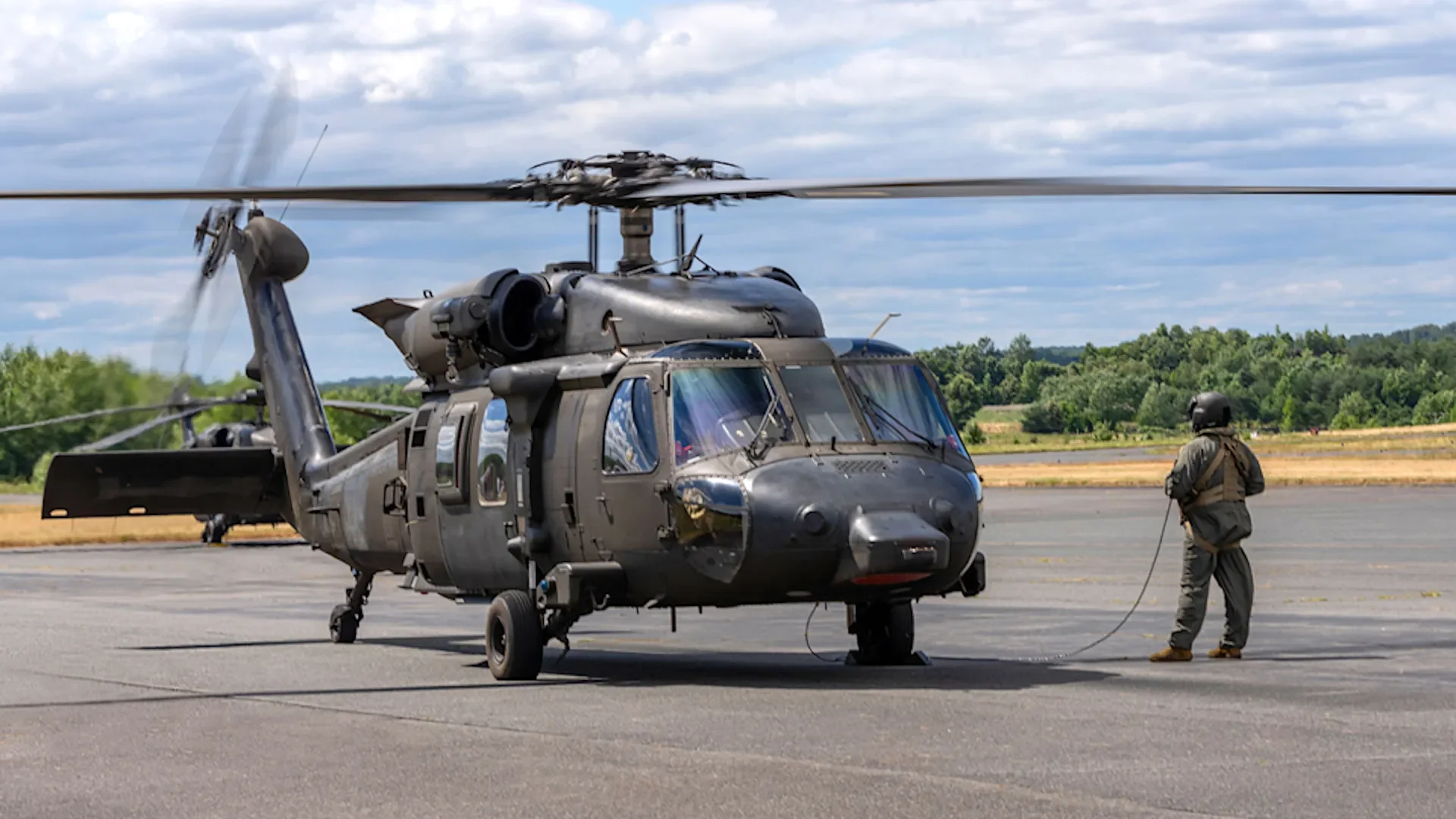

Inside the UH-60MX Autonomy Architecture
October 31, 2025 | 4 min brief
The UH-60MX is often framed as another autonomous aviation demonstration. That undersells what the aircraft actually represents. Control authority is beginning to move beyond the cockpit and into a wider operational architecture built around software, networks, and distributed control.
At Northern Strike 2025, the Army deployed the UH-60MX using Sikorsky’s MATRIX autonomy stack in an operational environment designed to stress distributed control, autonomy integration, and mission execution under pressure. The aircraft still looks like a Black Hawk, but operationally, it begins behaving like a different type of aviation system.
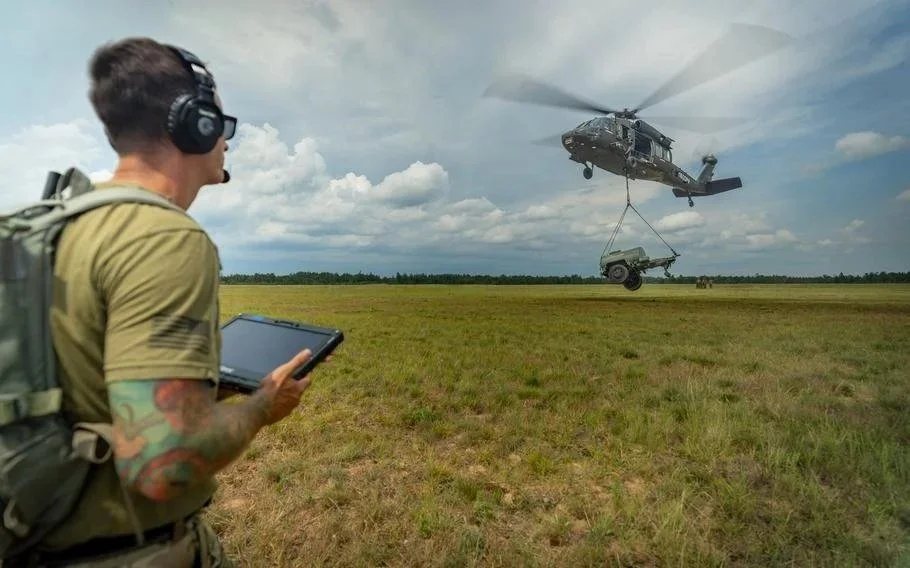
Sikorsky’s MATRIX-enabled UH-60MX executes a sling-load mission during Northern Strike.
Media: U.S. Army / Northern Strike Photo
Autonomy changes how the aircraft participates in the fight. Mission authority is distributed across operators, relay nodes, autonomy logic, onboard processing, and the network carrying the aircraft’s picture of the battlefield. The pilot remains part of the system, increasingly as one layer inside a wider operational structure.
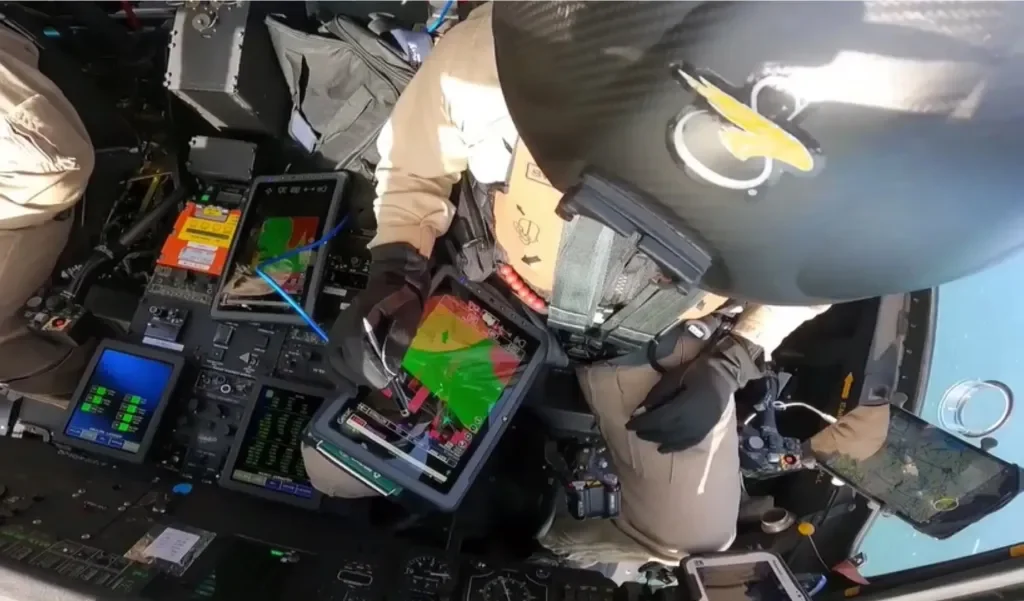
MATRIX turns cockpit input, tablet planning, and onboard systems into autonomous aircraft behavior.
Media: Sikorsky / Lockheed Martin
Expanded autonomy also expands dependence on the link between operator and aircraft. In controlled conditions, that relationship appears stable. In a contested electromagnetic environment, it becomes the center of the problem. Latency, degradation, and signal disruption shape whether autonomy remains an operational advantage or collapses into vulnerability. MATRIX is designed around that reality. When link integrity degrades, the system transitions into reversionary behavior where the aircraft maintains stability, executes preassigned actions, or holds position until connection returns.
The specific threshold that triggers those transitions remains outside publicly available documentation, but that figure will ultimately define how the aircraft performs under sustained electronic warfare pressure against a peer adversary. In large-scale combat operations, an aircraft holding position inside contested airspace becomes a target. Survivability shifts toward the resilience of the architecture surrounding the aircraft itself.
Apache-style survivability logic depended heavily on terrain masking, maneuver, and physical positioning. Autonomous aviation expands the equation. Signal integrity, relay continuity, onboard processing, and network persistence influence whether the aircraft remains operational inside the fight. Control depends on whether the network around the aircraft survives contact.
That pressure extends directly into the aircraft’s design tradeoffs. The Size, Weight, Power, and Cost burden introduced by autonomy systems remains largely outside publicly released program documentation, but autonomy always competes against payload, endurance, cooling, internal volume, and fuel. As autonomous capability expands, those tradeoffs move from engineering considerations into operational ones.
MATRIX approaches those constraints through software integration layered onto an existing airframe. Earlier Army autonomy efforts remained concentrated inside controlled demonstrations and contractor-led testing environments. Northern Strike pushed the capability into operational conditions where execution is shaped by mission tempo, environmental friction, timing constraints, and force-level integration.
That retrofit logic is what makes the UH-60MX more than a technology demo. DARPA’s $6 million award to Sikorsky did not fund a clean-sheet aircraft. It funded the installation of ALIAS/MATRIX autonomy onto the Army’s experimental fly-by-wire UH-60M, turning an existing Black Hawk lineage into the UH-60MX testbed.
The distinction becomes important because autonomy systems rarely fail cleanly under combat conditions. They degrade progressively through latency, partial signal loss, incomplete battlefield awareness, or degraded coordination between nodes. The operational challenge extends beyond whether the aircraft can fly autonomously. The challenge is whether the surrounding architecture preserves enough coherence to keep the mission viable under pressure.
That shift changes how aviation assets integrate into maneuver operations. Reducing pilot exposure during high-risk phases of flight changes how commanders assign aircraft inside contested environments. Mission authority increasingly extends outside the aircraft itself, allowing ground elements and distributed operators to interact directly with aviation assets inside a connected control structure. Aviation becomes a networked extension of maneuver operating across a broader battlespace architecture.
The UH-60MX represents a transition layer between legacy aviation and a distributed control model still taking shape across the force. Its value comes through demonstrating how existing platforms adapt through autonomy, software integration, and networked control. The progression from ALIAS to MATRIX reflects a steady expansion of that architecture from demonstration into operational employment.
Northern Strike marks the point where autonomous Army aviation moved beyond controlled testing and entered force-level execution. The question of whether the aircraft can perform the mission is becoming easier to answer. The larger question centers on how resilient that architecture remains once the network itself becomes contested.
Key Takeaways
• MATRIX moves control outside the cockpit, spreading mission authority across software, operators, relay nodes, onboard processing, and networked control
• The datalink is the pressure point, where latency, degradation, and electronic warfare can turn autonomy from advantage into liability
• UH-60MX is the bridge platform, proving how an existing Black Hawk can absorb autonomy, plug into maneuver networks, and stay relevant without waiting for a clean-sheet replacement
UH-60MX ARCHITECTURE ASSESSMENT
| Category | Analysis |
|---|---|
| Platform | UH-60MX Black Hawk |
| Core System | Sikorsky MATRIX autonomy suite derived from DARPA’s ALIAS program |
| Flight Architecture | Full-authority fly-by-wire and optionally piloted configuration |
| Operational Shift | Distributes mission authority across operators, autonomy logic, onboard systems, and networked control nodes |
| Control Interface | Tablet-directed and operator-assisted mission control with autonomous reversionary behavior |
| Datalink Dependency | Mission effectiveness depends on signal integrity under degraded and contested electromagnetic conditions |
| EW Survivability | Aircraft survivability increasingly depends on network resilience, relay continuity, and control persistence under pressure |
| ALE Integration | Positions the aircraft inside distributed sensing, launched-effect, and maneuver-network architectures |
| SWaP-C Pressure | Autonomy systems compete against payload, endurance, cooling, fuel, and internal volume constraints |
| MOSA Alignment | Supports modular integration and rapid capability insertion across evolving mission systems |
| Strategic Role | Serves as a transition platform between legacy Army aviation and distributed autonomous operations |
| Key Takeaway | MATRIX turns the UH-60MX into a control-architecture testbed where survivability depends as much on the network as the aircraft itself |
TAGGED: Autonomous Aviation, UH-60MX Black Hawk, Sikorsky MATRIX, Future Vertical Lift
-

ANDRES CARDENAS | Lead Analyst
Modern Warfighter Defense Publication
/ STAY CONNECTED /