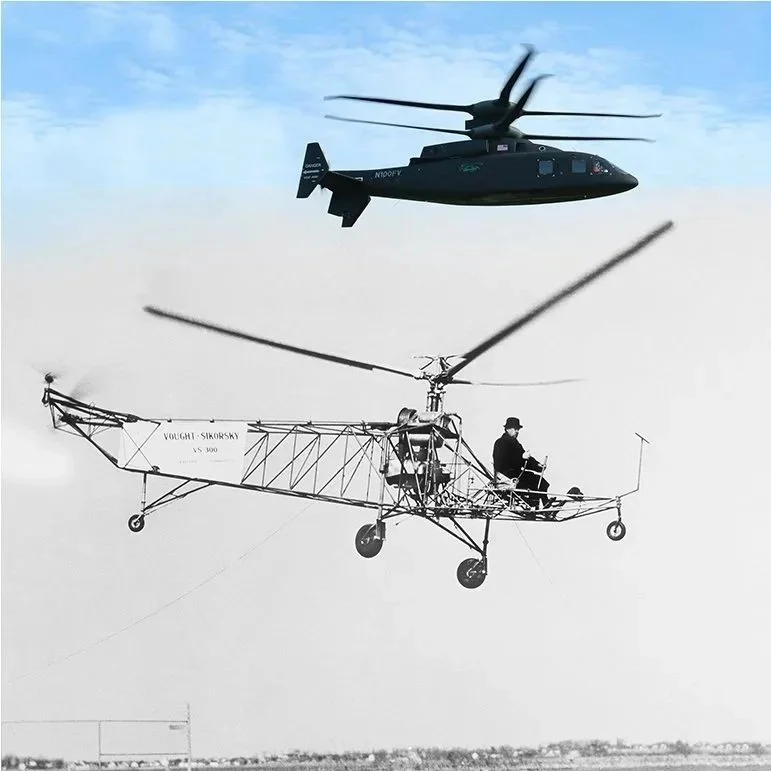
DEFIANT X // ASSAULT REDEFINED
From Sikorsky’s first lift to SB>1 Defiant, the pursuit remains: expand what vertical lift can become.
WHEN DEFIANT FIRST BROKE COVER
West Palm Beach, Florida (March 21, 2019.) —The SB>1 Defiant completed its first flight carrying a configuration the legacy fleet had never fielded. Stacked coaxial rotors overhead, a rear pusher propulsor at the tail. Both were the product of a decade-long push to move military rotary-wing performance past what conventional design could deliver.
It was such a beautiful sunny day in Florida, the SB>1 Defiant felt like stretching her legs. 😎 #FVL #FLRAA pic.twitter.com/d033oLw6sS
— Sikorsky (@Sikorsky) November 13, 2019
For decades, the military helicopter followed a familiar formula: one main rotor, one tail rotor, and a mission profile shaped by the limits of that architecture. Defiant broke that formula immediately. Its counter-rotating coaxial rotors eliminated torque without a conventional tail rotor, while the aft pusher propulsor shifted the aircraft's purpose toward forward speed. It did not just look different. It made the argument, in mechanical form, that the next generation of vertical lift had no choice but to be different.
That difference ran deeper than cosmetics. Sikorsky and Boeing built Defiant around two coaxial main rotors and a rear-mounted pusher propulsor — a configuration unlike anything in production rotorcraft. The Army's Future Vertical Lift roadmap was pointing in the same direction: aircraft that could fly farther and faster, carry heavier payloads, team with unmanned systems, and operate across Multi-Domain Operations. Defiant was testing more than a new shape. It was testing whether Army aviation could move beyond the speed, range, and survivability assumptions the legacy fleet had been built around.
Defiant was not designed to be incremental. Its coaxial rotor system and rear pusher propulsor promised a 60 percent combat-radius extension over conventional helicopters, with high-hot hover performance the legacy fleet could not match. The Defiant X variant, the weaponized form built for FLRAA, was sized to carry twelve troops or 3,680 pounds of cargo while fitting inside the same footprint as the Black Hawk it was meant to replace. Same ramp. Different aircraft entirely.
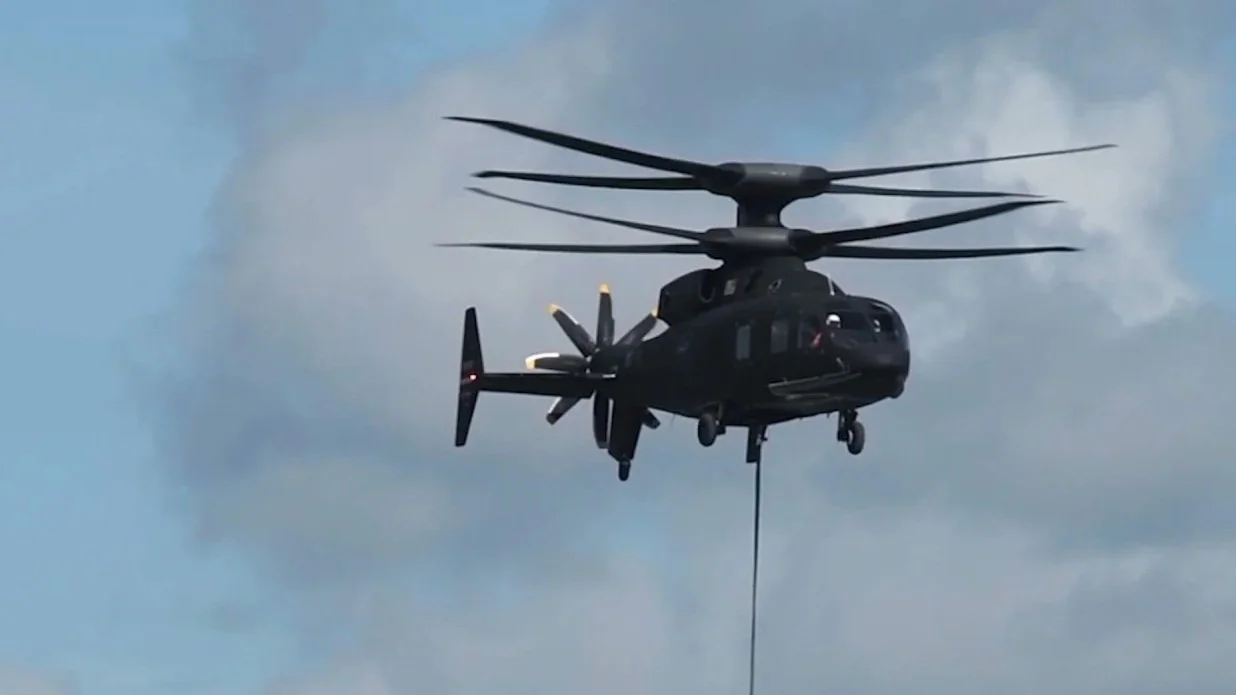
The flight-test program gave the concept substance. By January 2022, chief test pilot Bill Fell had flown 236 knots in level flight, reduced thrust through the pusher propulsor, and decelerated without pitching the nose up, approaching a confined landing zone with full forward visibility before dropping nearly vertically into a tight clearing. The program also demonstrated bank angles beyond 60 degrees and lifted a 5,300-pound external load. The envelope kept expanding.
But Bell’s Bell V-280 Valor had been expanding its own envelope longer. The tiltrotor had already reached 300 knots in level flight and logged 190 flight hours across 150 flights while Defiant was still closing on those numbers. The Army’s FLRAA requirement set 250 knots as the cruise-speed threshold, with 280 knots desired. Defiant was approaching the floor. Valor had already cleared the ceiling.
In December 2022, the Army awarded the FLRAA contract to Bell Textron, a program valued at approximately $7.1 billion. Sikorsky protested. The GAO denied it in April 2023. Defiant’s flight program was over. The airframe now sits at the Army Aviation Museum at Fort Novosel, Alabama.
Key Takeaways
• Armed Black Hawk compresses lift, escort, and fires into a single aviation problem set
• The six-station weapons suite expands the aircraft’s presence, allowing it to support the formation beyond insertion
• Transformation in Contact is pushing near-term lethality, using available platforms while future aviation systems continue development
• Black Hawk modernization is moving on two tracks with armament and autonomy shaping the platform’s next phase
• Fleet commonality matters, reducing sustainment strain while expanding mission options across Combat Aviation Brigades
• Survivability depends on integration, not the aircraft operating alone inside defended airspace
ARMED BLACK HAWK ROLE COMPRESSION
| Baseline Role | Armed Configuration |
|---|---|
| Tactical lift platform | Lift with organic fires |
| Insertion and extraction | Presence beyond the LZ |
| External escort dependency | Self-supporting formation support |
| Single-mission tasking | Role compression across CAB operations |
| Sustainment through common fleet | Expanded lethality through shared logistics |
| Survivability through movement | Survivability through integration |
TAGGED: Armed Black Hawk, Force Modernization, Combat Aviation, Systems Integration
-

ANDRES CARDENAS | Lead Analyst
Modern Warfighter Defense Publication
/ STAY CONNECTED /
DISCUSSION
Add a response to this brief.