
Scaling the Airframe or Scaling the Software: Sikorsky's Real Gambit Behind Nomad
July 23, 2026 | 8 min brief
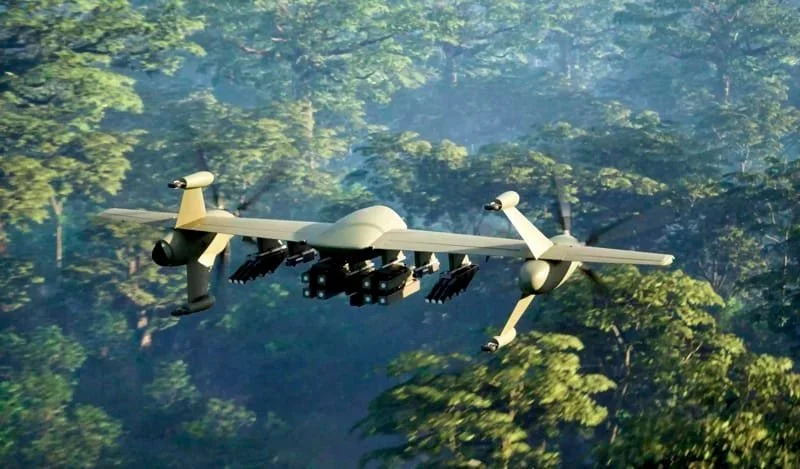
Sikorsky presents Nomad as a scalable family of rotor-blown-wing aircraft extending from Group 3 drones to Group 5 platforms approaching the footprint of a Black Hawk. The company's debut material showed a common vertical-lift concept expanding across several weight classes, from tactical reconnaissance to strike and crewed-uncrewed teaming. Sikorsky formally introduced the family on October 6, 2025, after completing an earlier flight campaign with the smaller aircraft that became Nomad 50.
The aircraft disclosed so far support a more limited claim. Nomad 50 established that Sikorsky's tail-sitting configuration can transition from vertical lift to wing-borne flight at small scale, while Nomad 100 moves the design into a militarily relevant weight class under DARPA's Early VTOL Aircraft Demonstration program. Past Group 3, the Nomad family stops looking like one aircraft scaled upward. Larger variants require different propulsion systems, structures, and landing geometry, pushing the design toward distinct airframes built around the same autonomy architecture. MATRIX, Sikorsky's autonomy system, may ultimately provide the strongest continuity across the family, even as the airframes move farther apart.
WHAT HAS FLOWN
The test campaign established the basic aerodynamic proposition. Sikorsky demonstrated that a 115-pound battery-powered tail-sitter could rise vertically, control itself through transition, and cruise on the wing. Operational payload, endurance, field support, weapons integration, and survivability remain unresolved. Nomad 50 solved the flight-control problem. The military case begins with Nomad 100.
Sikorsky moved into that next phase with Nomad 100, an 18-foot-span Group 3 aircraft built for DARPA's EVADE effort. On July 22, 2026, the company announced at the Farnborough International Airshow in the United Kingdom that Nomad 100 had completed its initial ground and flight-testing phase. The aircraft will now enter a government-led campaign intended to evaluate military payloads and mission applications. Sikorsky released few performance details from the initial flights, while the official imagery deliberately obscured proprietary features of the aircraft.
The footage confirms that Nomad 100 has entered flight testing but it does not reveal the aircraft’s propulsion configuration. Sikorsky has withheld the Nomad 100’s engine type, generator output, battery capacity, fuel load, propeller diameter, and propulsion redundancy. Without those specifications, it is impossible to independently estimate the Nomad 100’s range, acoustic and thermal signatures, or ability to remain airborne after an engine, generator, battery, or propeller failure. The July announcement therefore marks the completion of an initial test phase while leaving the aircraft’s operational performance undisclosed.
The milestone also arrived well after DARPA’s public schedule. In June 2025, the agency said EVADE flight testing would begin that month and that successful systems could transition to military users by the end of the year. Nomad 100 completed only its initial test phase in July 2026. Neither DARPA nor Sikorsky has explained the delay, but the aircraft remains in risk-reduction testing more than a year after flight testing was expected to begin.
WHAT EVADE WILL TEST
EVADE accelerated flight demonstrations planned under DARPA’s AdvaNced airCraft Infrastructure-Less Launch And RecoverY program, known as ANCILLARY. DARPA selected aircraft from AeroVironment, Griffon Aerospace, Karem Aircraft, Method Aeronautics, and Sikorsky. Each design must remain below 330 pounds maximum gross takeoff weight while providing at least 12 hours of endurance at 100 nautical miles with a 60-pound payload. Planned demonstrations include intelligence collection, communications relay, logistics, weapons delivery, and synthetic-aperture radar missions.
Those requirements move Nomad beyond a question of whether the aircraft can transition. A militarily useful Group 3 system must lift its mission equipment, remain on station, provide power and cooling to its payloads, communicate at operational distances, and recover without adding a runway or a large ground crew to the formation. The aircraft must achieve those results without allowing vertical-lift power demands to erase the endurance benefit of cruising on a wing.
The government campaign will expose how each aircraft reaches the published threshold. The 60-pound allowance must cover the complete mission installation, including the sensor or weapon, mounting structure, wiring, processors, datalinks, and any targeting equipment. A nominal 60-pound payload therefore does not translate directly into 60 pounds of cargo, sensor, or ordnance. Gross weight, fuel fraction, reserve assumptions, weather, flight profile, and time spent hovering will determine whether Nomad offers practical utility or reaches the threshold only under a narrow test configuration.
DARPA's program structure also places a limit around Sikorsky's maritime claims. To accelerate first flight, EVADE deferred requirements involving maximum aircraft dimensions and autonomous takeoff and landing in high sea states. DARPA identifies sensors and algorithms for recovery aboard ships during storms as possible later development work. Current EVADE participation therefore does not show that Nomad has solved autonomous recovery on a pitching deck in high winds and rough seas.
That gap carries particular weight for a tail-sitter. The aircraft must descend vertically while managing crosswinds, deck motion, disturbed airflow around the ship, and limited landing space. It then occupies the deck in a vertical orientation unless crews lower or reposition it. Safe recovery is only one part of the shipboard problem. Handling, securing, refueling, payload access, maintenance, and movement through a hangar must also fit naval operating procedures. Sikorsky has identified ship decks as part of the Nomad mission set, but the hardest portion of that claim remains outside the present demonstration baseline.
Light attack carries its own unresolved integration burden. Sikorsky has identified weapons delivery as a Nomad mission, but no public evidence shows a captive-carry trial, safe-separation test, or live firing from Nomad 100. A weaponized configuration would also require launch hardware, electrical interfaces, targeting support, firing-authority software, and structural work while consuming payload and endurance.
WHERE THE FAMILY BEGINS TO SEPARATE
Nomad 50 is a 115-pound battery-powered demonstrator. Nomad 100 enters the Group 3 class with a larger structure and a military payload requirement. Sikorsky says most proposed Nomad variants will use hybrid-electric propulsion, while the largest versions would likely move to conventional drivetrains.
Propulsion changes affect far more than the engine compartment. A hybrid-electric aircraft may carry fuel, a generator, power electronics, electric motors, cooling equipment, and a battery or other storage system sized for peak vertical-lift demand. A turbine-driven version introduces a different transmission path, fuel system, thermal signature, maintenance structure, and weight distribution. Each change affects the center of gravity, rotor sizing, wing loading, control laws, and landing arrangement.
The tail-sitter configuration also becomes harder to preserve as payloads grow. Sensors, communications equipment, weapons, and cargo must tolerate the aircraft rotating through 90 degrees between ground position and cruise. Payload bays must remain accessible while the aircraft rests vertically. Fluids and cooling systems must work through both orientations. Larger rotors and higher installed power increase the danger zone around personnel during launch and recovery.
Sikorsky has disclosed too little about the proposed Group 4 and Group 5 aircraft to show how those problems will be solved. Igor Cherepinsky, director of Sikorsky Innovations, said in October 2025 that the Group 4 design had reached preliminary design review and that the company intended to move ahead without a development contract. “We’re going to go build one and demonstrate it anyway,” Cherepinsky told reporters. The statement confirms Sikorsky’s intent to advance beyond Group 3 while leaving the larger aircraft’s mechanical arrangement and degree of physical commonality unresolved. Each scale-up decision disclosed so far trades physical commonality for a new engineering solution, which means the family label will ultimately rest on what Sikorsky keeps constant across those trades.
The family may ultimately share aerodynamic knowledge, flight-control methods, autonomy software, mission interfaces, and portions of its digital engineering environment while using different physical solutions at each scale. That would still carry value, but it would be a different proposition from one airframe architecture enlarged across the full range. The larger Nomad becomes, the more the family claim depends on what Sikorsky counts as common.
ENTERING AN ESTABLISHED MARKET
Nomad is also arriving in a field where tactical runway-independent aircraft already have years of operational exposure. Sikorsky brings deep experience in rotorcraft engineering and military integration, but it is entering this segment behind companies that have already placed Group 3 VTOL systems with military users.
Shield AI's V-BAT uses a ducted-fan tail-sitter configuration and is advertised with more than 12 hours of endurance. The company says V-BAT has operated in Ukraine under GPS and communications jamming and has deployed aboard multiple classes of U.S. Navy vessels and with Marine Expeditionary Units. Shield AI also lists autonomous recovery in winds up to 25 knots and from moving ships traveling at up to 10 knots. These are company claims, but they reflect a level of operational exposure Nomad has yet to reach.
V-BAT's record has also drawn scrutiny. Reuters reported in June 2026 that more than 50 aircraft from Shield AI's internal fleet had crashed during testing or training over an 18-month period, alongside allegations involving safety practices and the representation of some demonstrations. Shield AI disputed the broader characterization and said V-BAT had accumulated 18,000 flight hours since 2019, with ten customer operational mishaps since the upgraded version entered service. The contrast is useful. V-BAT carries far more operational evidence than Nomad, but operational maturity has also exposed failure modes, handling risks, and institutional problems that a prototype program has yet to encounter.
AeroVironment's JUMP 20 represents a different approach. The aircraft uses a fixed wing for cruise and separate lift rotors for vertical takeoff and landing. AeroVironment publishes endurance above 13 hours, an operating range of 185 kilometers, and deployment in less than 30 minutes. The Army awarded the company an $8 million agreement in 2022 to deliver one FTUAS Increment 1 system to a brigade combat team after a competitive evaluation, and JUMP 20 later participated in the Army's Increment 2 rapid-prototyping effort.
JUMP 20 carries the drag and weight of separate vertical-lift hardware, but its fuselage remains horizontal on the ground and in flight. That simplifies payload access, deck handling, and the carriage of sensors or cargo that cannot rotate with the aircraft. Nomad's rotor-blown-wing architecture seeks a cleaner propulsion arrangement in cruise. The government campaign will reveal whether the aerodynamic advantage compensates for the operational complications of the tail-sitter layout.
MATRIX CHANGES THE COMPETITIVE POSITION
DARPA has installed Sikorsky's MATRIX autonomy architecture across all five EVADE aircraft, placing the same flight-control and navigation foundation inside every competing platform in the demonstration. The arrangement allows DARPA to compare aircraft without introducing a separate autonomy stack for each entry. It also gives Sikorsky two distinct positions inside the program. Nomad competes for recognition as the aircraft. MATRIX remains part of the demonstration regardless of which airframe performs best during the campaign.
That fallback carries real value. Autonomy software creates integration, upgrade, and sustainment work when it moves from a demonstration into an operational system. Revenue can continue through new payloads, mission software, safety releases, interface changes, and aircraft modifications. FACE and SOSA were developed in part to improve portability, replacement, reuse, and competition across military systems, but open interfaces still leave substantial value in the software operating through them.
The distinction between influence and ownership remains important. MATRIX is standardized across the EVADE campaign, while its place in any future service acquisition, production aircraft, or program of record remains unsettled. A military customer could demand government-owned interfaces, recompete the autonomy layer, or integrate another system after the demonstration. Sikorsky's current advantage is access across the evaluation, common experience with all five aircraft, and direct insight into how each configuration interacts with the same autonomy framework.
The arrangement still creates a stronger industrial position than Nomad alone could provide. If Nomad performs well, Sikorsky can compete as the airframe prime while supplying the autonomy architecture. If another aircraft offers better endurance, payload, handling, or cost, Sikorsky may remain involved through MATRIX. The software position limits the risk of entering a hardware market where several competitors hold greater operational maturity.
Nomad 50 established the aerodynamic foundation. Nomad 100 must now show that the configuration can carry useful payloads, meet the EVADE endurance requirement, and recover under the operating conditions attached to Sikorsky’s maritime claims. Group 4 and Group 5 will determine whether Nomad remains a coherent aircraft family or becomes a collection of distinct airframes joined by common software. Sikorsky has already secured a role through MATRIX. Nomad must earn the larger claim.
SOURCES: DARPA, Sikorsky/Lockheed Martin, Army Recognition
TAGGED: Sikorsky, Nomad, DARPA EVADE, Autonomous VTOL, Uncrewed Aircraft Systems
-

ANDRES CARDENAS | Lead Analyst
Modern Warfighter Defense Publication
/ STAY CONNECTED /