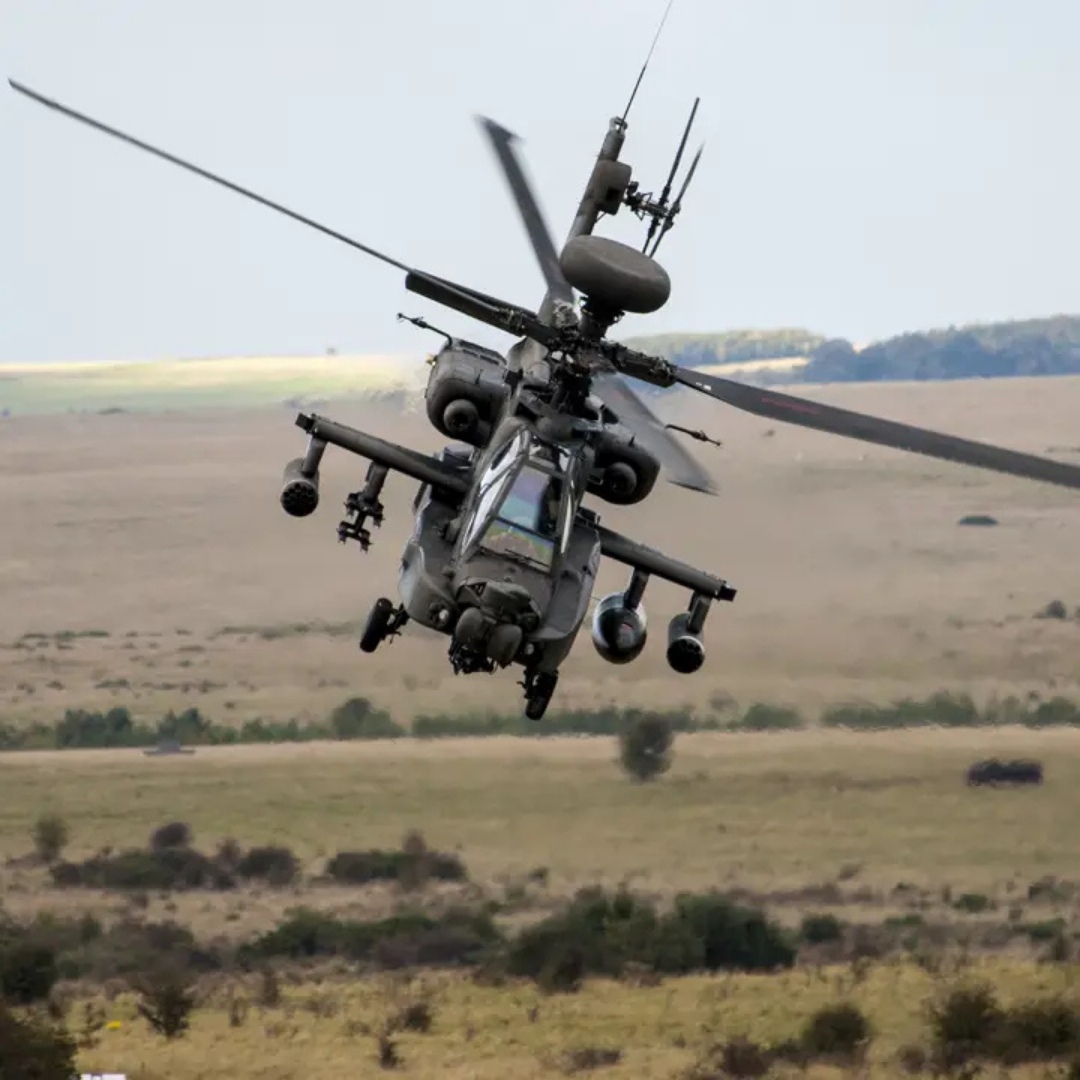

Project NYX: Testing the Future of Apache Formation
July 21, 2026 | 7 min brief
MAY 2026 — The British Army launched Project NYX to answer a question years of attack aviation development have been building toward: How much of the mission can an autonomous aircraft perform before it becomes another crew member instead of another sensor?
In July, Anduril unveiled Thunder as one response to that requirement. The aircraft is new. The operational problem it is intended to address is not.
Apache crews have spent years expanding what they can see and influence through manned-unmanned teaming. Existing systems allow crews to receive uncrewed-aircraft video, control sensors and laser designators, and, at higher levels of integration, direct an uncrewed aircraft's flight path. The arrangement extended the Apache's reach beyond its own onboard sensors, but it also required crews to monitor, direct, and manage another aircraft while flying and fighting their own.
Project NYX will determine whether a more autonomous aircraft can absorb tactical responsibilities within the formation without requiring Apache crews to continuously direct its actions. The Ministry of Defence describes the program as a concept-demonstrator effort delivered with UK Defence Innovation to develop uncrewed systems capable of operating as loyal wingmen while retaining human authority over weapons employment. Thunder represents one approach to that requirement. The competition will determine whether attack aviation is ready to trust an autonomous aircraft with a larger share of the fight without giving up command.
FROM REMOTE ACCESS TO AUTONOMOUS SUPPORT
Manned-unmanned teaming expanded what Apache crews could see and influence across the battlespace. The AH-64E can receive full-motion video from systems such as the RQ-7 Shadow and MQ-1C Gray Eagle, control their sensor payloads, and use remotely acquired target information to support engagements. Army testing has demonstrated cooperative attacks involving Apaches, Shadows, and Gray Eagles.
Those capabilities increased the Apache's reach. They did not remove the work required to manage the unmanned system.
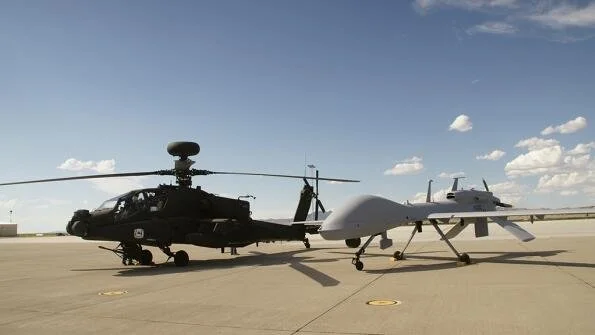
An AH-64 Apache and a Gray Eagle during a manned-unmanned teaming trial
Media: General Atomics Aeronautical Systems Inc.
Army assessments of MUM-T operations found that crews still had to balance flying the Apache with managing the unmanned platform. Even with those capabilities, pilots and gunners remained responsible for flying, navigating, communicating, maintaining situational awareness, employing weapons, and coordinating with the unmanned aircraft through the data link.
The problem is larger than linking two platforms. A useful teammate reduces the need for low-level supervision. Apache crews assign tasks, monitor execution, and act on the information they receive. The value of autonomy depends on reducing the crew's workload rather than adding to it.
Project NYX makes that command relationship explicit. The Ministry of Defence describes the aircraft as operating under human supervision during precision engagement. The question is no longer whether an uncrewed aircraft can carry a sensor or a missile. Existing systems already do both. The question is how much of the mission it can perform before it becomes another crew member instead of another sensor.
THE MULTI-MISSION REQUIREMENT
The missions assigned to Project NYX show that the British Army is seeking more than an airborne reconnaissance asset. The program covers reconnaissance, precision strike, target acquisition, and electronic warfare in contested environments. The Ministry of Defence's June 2026 Defence Investment Plan sets the target: up to 24 armed autonomous drones fielded by 2030, flying alongside the Army's upgraded AH-64E Apache fleet. That fleet reached 50 aircraft when the UK accepted its final AH-64E at Boeing's Mesa facility in March 2025.
The program is funded in stages. The MoD awarded roughly £10 million across four industry teams in May 2026 to develop concept demonstrators, against a disclosed Project NYX line of £220 million in the Defence Investment Plan. That initial award is less than 5 percent of the disclosed program line. Up to two of those teams will be selected in autumn 2026 to build prototypes. Fielding is targeted for 2030 if the prototypes succeed.
These mission areas place different demands on the aircraft. Reconnaissance is a sensor and endurance problem: watch long enough, and move what you see into the formation fast enough to matter. Target acquisition adds a harder requirement on top: the identification and location data must be accurate enough to support action, not merely improve awareness. Electronic warfare changes the power and positioning math again, since jamming or deception effects need specialized payloads and enough power to produce them, whether from standoff range or, in some concepts, from closer in. Precision strike creates the hardest command-and-control problem, because it joins weapons integration with human engagement authority and puts the aircraft nearer to whatever it is trying to kill.
No single airframe carries every one of those payloads at once. A common aircraft and mission system, configurable by mission, could answer those different requirements without creating a separate airframe program for each one. That is the argument for modularity. It also helps explain why Project NYX evaluates the aircraft as one part of a broader system.
The range of missions also changes how the aircraft fits into the formation. A reconnaissance-configured aircraft might move ahead of the Apaches and report what it detects. An electronic-warfare aircraft could disrupt an enemy system during a specific phase of the mission. An armed aircraft could carry weapons forward without requiring another crewed attack helicopter to carry them. In each case, the aircraft contributes something different while remaining connected to the same operational plan.
THUNDER AS AN INDUSTRY RESPONSE
Anduril and Archer Aviation unveiled Thunder at the Farnborough International Airshow on July 20, 2026, as the defense variant of a jointly developed autonomous VTOL platform. Anduril President Chris Brose told Breaking Defense the aircraft has been in development for roughly three years, built from lessons drawn from the company's YFQ-44A Fury fixed-wing aircraft, which is in production for the Air Force's Collaborative Combat Aircraft program.
The aircraft is a clean-sheet design built around a series hybrid-electric powertrain and dual tiltrotors that vary rotor RPM to maintain efficiency across different phases of flight. Archer says the arrangement reduces fuel burn in cruise and lowers the acoustic signature during low-altitude approach. The tiltrotor concept builds on engineering work pioneered by Karem Aircraft and later advanced by Overair, whose patent portfolio Archer acquired in 2025, according to The Air Current. While that work gives Thunder an established engineering foundation, the concept has yet to produce an operational aircraft.
The payload bay gives the modularity claim a physical basis. Anduril has described a main bay that can carry up to 10 air-to-ground missiles, including Hellfire and JAGM, or 16 air-launched effects, or up to 76 70mm rockets, as alternative loadouts.
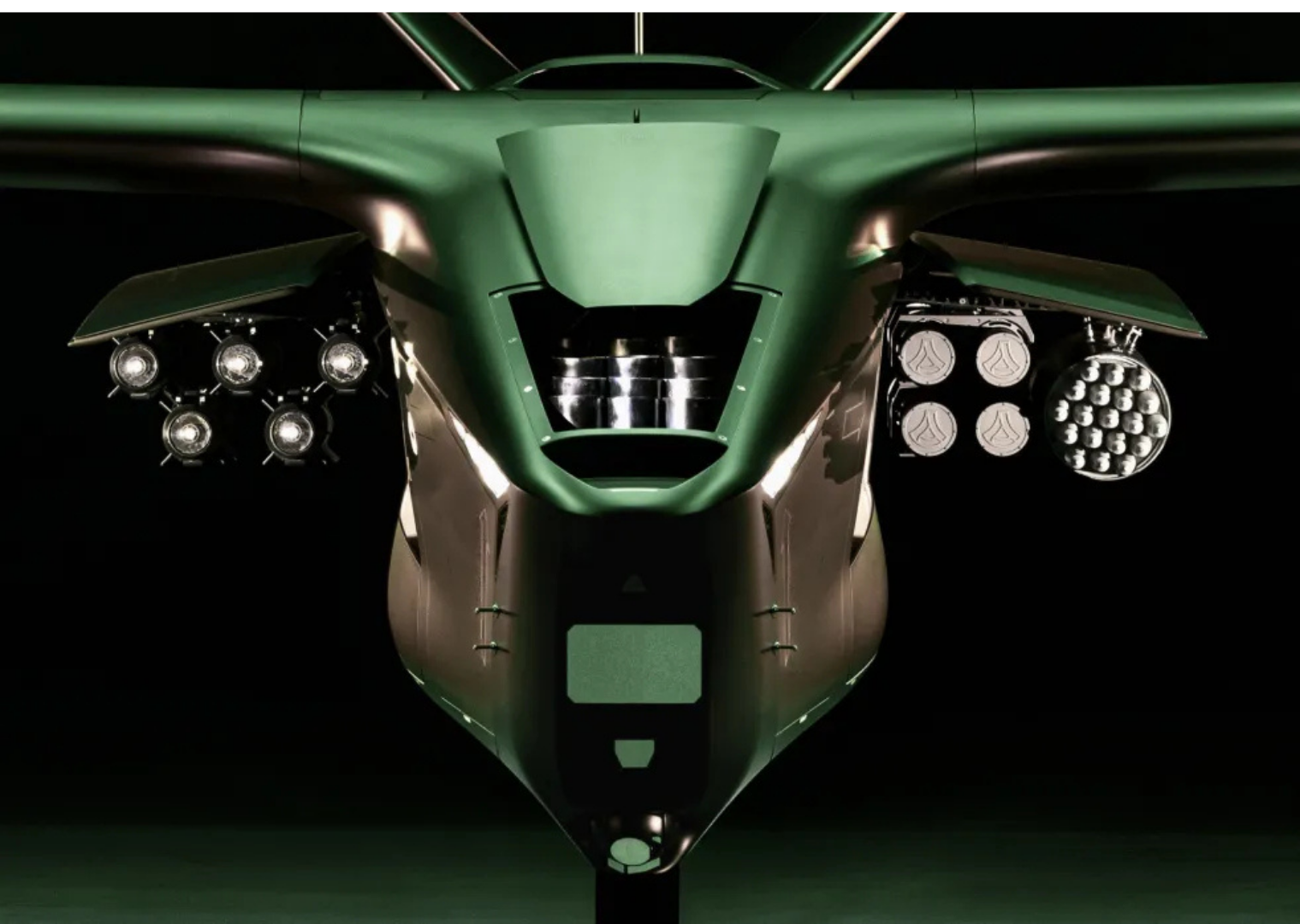
Thunder displayed with a representative precision-strike payload
Media: Anduril Industries
Autonomy runs on Anduril's Lattice for Mission Autonomy software, which the company says handles formation behavior, separation, routing, timing, tasking, and deconfliction. According to Anduril, a single Apache teamed with three Thunder aircraft could carry three times the munitions load into a fight. The claim has yet to be independently verified.
Each of those design choices answers something specific in the customer's requirement. VTOL means the aircraft can work away from established runways. Wing-borne cruise provides speed and range a conventional helicopter would struggle to match. The payload bay's size gives it room for a range of sensor, weapon, or EW packages, within the limits any given loadout imposes on weight and range. Autonomy is the piece that lets it do all of that without an Apache crew flying it by proxy.
The tiltrotor layout carries a cost the public design case has yet to resolve. Thunder's tiltrotor configuration introduces mechanical systems absent from a conventional fixed-wing design, including rotating nacelles and the associated drivetrain and control architecture. The V-22, the most widely operated tiltrotor in service, requires roughly 22 maintenance man-hours for every flight hour, compared with a fleet-wide Navy average of about 12, according to NAVAIR's December 2025 comprehensive review of the platform. Separate industry reporting estimates the UH-60 Black Hawk at roughly 10 to 15 maintenance man-hours per flight hour. The figures come from different sources and should be compared cautiously. They still point in the same direction. Tiltrotor performance can carry a substantial maintenance burden. Thunder is a smaller, unmanned aircraft with a different propulsion system and mission profile, so its maintenance demands may differ significantly. Anduril has yet to publish enough detail to show where Thunder will fall on that spectrum, making maintenance one of the program's key questions as it moves toward prototype testing.
The payload figures raise another question. What does each loadout cost in range and endurance? The missile, launched-effects, and rocket figures represent alternative configurations rather than a combined load. A heavier configuration flies a shorter mission than a lighter one, and Anduril has yet to publish the range or endurance associated with each.
Autonomy depends on more than the aircraft itself. Thunder runs on Anduril's Lattice software, but public information has yet to establish how Lattice would interface with the British Army's tactical networks, including Bowman and the Morpheus program intended to replace it. That connection will determine how missions, sensor data, and engagement decisions move between Thunder, Apache crews, and ground commanders. Neither Anduril nor the Ministry of Defence has addressed it publicly.
Thunder remains in development. Archer and Anduril have flown full-scale surrogate aircraft under their previous partnership, but Thunder itself is expected to fly in 2027. Its published range, payload, acoustic performance, autonomy, and operating-cost figures remain design objectives until prototype testing demonstrates them under operational conditions.
Thunder is one of four competing approaches to the same operational requirement. Each makes different tradeoffs between performance, technical risk, and industrial strategy.
The four proposals reflect different ideas about where risk should be accepted. Thales adapts Schiebel's Camcopter, an established rotary-wing UAS, into an autonomous collaborative platform, favoring a proven aircraft over a clean-sheet design. BAE Systems is pitching sovereignty as much as engineering, describing its offer as a "100% sovereign UK solution." Tekever is attempting its first rotary-wing aircraft after building its reputation on fixed-wing ISR and the RAF's Storm Shroud electronic-warfare drone, relying on its autonomy and sensing experience to carry a hardware program it has yet to demonstrate, according to Aviation Week.
Anduril's Thunder sits at the opposite end of that spectrum. It is the only proposal built around a new tiltrotor aircraft, making it the most performance-ambitious and least flight-proven response to the requirement. The Ministry of Defence will narrow the field to as many as two contenders in autumn 2026. More than selecting a platform, the competition will reveal which balance of performance, autonomy, industrial strategy, and technical risk the British Army believes best fits the future of attack aviation.
THE FORMATION IS A TEST
Aircraft performance gets an aircraft into the competition. Formation performance determines whether it belongs there. That demands more than exchanging data. The autonomous system must understand assigned tasks, operate within airspace and weapons-control measures, respond to changes in the mission, and present information in a form the crew can use. It must also behave predictably enough that Apache crews and ground commanders can build their plans around it.
Cockpit attention is the hardest thing to fake. Earlier MUM-T systems gave Apache crews access to valuable sensors but also required attention that competed with flying the aircraft. An aircraft that demands frequent correction, confirmation, or manual intervention may still carry useful payloads. It would fail the actual test Project NYX is running.
Communications may become the harder test. Autonomous aircraft may require less continuous control, but they still need to receive missions, report status, pass sensor data, and coordinate with other elements. Contested environments may interrupt those links. The system must continue safely and usefully when communications are degraded, delayed, or lost.
The command arrangement must preserve human authority over weapons without requiring continuous supervision of every other action. That boundary sounds clear in a policy statement. It becomes more complicated when an autonomous aircraft detects a possible target, changes its route, shares targeting data, or positions itself for an engagement. Project NYX will have to demonstrate how authority, recommendation, approval, and execution flow through the formation without slowing the fight.
None of these questions will be answered in a press release. They will be answered in flight, under operational testing, alongside the crews and systems expected to fight with the aircraft.
WHAT COMES NEXT
Project NYX is often described through the language of loyal wingmen, but the program's underlying test is more specific. The British Army is evaluating whether autonomous aircraft can assume meaningful responsibilities inside an Apache formation without transferring an unmanageable amount of work back to the crew.
Thunder addresses that test with a tiltrotor built for austere basing and a payload bay sized for a range of configurable loadouts. Its autonomy stack is drawn from Anduril's Fury program. Its design connects directly to the missions named by the customer. Its actual value depends on whether those elements function together under operational conditions the company has not yet flown.
The timing creates an unavoidable sequence. The Ministry of Defence expects to narrow the field to as many as two contenders in autumn 2026, while Thunder's first flight is not planned until 2027. The initial downselect will therefore rely on design evidence, surrogate flight data, subsystem maturity, and each team's ability to demonstrate a credible prototype. It will not be based on Thunder, or any competing design, flying the configuration it ultimately intends to field.
Project NYX is ultimately less a competition between four aircraft than a test of whether attack aviation is prepared to delegate meaningful work to autonomous systems without delegating command. Whether the concept proves more convincing than the aircraft is what the British Army's evaluation, and eventually its crews, will decide.
Key Takeaways
Project NYX asks whether autonomy can shoulder more of the mission while the crew retains authority over every weapon released
Thunder answers that requirement with a clean-sheet tiltrotor built around modular payloads instead of a fixed mission.
One configurable aircraft supports multiple mission sets without requiring a separate airframe for each
The Ministry of Defence's first downselect will reward engineering credibility long before any contender proves itself in flight
The future Apache formation will delegate execution while keeping command with the crew.
TAGGED: AH-64E Apache, Project NYX, Anduril, Army Aviation, Autonomous Systems
-

ANDRES CARDENAS | Lead Analyst
Modern Warfighter Defense Publication
/ STAY CONNECTED /