
Grey Wolf Reaches Full-Rate Production With Its Support System Still Unfinished
Boeing’s first full-rate order arrives with the helicopter already guarding the missile fields. The next budget request puts most of its money into keeping the fleet supported.
October 1, 2026 | 5 min brief
RIDLEY PARK, Pennsylvania (October 1, 2026) — Boeing announced its first full-rate production order for the MH-139A Grey Wolf on Thursday, the helicopter replacing the UH-1N Huey at the Air Force’s intercontinental ballistic missile fields. The four-aircraft order brings the total under contract to 42, with 27 delivered, according to the company. In early 2024, 42 was the size of the entire planned fleet. The Air Force now plans for 56.
The company’s release gave no award date or value. Defense News reported, citing a Boeing spokesperson, that the contract was awarded September 25 and is worth roughly $85 million including sustainment. The spokesperson expected deliveries in 2028 or 2029.
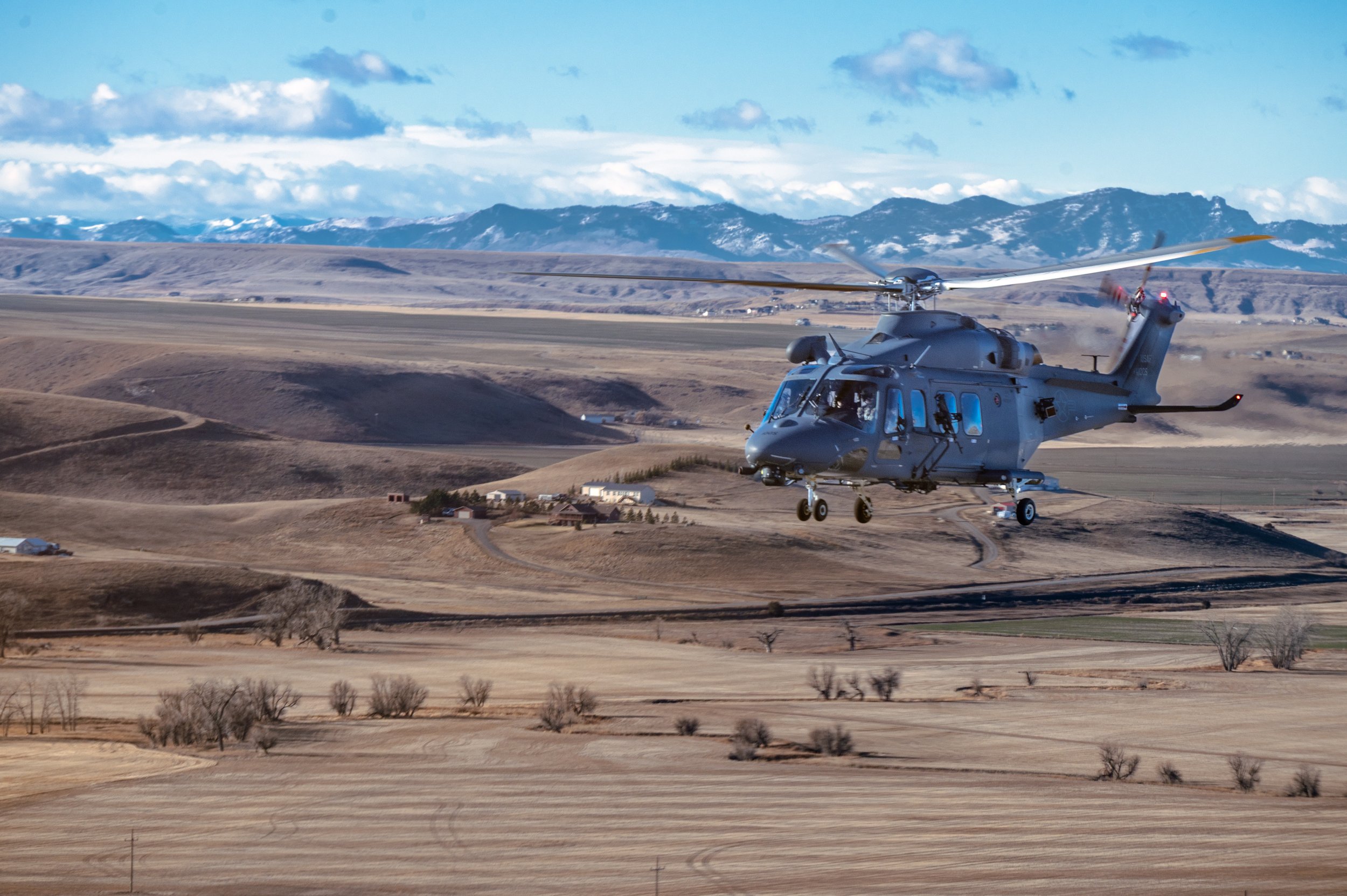
The order arrives with the Grey Wolf already on the mission. Air Force Global Strike Command declared initial operational capability effective August 10. In January, two Grey Wolves from Malmstrom Air Force Base, Montana, flew the first operational Minuteman III convoy mission, escorting maintenance and armored security vehicles more than 100 miles during a six-hour movement without refueling. The Air Force credits the helicopter with more speed and range than the Huey and room for more troops, which matters when security forces have to reach dispersed launch facilities quickly.
THE FLEET THAT SHRANK AND GREW BACK
The fleet plan has moved more than the schedule. The original baseline covered 84 helicopters, and the December 2022 Selected Acquisition Report showed 80. The FY2025 budget cut the plan to 42 in 2024, a reduction GAO attributes to higher Air Force priorities.
Cutting the buy spread the program’s fixed costs across fewer aircraft. Unit-cost growth crossed into a critical Nunn-McCurdy breach, and Congress was notified in April 2024. The June 2024 acquisition report records that the Air Force then authorized restoring the fleet to at least 56 to meet mission requirements. That brought cost growth back below the critical threshold, although a significant breach remained.
GAO counts those 56 as six development aircraft and 50 production aircraft. Boeing’s order history now covers all six development aircraft and 36 production aircraft. That leaves 14 production aircraft still to be put on contract.
A HARD PATH TO FULL RATE
Grey Wolf is a militarized version of Leonardo’s commercial AW139. Leonardo builds the airframe in Philadelphia, and Boeing militarizes it at Ridley Park. Certification and testing still slowed the program. The June 2024 acquisition report recorded outstanding FAA certification documentation that delayed developmental testing and the start of operational testing. GAO later reported that late training manuals held up crew training.
DOT&E reported that initial operational testing finished in June 2025 and that classified reporting would inform the full-rate decision. Its annual report flagged intercom and gun-mount concerns, along with availability problems tied to repairs and supply support. GAO’s January 2026 review linked the delayed IOC to insufficient aircraft for pilot transition and noted future integration and retrofit work, including friendly-force identification.
The full-rate decision itself has not surfaced publicly. The Air Force’s FY2027 budget had forecast it for August 2026, the same month as IOC. Boeing’s announcement is the first public sign that the program has crossed it.
The full-rate decision itself has not surfaced publicly. The Air Force’s FY2027 budget had forecast it for August 2026, the same month as IOC. Boeing’s announcement is the first public sign that the program has crossed it.
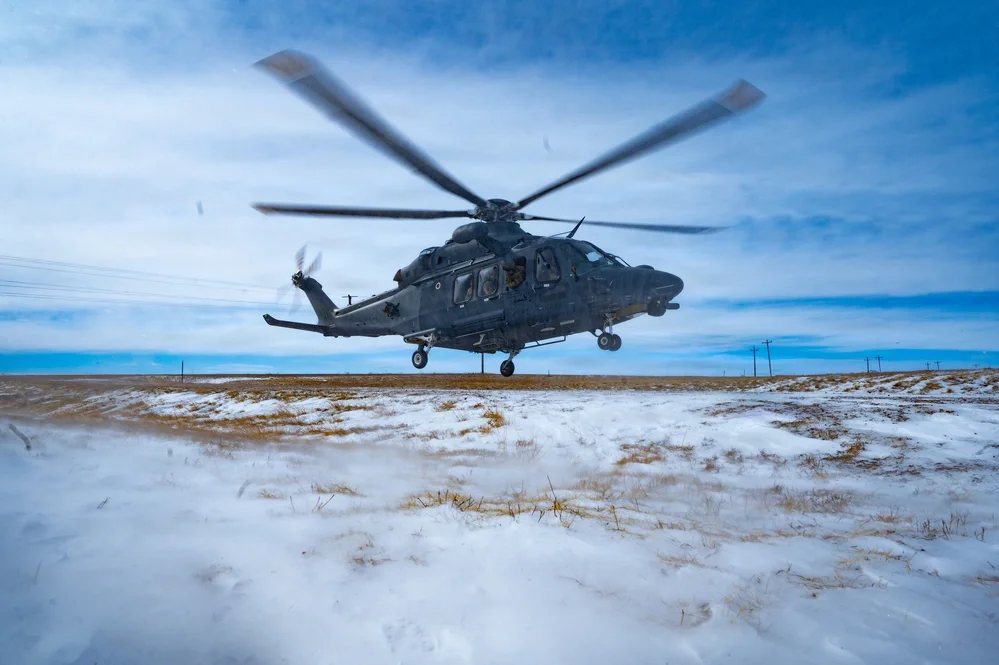
A 582nd Helicopter Group MH-139 Grey Wolf takes off near Pine Bluffs, Wyoming, Feb. 19, 2026. The group supports security across Air Force Global Strike Command’s missile wings.
U.S. Air Force photo by Airman 1st Class Nicholas Rowe.
THE SUPPORT SYSTEM IS STILL BEING BOUGHT
The FY2027 budget asks for four more Grey Wolves at $252.9 million, with the award forecast for March 2027. The helicopters account for $89.4 million in flyaway cost. Support accounts for $163.6 million, nearly two-thirds of the request, including $75.2 million for interim contractor support and $22.1 million to stand up depot work.
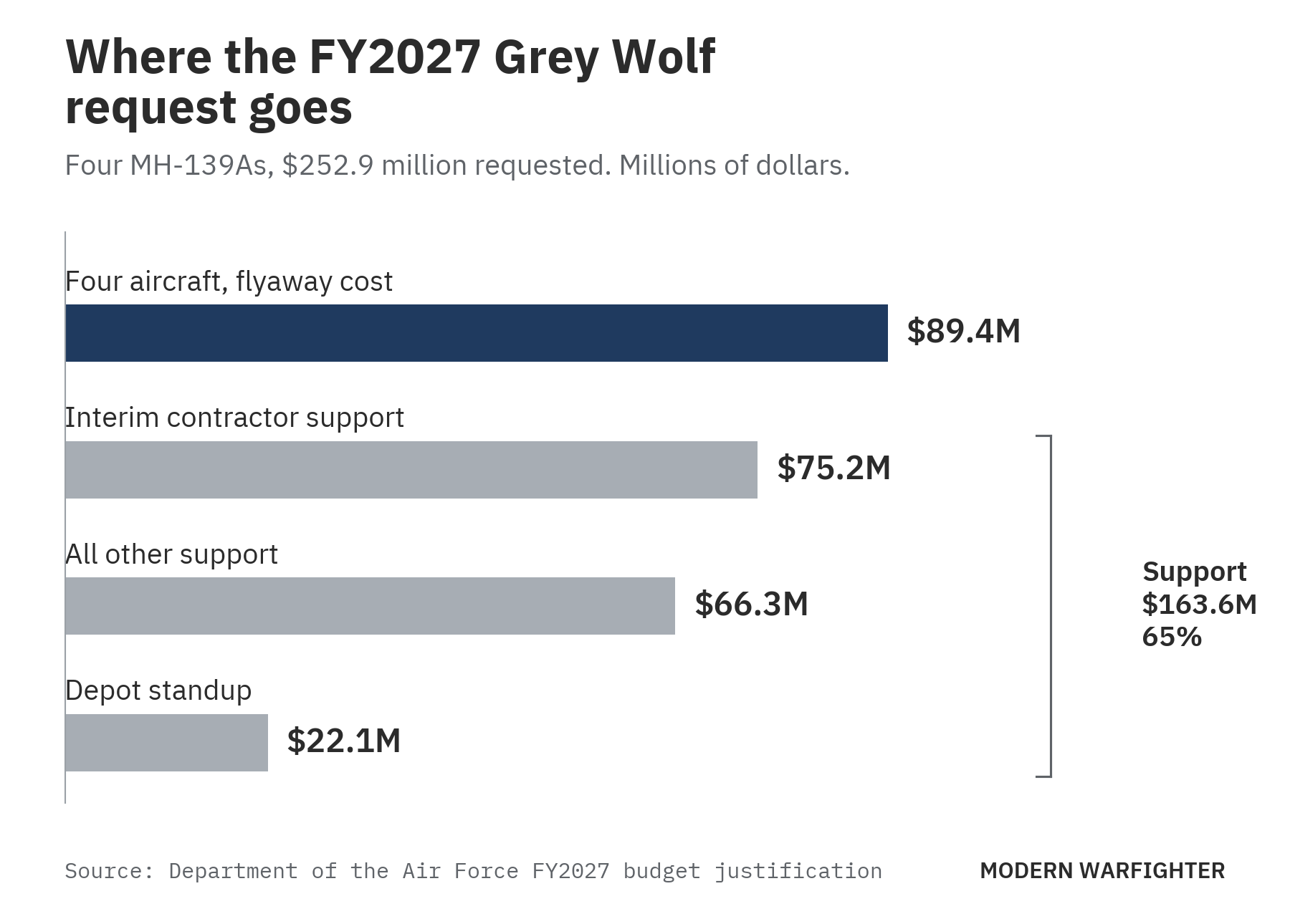
Support makes up nearly two-thirds of the Air Force's FY2027 Grey Wolf request. The four helicopters themselves account for about a third.
Chart: Modern Warfighter
Interim contractor support pays a contractor to sustain the fleet until government depots take over. The Air Force assigned that depot work in 2022, splitting components between Fleet Readiness Center East and three Air Logistics Complexes, with software sustainment at Warner Robins. The budget plans to integrate common assets into existing depots in FY2027 as designated repair sites are activated.
That is the practical meaning of full-rate production for this program. The budget lists a maximum production rate of 16 helicopters a year, and the FY2027 request buys four. The network that keeps those helicopters flying is still being assembled, and contractors are covering the gap.
WHO PAYS FOR THE NEXT ONES
The FY2026 spend plan funds eight Grey Wolves, two through the regular defense appropriation and six through the 2025 reconciliation law. Boeing announced two four-aircraft orders in 2026, in January and September. The counts match, which suggests reconciliation money paid for most of the FY2026 buy. The contract and funding records that would confirm the match have not been released.
FY2027 is less settled. The request covers four aircraft. The House-passed defense authorization bill and the Senate Armed Services Committee’s version would support eight, and House appropriators kept the requested funding level. Until full-year appropriations pass, the program runs under a continuing resolution that extends through December 11.
The Grey Wolf is already flying the mission it was bought for, and this order adds four more helicopters to it. The harder part of the program now sits in the support budget. Most of next year’s request goes to keeping the fleet maintained until the Air Force’s own depots can do the work.
VERIFICATION: The source record behind this analysis, including what could not be confirmed. VIEW VERIFICATION →
TAGGED: MH-139A Grey Wolf, U.S. Air Force, Boeing, Acquisition Briefs, Force Transition
-

ANDRES CARDENAS | Lead Analyst
Modern Warfighter Defense Publication
/ STAY CONNECTED /