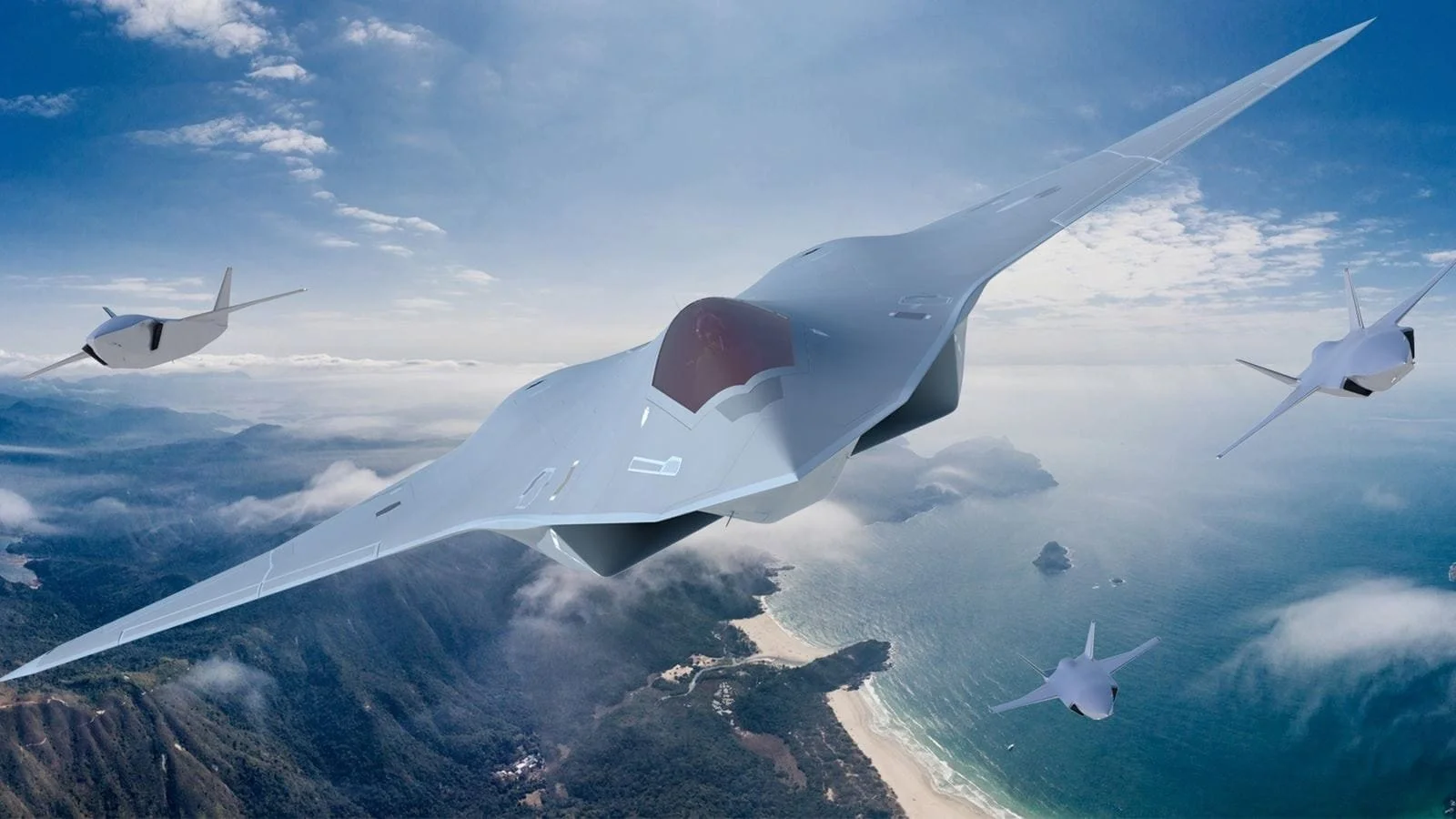

F-47 Gamble: NGAD, CCAs, and the Future of Air Dominance
Sixth-generation air dominance trades solitary stealth for autonomous networks. In the Western Pacific, that makes the F-47 dependent on a digital backbone peer-state electronic warfare is built to shred.
May 28, 2026 | 5 min read
MODERN WARFIGHTER (May 2026) — Fighters launching from Guam or Japan must cross thousands of miles of open ocean before reaching contested airspace over the Western Pacific. Every additional mile stretches the datalink architecture binding future NGAD formations together across an electromagnetic environment China is preparing to contest from the opening phase of a Pacific fight.
That operational reality explains the central gamble shaping the Pentagon’s future airpower strategy. The next generation of American air dominance may depend as much on the network around the fighter as on the aircraft itself.
The consequences of that shift have been unfolding since March 21, 2025, when the Air Force awarded Boeing the contract to develop its Next Generation Air Dominance platform.
The program has moved quickly since that award, with manufacturing for the first F-47 test units already underway as of late 2025.
The sixth-generation fighter, designated in procurement circles as the F-47, arrived with the standard institutional promises of advanced stealth, deep penetration, and extended range.
The larger transformation sat behind the classified airframe. Autonomous Collaborative Combat Aircraft (CCAs) were built to scout ahead, carry additional ordnance, jam enemy sensors, and extend targeting information beyond what manned aircraft can safely sustain. By designing the F-47 as the center of a coordinated autonomous formation, the Air Force acknowledged a strategic reality visible across modern battlefields. Concentrated combat power is becoming harder to preserve against peer-state attrition.
The architecture treats the crewed fighter as the coordinating center of a wider autonomous formation.
Remove the datalink connecting that formation and the operational advantage begins to erode quickly. The result is a collection of advanced aircraft still capable on their own, but separated from the network that gives the F-47 concept its real power.
THE COST CURVE
The operational pressures forcing that shift are already visible. Ukraine punished concentrated combat power through drones, artillery, and electronic warfare layered across dense attritional battlespace. In the Red Sea, U.S. naval forces expended multi-million-dollar interceptors against waves of inexpensive drones and missiles launched by Houthi forces.
Across the Pacific, Chinese anti-access planning focuses heavily on exhausting finite American inventories through missile saturation, contested logistics, and industrial pressure stretched across enormous distances.
Ukraine and the Red Sea exposed the same pressure point. Advanced militaries are being forced to spend expensive systems against cheaper forms of mass. For the Air Force, autonomous aircraft offer one answer, but only if the network holding them together survives combat.
The Air Force’s bid to manufacture this autonomous mass relies on a distributed launch architecture, with some CCAs deployed alongside the F-47 and others integrated mid-mission from regional nodes hundreds of miles away. Yet, this reliance on distributed hardware introduces an immediate industrial paradox.
THE PRODUCTION PROBLEM
A 2024 Congressional Research Service assessment concluded that the United States lacks the production infrastructure to rapidly regenerate attrited autonomous systems at the scale a peer conflict would demand. Affordable mass means little if factories fail to replace losses under wartime conditions. A doctrine built around attritable systems still depends on an industrial base capable of sustaining attrition at scale. If these systems cannot be replaced quickly, they cease to be truly attritable and instead become another scarce operational resource.
That vulnerability becomes more serious because the architecture depends on continuous coordination across a battlespace Chinese doctrine is designed to disrupt. PLA operational planning places heavy emphasis on spectrum warfare, kill-chain targeting, and attacks against the communications layers connecting American forces together.
WHEN THE NETWORK BREAKS
Under sustained electronic attack, the operational consequences for a stretched Pacific formation emerge quickly. CCAs operating at extended range face a narrowing set of choices: revert to pre-programmed behavior with degraded situational awareness, attempt to reacquire signal while potentially exposing routing patterns and formation spacing to enemy sensors, or withdraw from the battlespace entirely.
RAND describes PLA doctrine as a contest between opposing operational systems, with “system destruction warfare” forming its theory of victory. Mitchell Institute analysis points toward the same pressure across the Pacific air campaign. For the F-47, a network-dependent formation operating inside a network-denied battlespace risks fracturing the coordination structure the entire force depends on.
Without its autonomous fleet, the F-47 is forced to absorb missions originally distributed across multiple systems. The aircraft remains highly capable, but it also becomes finite, expensive, and isolated across a hostile ocean.
The Western Pacific presents a communications and jamming environment far beyond the permissive conditions U.S. airpower has operated inside during recent decades. For NGAD, the question is how the system functions when datalinks, tankers, and supporting communications come under attack at the same time?
Air Force officials are actively pursuing resilient datalinks, fallback autonomy protocols, mesh networking, and low-probability-of-intercept or low-probability-of-detection communications designed to preserve the network under combat jamming. Classified solutions may address parts of the problem more effectively than public analysis can assess. But autonomy does not eliminate the need for coordination. It changes what happens when coordination begins to fail.
Whether those systems survive sustained combat jamming across Pacific distances remains uncertain because the architecture has never faced the conditions it is being built to endure.
Taken together, the assessments from RAND, Mitchell Institute, and the Congressional Research Service point toward the same conclusion. If that network fractures under sustained electronic attack, the Air Force will have built the most sophisticated and most fragile command structure in the history of American airpower. Autonomous systems crossing thousands of miles of contested ocean. Waiting for orders that will never arrive
TAGGED: F-47, NGAD, Collaborative Combat Aircraft, Electronic Warfare, Indo-Pacific Airpower
-

ANDRES CARDENAS | Lead Analyst
Modern Warfighter Defense Publication
/ STAY CONNECTED /