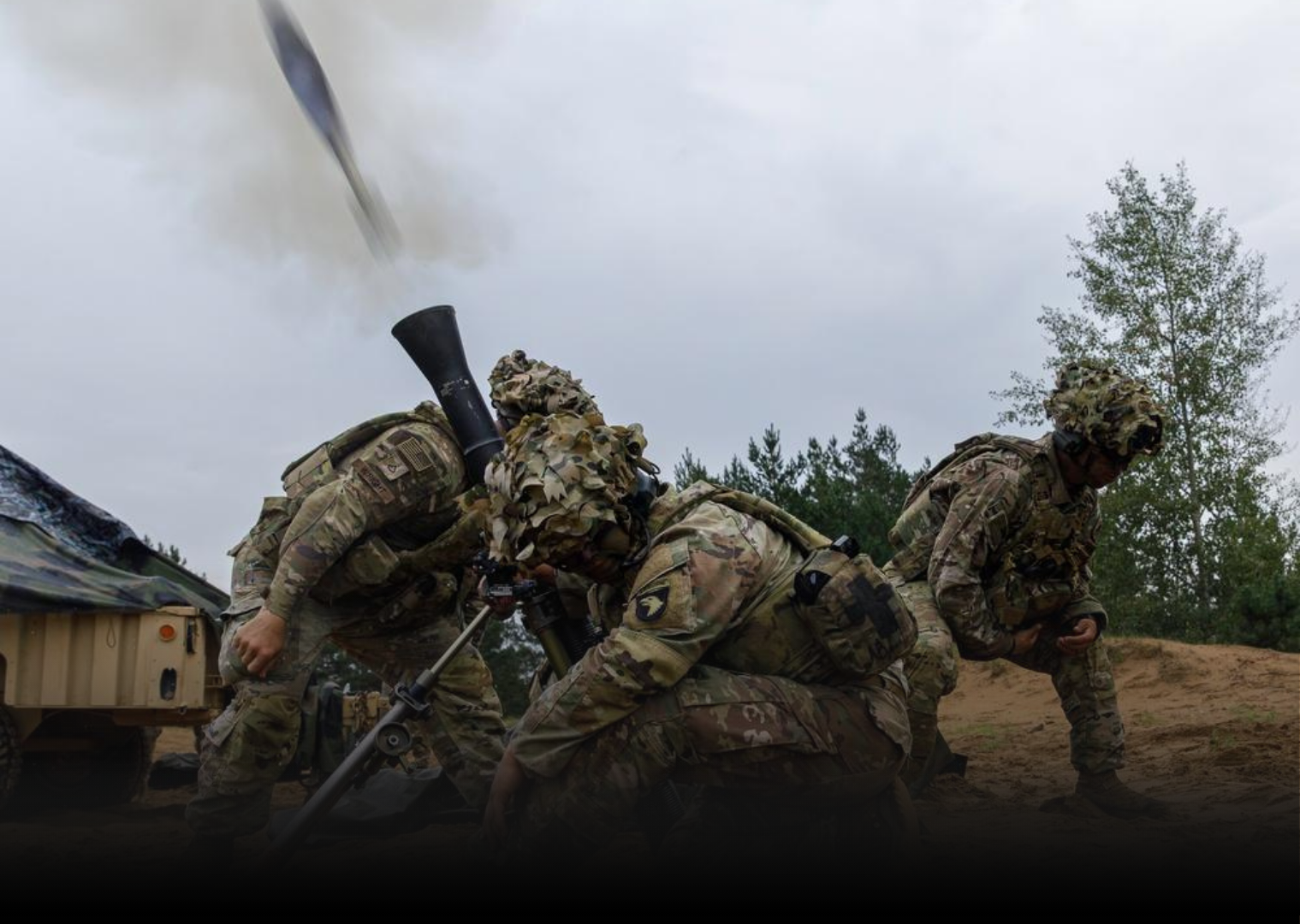
The Army is pushing the 81mm mortar toward range and effects once associated with the 120. A new carrier and fire-control system could change how the section fights with it.
August 23, 2026 | 7 min brief
The 81mm THAT CHANGES the Mortar sECTION
Mortar squads have always worked around the same trade. The 60mm stays light by giving up range and effect. The 81mm reaches farther without taking on the full burden of the 120. The 120 brings a heavier round and greater reach, then makes the section solve for everything required to move and feed it. More firepower has always meant more weight.
E81 is trying to narrow that gap. The Army wants more of the 120’s range and punch from an 81mm round. IBMS pairs it with a vehicle-mounted setup built to get the gun firing and moving again faster. The Mortars App changes how firing data reaches the gun. The round, the carrier, and the fire control are changing together.
The pressure is coming from the fight around them. As more artillery moves toward division-level employment, mortars carry more of the immediate fires fight at battalion and company level. UAS and faster counterfire also leave crews less time to occupy, fire, and move before somebody finds them. The Army’s Close Combat Lethality Task Force points to the same problem: the mortars staying close to the fight need more range, lethality, and mobility.
THE CALIBER TRADE
The fielded M252A1 weighs 74.9 pounds and reaches 5,844 meters. It is still light enough to hump, which is part of why it remains useful to light infantry, airborne, and air assault formations. The M120 buys more range and effect with a heavier gun and heavier ammunition.
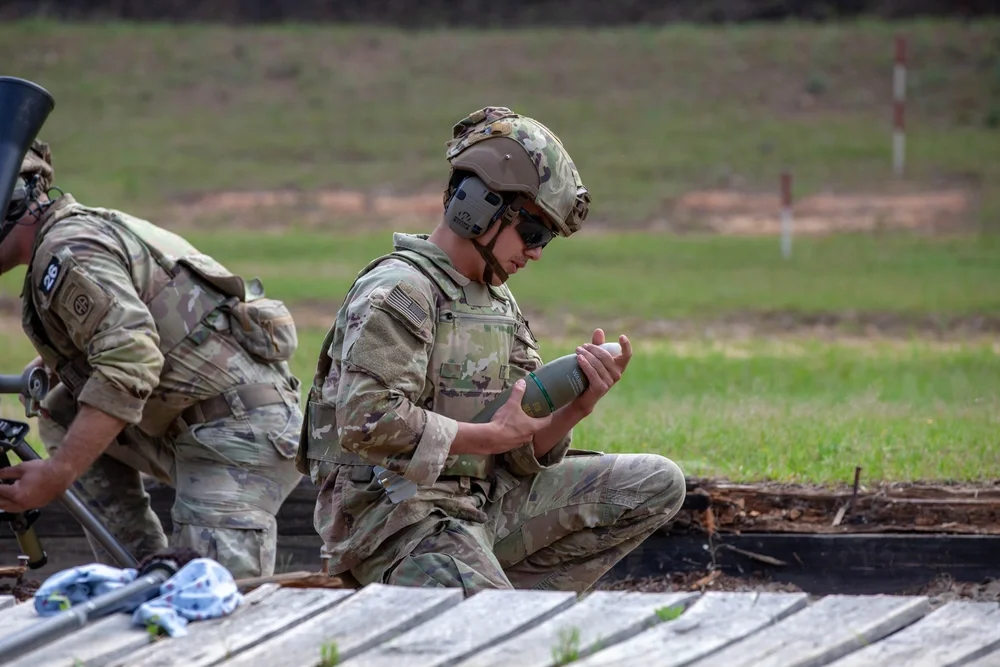
An 11C handles an 81mm round during the 2024 International Best Mortar Competition at then-Fort Moore, Georgia.
Media: U.S. Army
E81 goes after the gap between them. DEVCOM's Enhanced Range and Lethality Mortar Systems effort is trying to put 120mm-like range and lethality into an 81mm high-explosive round without giving the crew another heavy mortar to move. Engineers are using mature components in the new round, including the M734A1 multi-option fuze, fielded energetics, and warhead-liner technology derived from the M824A1 program. The propulsion effort has reached industry as well. In March 2026, Nammo Pocal received a $1.86 million prototype award for an Enhanced 81mm Mortar Cartridge Propulsion System.
The strongest performance claims remain developmental. Army authors writing in Infantry this spring reported that E81 ammunition had demonstrated a larger blast radius than existing 120mm rounds and described the developmental system as capable of outranging the current M120. The public material leaves the exact 120mm comparison round, test geometry, and measured range unspecified.
The Army is trying to move part of the 120mm's performance into a lighter round. Exactly how much performance moves with it remains an open test question.
THE GUN HAS TO LEAVE
Range and lethality only solve part of the problem. A mortar section still has to occupy, fire, and displace.
IBMS pairs E81 with a vehicle-mounted setup. In the mortar-employment concept for the Mobile Brigade Combat Team published this spring, the gun sits on an ISV-Utility using an articulated armature and non-settling baseplate. The crew can still pull it off the vehicle and occupy a dismounted firing position when the terrain or mission calls for it.
Being mounted changes what happens at the firing point. Army authors describe the developmental IBMS going from receipt of a fire mission to rounds out in seconds, compared with minutes for a trained crew using the current M120 Mortar Stowage Kit. After the last round, the system is intended to get the section moving again within seconds. Robert Lucas, an Infantry Brigade Combat Team capability developer at the Maneuver Center of Excellence, described the objective as helping crews “mitigate the counter-battery threat by increasing battlefield mobility.”
The Army is testing another answer to the same timing problem. During Balikatan 2026, soldiers from 2nd Battalion, 35th Infantry Regiment fired the vehicle-mounted Scorpion Light 81mm system in the Philippines. Scorpion receives fire missions digitally and automatically lays the tube, leaving the crew to prepare the charge and drop the round. Global Military Products says it can fire eight rounds and move within two minutes. Scorpion sits outside the E81 and IBMS programs, but it points in the same operational direction: compress the time between receiving a target, firing, and leaving the position.
IBMS also changes what leaves with the gun. The proposed configuration carries 70 E81 rounds, compared with 34 in the M120 Mortar Stowage Kit used by Army authors. The number of rounds on board more than doubles. How long that ammunition lasts still depends on the missions being fired, but more of the section’s ammunition moves when the gun moves.
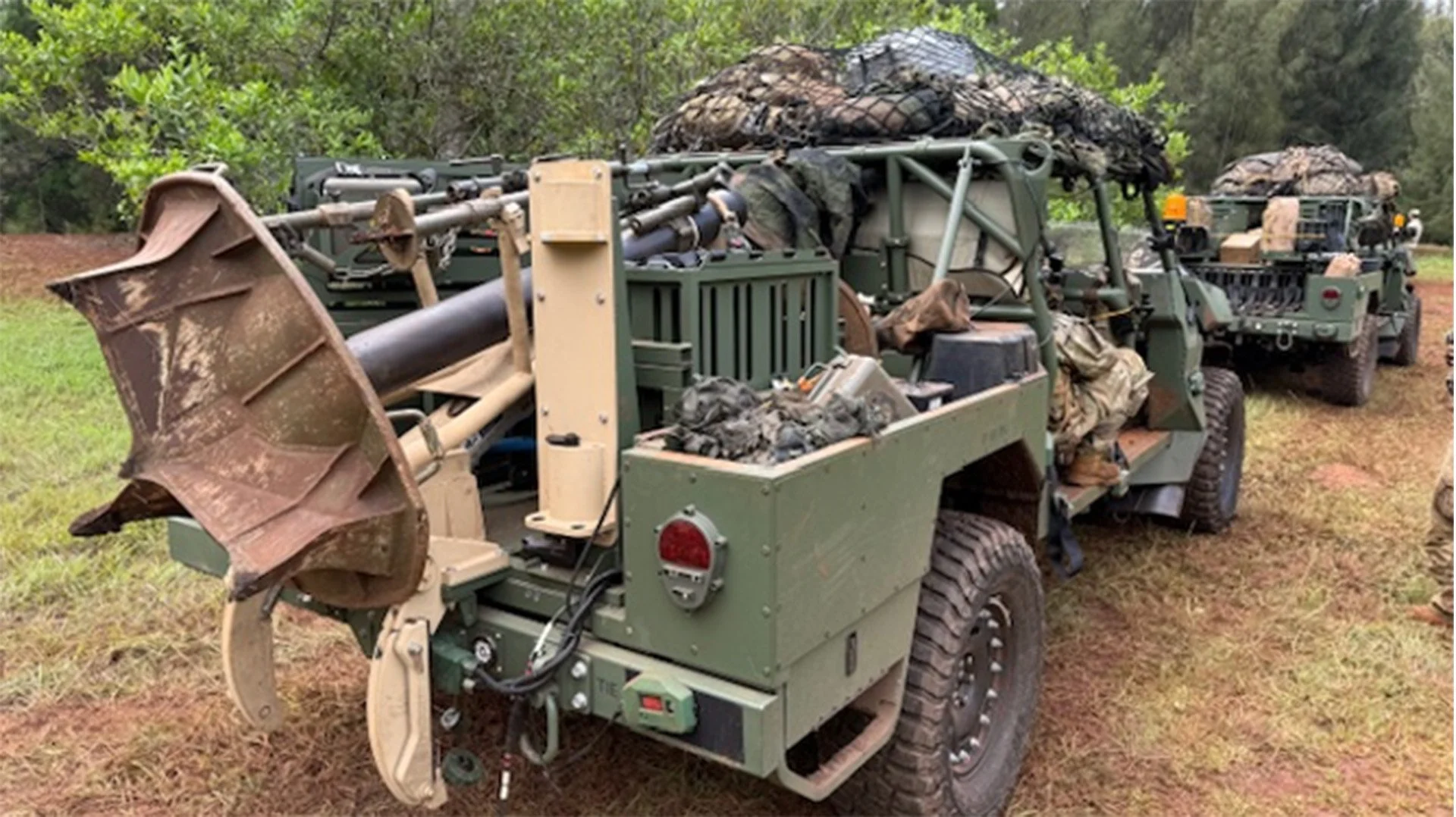
A 120mm Mortar Stowage Kit rides in an ISV-Utility during a Joint Pacific Multinational Readiness Center rotation. The developmental IBMS concept attacks the emplacement, displacement, and ammunition-capacity limits Army observers have identified in current heavy-mortar employment.
Media: Lt. Col. John Leisinger.
THE FIRING POSITION
Counterfire begins before a radar plots a mortar trajectory.
UAS can watch routes and firing points. Electronic emissions can expose activity. Thermal signatures, vehicle movement, ammunition handling, and the firing signature itself all give the enemy ways to find a section. Army capability developers tie mortar modernization directly to counterbattery survival. Auto-lay, faster emplacement, and shoot-and-scoot employment all shorten the time a section remains exposed.
IBMS attacks the time a section stays fixed to one location. Greater range opens more firing-position options. The vehicle keeps the gun and more ammunition together. The articulated mount and auto-lay reduce the steps between stopping, laying the gun, firing, and moving again.
The section still gives itself away when it shoots. The difference is how long it stays there afterward.
THE FDC CHANGES WITH IT
The fire-control side is changing too.
MFCS entered the Army in 2003, followed by LHMBC in 2004. For the next two decades, the Army carried two separate software lines for mortar fire control. Planning for a common replacement began in 2020. The Mortars App appeared in an initial form in 2023, version 4.0 completed formal testing in January 2024, and the Army secured full-release clearances in March 2026.
The Mortars App puts those fire-control functions on the Common Fire Control Framework and can run on devices as small as an Android phone. MFCS and LHMBC depended on separate codebases, which meant maintaining and updating both as developers retired or moved on. The new app brings those functions onto one software base that can move across phones, tablets, and other hardware. Soldier touchpoints shaped it before release.
The vehicle, armature, baseplate, auto-lay system, and crew move the gun. The software moves the firing data. One cuts time out of the drill at the firing point. The other cuts time out of getting onto the mission.
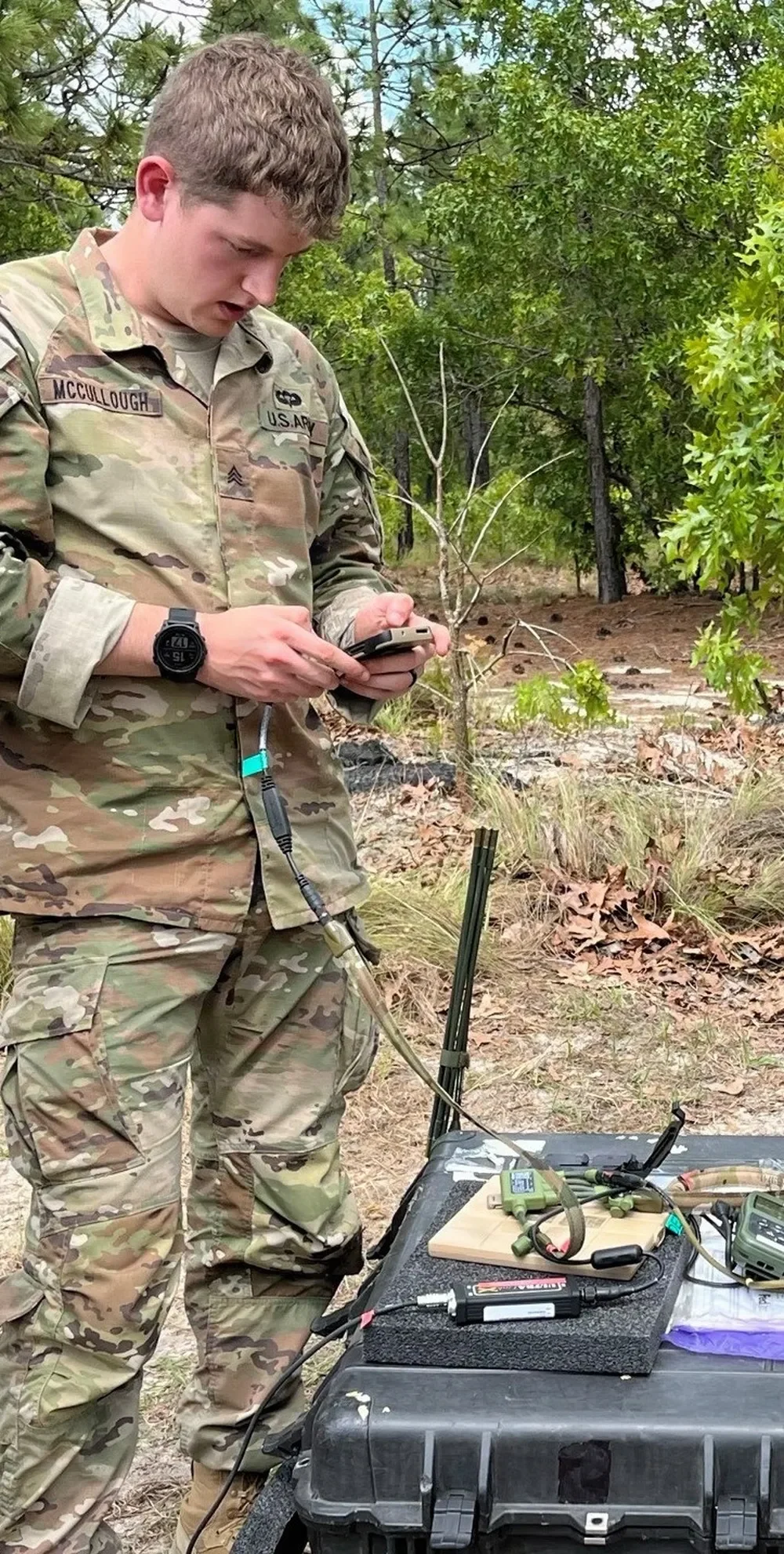
A Soldier interacts with the Mortars App during a Touch Point event at Fort Bragg, North Carolina in May 2024.
Media: U.S. Army photo by Eric Kowal
THE PROGRAM STILL HAS DISTANCE TO COVER
The pieces are moving on different schedules.
IBMS development reaches back into fiscal 2023. The Army's FY2025 budget put $6.012 million into 81mm development, mobility work, testing, prototyping, and improvements to the existing 120mm Mortar Stowage Kit.
No single prime integrator has emerged in the public record. Nammo Pocal holds the confirmed E81 propulsion prototype award. Elbit America appears in Army budget material for M120 stowage-kit modernization.
The ammunition has farther to go than much of the hardware around it. A 2024 Army industry notice called for non-ammunition IBMS components to reach Technology Readiness Level 6 by the end of fiscal 2025. E81 ammunition received until the second quarter of fiscal 2027. The Close Combat Lethality Task Force points farther out, toward a fiscal 2029 joint program of record for mortar auto-lay and the E81 family of munitions.
The round, carrier, and fire-control pieces are moving toward the same system. The Army still has to prove they work together.
WHAT HAPPENS TO THE MORTAR SECTION
The current 60mm, 81mm, and 120mm mix grew around differences soldiers could feel in the gun and the ammunition: weight, range, effect, and how each system moved with the formation. If E81 pushes the 81 farther into territory occupied by the 120, replacing one mortar with another becomes only one option.
Army authors are already exploring what else could change. The Spring 2026 Infantry article proposes experimenting with more E81-equipped sections across company and battalion levels. Its authors also draw a clear line around the idea. Current observations are still insufficient to justify more mortar systems or more 11C positions.
The 120 keeps advantages a developmental 81 still has to prove it can match across missions. Projectile mass, ammunition types, sustained fires, and the performance of the complete system still shape that comparison. E81 creates more overlap between two weapons built around different tradeoffs.
E81 may push the 81 farther into the range and effects once associated with the 120. IBMS may change how quickly the section can occupy, fire, and displace. The Mortars App changes the software underneath the fire mission. Each alters a different part of how the section fights.
The Army still has to prove those pieces together and decide what to do with the capability they create. The harder question comes after the engineering: what happens to the mortar formation when the old caliber trade stops drawing the same boundaries?
TAGGED: U.S. Army, Mortars, E81, Infantry Battalion Mortar System, Warfighting Systems
-

ANDRES CARDENAS | Lead Analyst
Modern Warfighter Defense Publication
/ STAY CONNECTED /