
The Permanent Platform: Chinook Block II and the Autonomy Pivot
May 25, 2026 | 7 min brief
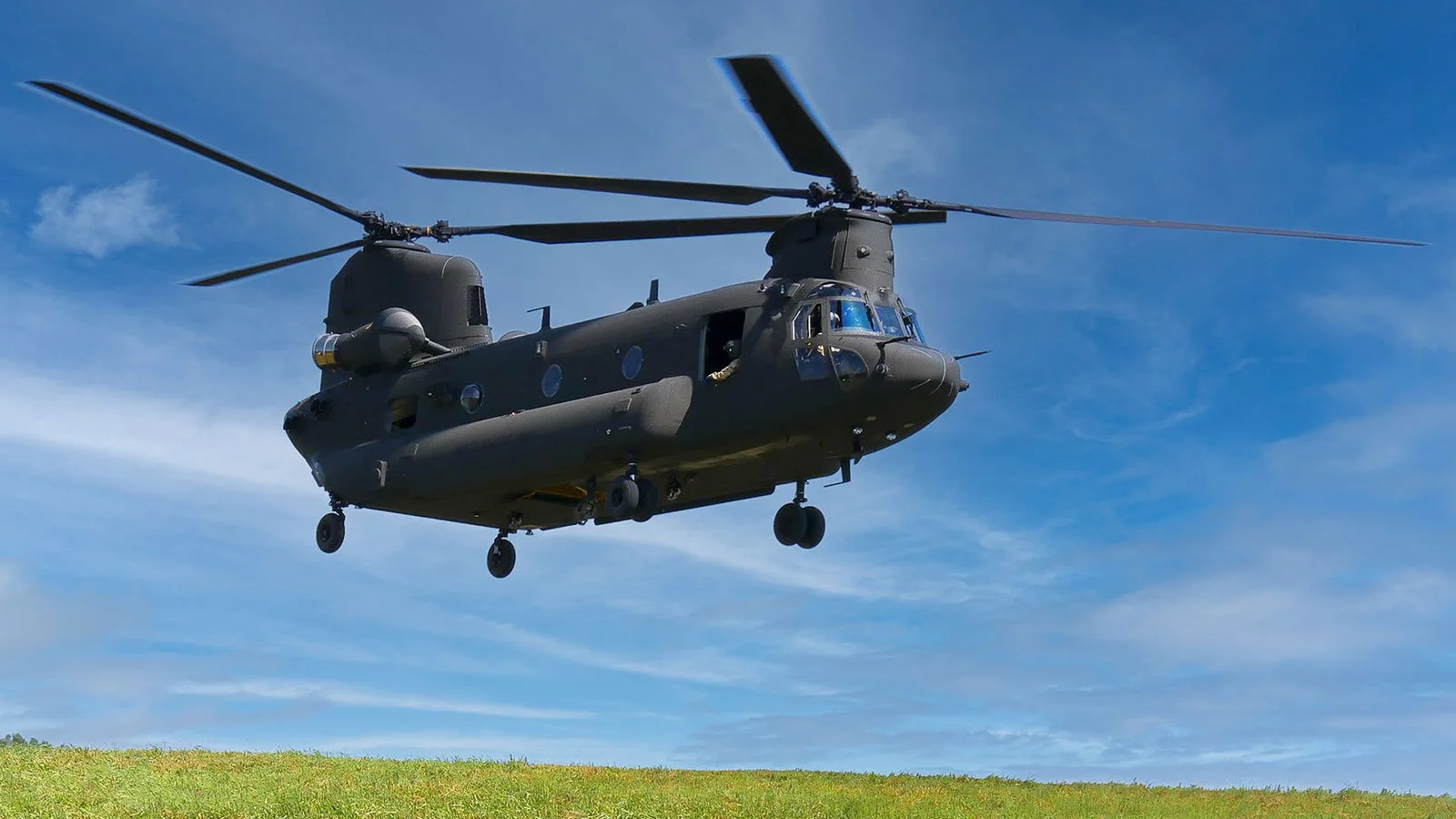
HUNTSVILLE, Ala. (April 16, 2026) — Boeing announced that a CH-47F Chinook completed a fully automated approach and landing at Redstone Test Center, touching down with all four wheels on the runway without pilot input. The system that executed it, Approach-to-X, or A2X, has run more than 150 automated approaches since January 2026, with an average final position error under five feet. Crew members remained aboard throughout.
Media: Boeing highlights CH-47F Block II heavy-lift upgrades as the Chinook expands into autonomy and future mission roles.
"We built the interface and control laws around how pilots would naturally fly an approach. Our goal is to reduce pilot workload so crews can maintain more eyes-out awareness in a tactical situation." — Deanna DiBernardi, Boeing's H-47 Human Factors Engineering lead
That framing is the right place to start. A2X is a workload transfer. The software manages the final approach so the crew can manage the fight. That distinction matters in the environments Army rotary-wing aviation is designed to operate in: degraded visibility, contested landing zones, and nighttime insertions into tight terrain. These are the conditions where approach management has historically competed with situational awareness for crew bandwidth. A2X shifts that balance.
THE FOUNDATION BENEATH A2X
The landing itself is the most visible output of a longer investment Boeing has been making in the Chinook’s digital architecture. A2X runs on an upgraded Digital Automated Flight Control System. The Active Parallel Actuator System, or APAS, adds advanced control laws, flight-envelope protection, tactile cueing and back-drive while retaining the Chinook’s hydromechanical primary flight controls. Boeing added APAS to the Chinook production line in 2026 and installed the first production-line system on a British Extended Range aircraft in February.
Chris Speights, Boeing’s chief engineer for vertical lift, was direct about the roadmap at the Army Aviation Association of America conference in Nashville last month:
"That puts us on the path for flight automation, flight automation specifically, which starts today with pilot workload reduction and Approach-to-X. But it enables further capabilities in the future, as the customer desires, based on their concept of how the aircraft would be used."
The Army’s stated concept is an optimally crewed aircraft, a platform that can operate with reduced crew, single pilot, or in some mission profiles, an uncrewed setup. Heather McBryan, Boeing’s vice president and program manager for Cargo Programs, confirmed that Boeing is building toward that requirement:
"The Army wants to add layers of optimally crewed capability quickly, and we're working side by side with them to make those upgrades a reality."
Boeing has yet to provide a delivery timeline for the finalized A2X system. Additional flight testing is ongoing.
THE CHINOOK AS A LAUNCHED EFFECTS PLATFORM
The autonomy demonstration arrived alongside a separate and more speculative proposal. At the Nashville conference, Boeing released concept imagery showing a Block II Chinook opening its rear ramp during flight and dispensing a swarm of drones from a palletized internal launcher. The drones, configured for reconnaissance, electronic warfare, and strike, would move ahead of the aircraft, developing the battlespace before the Chinook arrives.
Media: Boeing CH-47F Block II Chinook concept showing in-flight Launched Effects deployment from the rear cargo ramp.
The volume case is straightforward. The Chinook has a large cargo bay and a 27,700-pound useful load, giving it capacity to carry a launched effects package at a scale unrivaled by alternative rotary-wing platforms in the Army’s inventory. That is the core of the argument and it is sound.
The survivability question is harder. The Chinook is large, slow relative to peer air defenses, and highly visible. Deploying reconnaissance and strike drones near contested airspace assumes a survivability margin the aircraft’s speed and signature fail to guarantee. The assumption is that launched effects, electronic warfare support, and standoff can extend the Chinook’s survivable operating radius far enough to make the concept work.
That assumption remains untested against a peer threat, and the concept remains unvalidated.
The Army’s common Launched Effects Dispenser for Ground and Rotorcraft, LEDGR, is in active validation across rotary-wing platforms, butthe Chinook application specifically remains outside active programs of record. The distinction between what Boeing demonstrated in April and what it showed in a concept video matters. The landing is a verified flight achievement. The drone swarm launcher remains a conceptual projection.
ALLIED PROCUREMENT AND PRODUCTION CONTINUITY
The international picture has solidified in ways that directly affect the Chinook’s long-term production trajectory.
Japan ordered 17 CH-47 Block II Extended Range aircraft in February 2025, co-produced with Kawasaki Heavy Industries. The Japan Ground Self-Defense Force has operated Chinooks since the 1980s as Japan orients toward southwestern island chain defense, a mission that is logistics-heavy, infrastructure-light, and dependent on rotary-wing lift in ways that fixed-wing access cannot substitute.
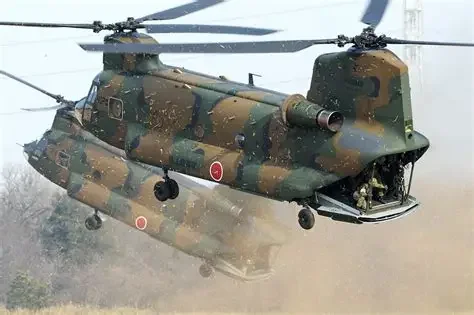
Japan’s CH-47JA fleet gives the Ground Self-Defense Force a proven heavy-lift backbone as Tokyo expands Block II procurement with Kawasaki co-production.
Germany’s broader 60-aircraft CH-47F Block II program received State Department approval as a possible Foreign Military Sale with an estimated value of $8.5 billion, with later U.S. Army contract actions, including an $876.5 million award, beginning production and support work for the program. That contract action runs through 2035 and represents the centerpiece of Germany’s post-Ukraine heavy-lift modernization. Few Western heavy-lift platforms match the Chinook’s combination of cost, availability, allied footprint, and existing training infrastructure.
By choosing the Block II, Germany joins a broad Chinook operator base that includes Italy, the Netherlands, Spain, Greece, Turkey, Canada, and the United States. Commonality varies by configuration, but the operator base creates opportunities for shared training and support when speed of reinforcement is the metric.

CH-47F Chinook proposed for Germany’s Schwerer Transporthubschrauber (STH) heavy-lift helicopter requirement. Boeing and Airbus Helicopters signed a strategic support partnership for the program in 2022.
Earlier this month, a $396.8 million contract modification extended Chinook production for South Korea and Spain under Block I Foreign Military Sales cases. The Army formally accelerated Block II procurement in September 2025, authorizing funds across FY2025 and FY2026 to outfit two Combat Aviation Brigades. Twenty-four aircraft are now under contract. Boeing has delivered six and says the Army plans to field its first equipped unit by mid-2028. Boeing’s Ridley Park facility is running continuous production on allied demand across three continents.
FINAL WORD
The April demonstration is real and the underlying architecture is credible. A2X has demonstrated repeatable automated approaches and a fully automated landing in flight testing, with final software refinement still underway before Army fleet integration. APAS provides the control foundation for future autonomy. The Army’s optimally crewed requirement is funded and in development. The allied procurement base is solid.
What remains unresolved is whether the operational concepts being built on top of that foundation can survive the conditions they’re designed for. Launched effects from the Chinook cargo bay remain undemonstrated and exist outside active programs of record. Optimally crewed operations remain a funded engineering requirement, distinct from a fielded fleet capability. The survivability of a heavy-lift platform operating near a peer air-defense network is an open question.
The Chinook’s value to the Army has always been that it does things nothing else can do at scale. That remains true. The question for the next five years is whether the capabilities being layered onto that scale can be validated fast enough to matter in the scenarios the Army is actually planning for.
PLATFORM STATUS MATRIX
| Demonstrated / Production-Ready | In Development / Integration | Unresolved / Speculative |
|---|---|---|
| Automated approach and landing (A2X) | Final A2X fleet integration | Cargo bay Launched Effects deployment |
| APAS production-line installation | Optimally crewed operations | Survivability near peer air defenses |
| Block II gross weight to 54,000 lbs | Layered supervised-autonomy capabilities | Fully uncrewed heavy-lift operations |
RELATED COVERAGE
-
![]()
Army Awards Collins Up to $472.4 Million for Chinook Avionics
August 26, 2026 · 3 min brief
The Army awarded Rockwell Collins a contract worth up to $472.4 million for Chinook avionics work. Federal records agree that one offer arrived but diverge on how the acquisition reached that point.
TAGGED: Chinook, Army Aviation, Autonomy, Launched Effects, Heavy Lift
-

ANDRES CARDENAS | Lead Analyst
Modern Warfighter Defense Publication
/ STAY CONNECTED /