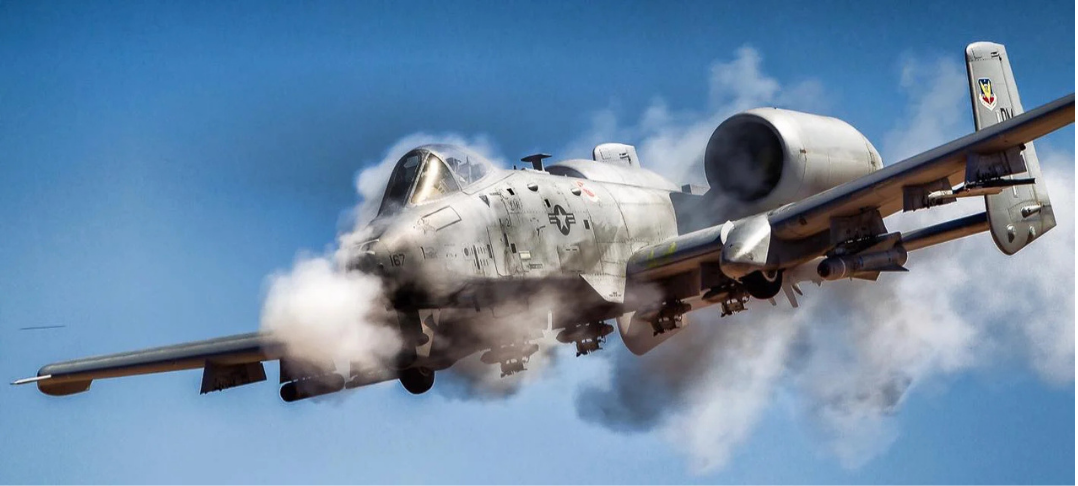

The BRRRRT Act: Congress Raises the A-10 Floor Again
Congress would raise the A-10 floor to 126 aircraft through 2033 as the training, depot, and testing structure behind the fleet continues to contract.
July 26, 2026 | 4 min read
MODERN WARFIGHTER (July 20, 2026) — Congress has moved again to set the size of the A-10 fleet. Rep. Abe Hamadeh introduced H.R. 9780, the Bolstering Recognition, Resurgence, Retention, and Remembrance of the Thunderbolt Act. Rep. Don Davis co-leads the bipartisan measure, which was referred to the House Armed Services Committee. At the time of the initial reporting, the formal legislative text remained unpublished. The available details came from the sponsor’s announcement and subsequent reporting.
The proposal would raise the statutory floor from 103 aircraft to 126 and carry that requirement through fiscal year 2033. It would require the Air Force to submit a plan to restore depot maintenance, pilot training, sustainment, and flight testing within 90 days of enactment. Further retirements would remain restricted until an aircraft built primarily for close air support had fully assumed the mission under a certification process involving the Army, Marine Corps, and U.S. Special Operations Command.
The Floor Has Already Moved Once
The Air Force entered fiscal year 2026 seeking authority to retire its remaining fleet of roughly 162 A-10s. Congress rejected that timeline. The FY2026 National Defense Authorization Act established a minimum inventory of 103 aircraft and prevented the service from completing the planned retirement.
In April 2026, Secretary of the Air Force Troy Meink announced that two squadrons would continue flying through 2030, one active-duty unit at Moody Air Force Base and one Air Force Reserve unit at Whiteman Air Force Base. Modern Warfighter covered that decision as evidence that replacement capacity and force-transition planning had failed to mature in time for the original retirement schedule.
The BRRRRT Act addresses a fleet Congress has already protected from immediate retirement. The FY2026 authorization preserved 103 aircraft, and the service has since committed to keeping two squadrons operational through 2030. H.R. 9780 would raise that protected inventory before the revised structure is fully in place and impose new requirements on the enterprise supporting it.
A Fleet Floor Cannot Generate a Squadron
A statutory inventory count alone cannot produce a combat-capable squadron. The FY2026 restriction protected 103 airframes from further divestment while pilot production, developmental testing, depot work, weapons instruction, maintenance manpower, and logistics capacity continued to contract.
The Air Force graduated its final planned class of A-10 student pilots in April 2026. The service had also closed the aircraft's depot maintenance operation at Hill Air Force Base and reduced testing activity tied to the platform. Preserving airframes while those functions contract leaves Congress with an inventory count that may exceed the institution available to operate it.
Raising the floor to 126 therefore creates a larger force-generation requirement. The Air Force would have to preserve 23 aircraft above the existing minimum and sustain the crews, maintenance capacity, parts, test functions, and training throughput required to keep that larger fleet operational. Reversing earlier drawdown decisions carries a cost that the inventory number alone cannot show.
The formal text will determine whether the restoration plan carries funding, enforceable milestones, or only a requirement for the Air Force to describe how those functions could be rebuilt.
A Standalone Bill Inside a Larger NDAA Fight
H.R. 9780 enters a legislative process already moving. The House Armed Services Committee has advanced FY2027 authorization language addressing A-10 training, testing, sustainment, maintenance, future retirement conditions, and possible transfers to another military department. Hamadeh also pursued A-10 provisions during the committee process before introducing BRRRRT as a separate bill
The standalone measure gives the 126-aircraft floor and replacement standard their own vehicle. It allows sponsors to build support around a defined proposal and establishes language that could return during negotiations over the final authorization act.
Passage as a separate law is one route. The larger test is whether its central requirements survive the House, Senate, and conference process surrounding the FY2027 NDAA.
Combat Use Returns to the Debate
Recent combat employment has returned operational demand to the retirement debate. A-10s supported the Sandy mission during the recovery effort for the downed F-15E crew. During the same campaign, a separate A-10 was damaged by Iranian air defenses, carried out of Iranian-controlled airspace, and abandoned after its pilot ejected safely.
Those events establish that the aircraft remained operationally committed while the service was closing parts of the structure required to train, test, and sustain it. The replacement question remains open. Combat employment demonstrates current demand, while transferring the mission to another platform or combination of systems would require separate operational proof.
The Unanswered Implementation Questions
The available description leaves several implementation questions unresolved. The first is whether the Air Force can produce 126 supportable aircraft or merely retain that number in inventory. The second concerns what training, depot, testing, and maintenance capacity has already been removed and how quickly it could be restored.
The certification provision also requires definition. Congress will have to establish what constitutes a replacement aircraft, when it has fully assumed the mission, and how approval from the Army, Marine Corps, and U.S. Special Operations Command would operate.
Funding remains equally important. A retirement restriction preserves aircraft, while sustained operations still depend on dedicated funding.
Congress Is Defining the Extension
The April extension established what the Air Force intended to preserve. H.R. 9780 would allow Congress to determine the fleet's minimum size, require a plan for restoring elements of the institution behind it, and define the conditions required before retirement resumes.
The standalone bill may never become the final vehicle. Its central provisions have entered the FY2027 authorization fight, where Congress will decide whether the A-10 extension remains a limited bridge to 2030 or becomes a larger force the Air Force must sustain through 2033.
SOURCES: U.S. House of Representatives
TAGGED: A-10 Warthog, BRRRRT Act, U.S. Air Force, Close Air Support, FY2027 NDAA
-

ANDRES CARDENAS | Lead Analyst
Modern Warfighter Defense Publication
/ STAY CONNECTED /