
ARMED BLACK HAWK: LIFT, LETHALITY, AND THE FIGHT FOR MASS
April 15, 2026 · Updated July 23, 2026 · 3 min brief
NASHVILLE, Tenn. (April 15, 2026) — As the Army pushes Transformation in Contact, Sikorsky’s Armed Black Hawk kits show how legacy aviation is being repositioned for the fight already forming. The company announced the production-ready kits at the Army Aviation Warfighting Summit in Nashville, with configurations intended to expand Black Hawk mission sets across air assault, close support, medevac, ISR, and tactical lift.
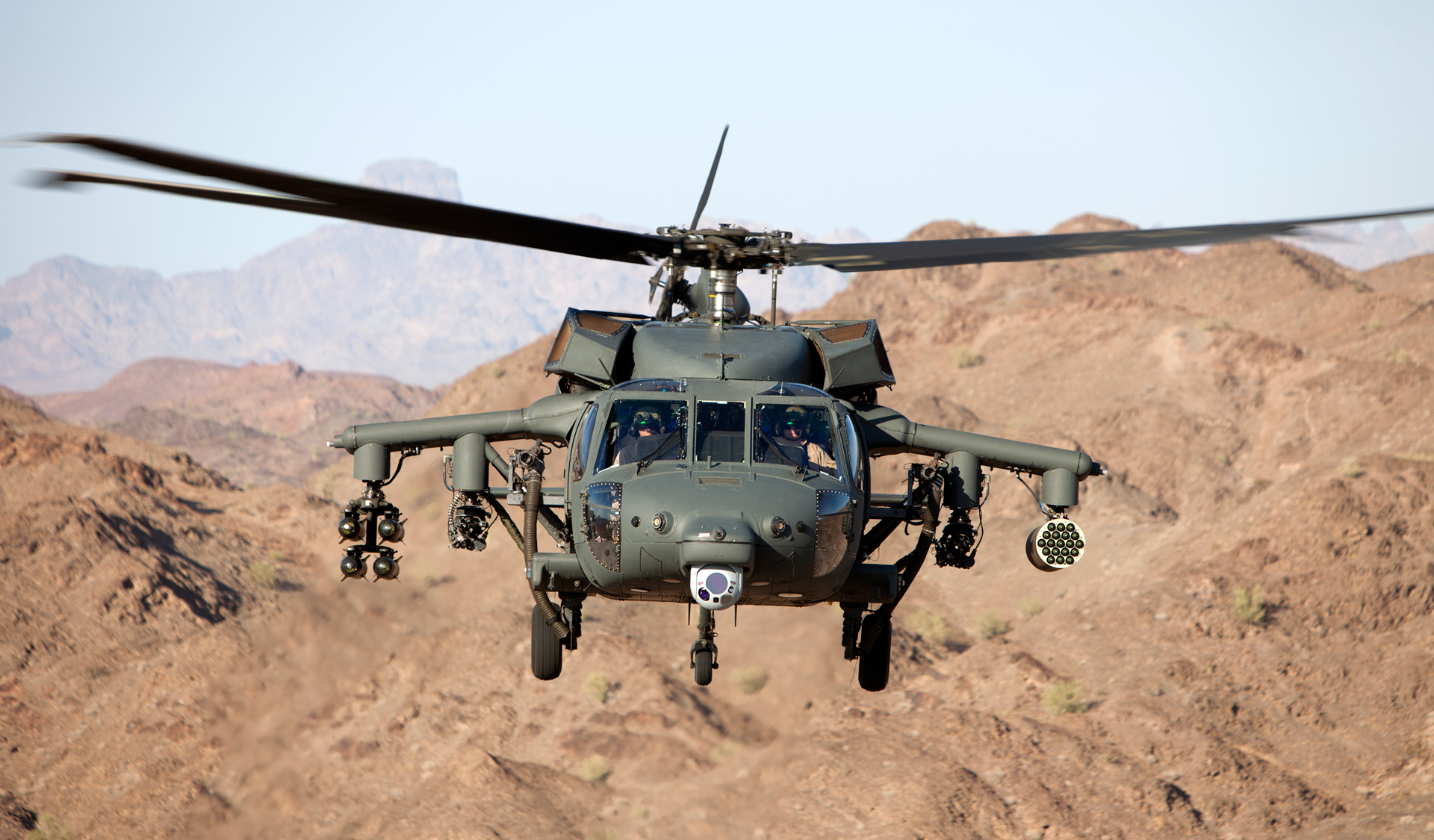
An experimental H-60 Black Hawk fitted with Sikorsky’s armed kit, showing the six-station external weapons layout and mission equipment carried for close-support roles.
Media: Sikorsky x The War Zone
“One Aircraft, Multiple Missions.”
Movement without protection remains a liability in contested airspace. The Black Hawk was built to move troops and equipment forward, but large-scale combat places a greater demand on the formation once it arrives. Lift, fires, and survivability now have to be treated as one problem. The Armed Black Hawk narrows that gap by placing greater protection and combat power on the aircraft already moving the force.
Sikorsky offers two production-ready kit paths built around a previously qualified digital weapons system that integrates with the Black Hawk's existing avionics. On the dual-wing configuration, four external stations carry combinations of fixed forward 12.7 mm guns, 7- or 19-shot Hydra 70 rocket pods, or Hellfire missiles, while pilot-controlled 7.62 mm miniguns mount at the cabin windows.
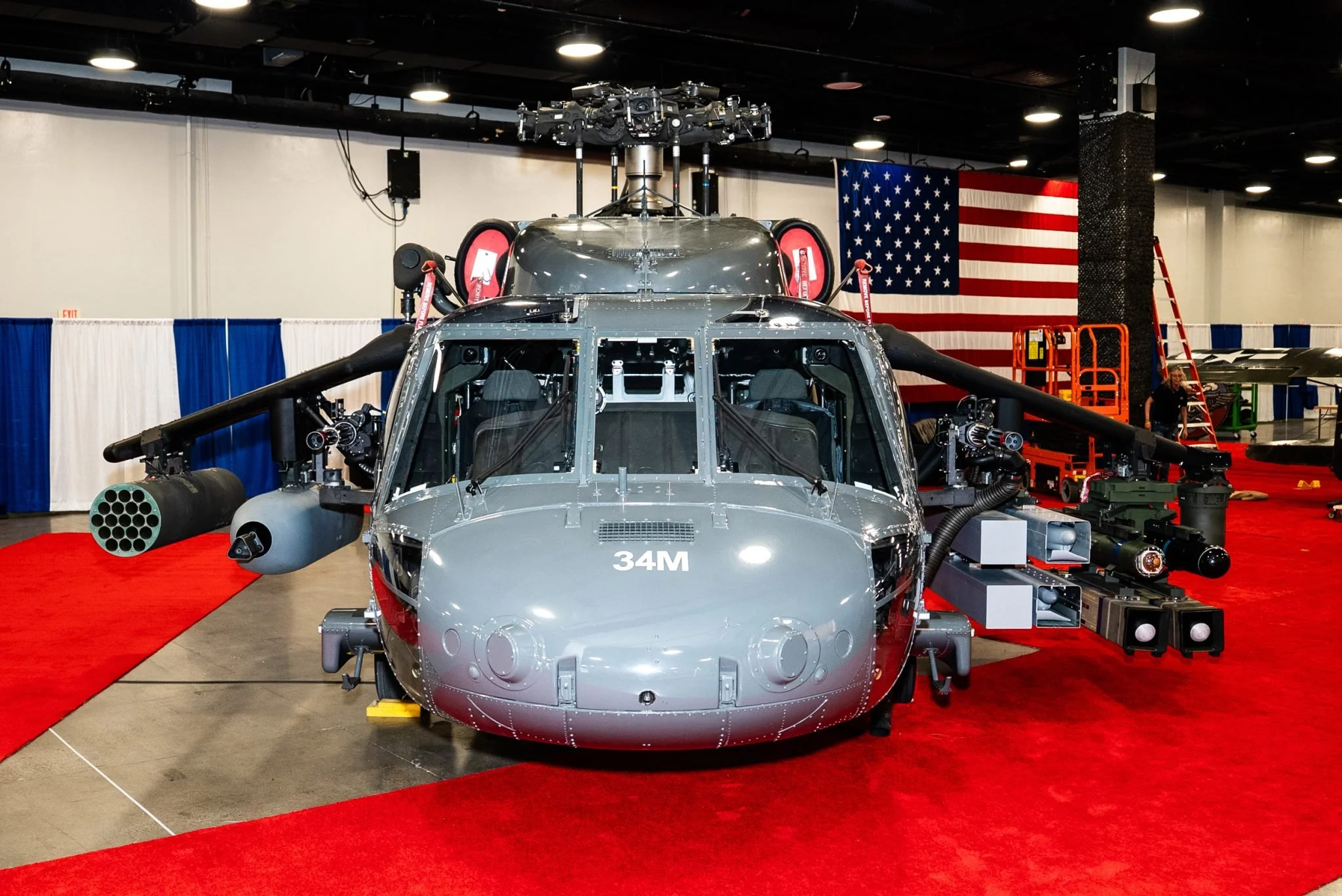
Head-on view of the Armed Black Hawk, showing wing-mounted rocket pod, cabin-window gun mounts, and missile stations on both sides.
Media: Sikorsky
The close-support kit is built for suppressive fire, armed escort, landing-zone preparation, and fire support to troops in contact. The precision-strike kit is built for deliberate engagement of vehicles, fortified points, and high-value targets, with a stated growth path to 16 Hellfire or JAGM missiles. That firepower could suppress immediate threats near the landing zone or extend the aircraft into standoff strike roles, depending on which kit an operator selects. It also imposes costs in weight, drag, fuel, and useful load. Sikorsky has not yet released sufficient performance data to measure the penalty precisely.
The concept fits the Army's Transformation in Contact approach. Formations can adapt an aircraft that already has support across the force. Future aviation programs continue through development in parallel. The armed kit offers a near-term way to distribute more firepower through the existing Black Hawk fleet.
Optionally piloted autonomy changes the risk equation. The H-60Mx is designed to fly with or without a pilot at the controls. That opens a path toward missions where commanders can risk the airframe without risking the crew. Combined with an armed configuration, that flexibility could eventually extend to strike, reconnaissance, resupply, or other missions where the cost of sending people becomes too high.
The timing reinforces that shift. The Army received its first H-60Mx on March 19, 2026, modified to fly with or without a pilot at the controls. Weeks later, Sikorsky introduced the armed kit in Nashville. The two developments land on the same modernization track within a single month. The Black Hawk is being recast as more than a utility helicopter. It is a platform that can carry greater firepower while commanders decide how much human risk a given mission requires.
A UH-60MX Black Hawk equipped with Sikorsky’s MATRIX autonomy suite during flight testing. The aircraft will support Army evaluation of manned, optionally piloted, and autonomous modes.
Media: Lockheed Martin / Sikorsky
The advantage extends beyond weapons. Fleet commonality keeps lift, protection, and persistence inside a shared logistics chain. That consolidation reduces the sustainment burden across the formation, and in a contested environment it can matter as much as range or payload.
That expansion comes with exposure. Added weight, heat, and signature increase risk inside defended airspace. Survivability depends on how the aircraft integrates into the formation. Terrain use, timing, stand-off fires, and coordination with other assets all factor in. In a peer fight, that integration also has to absorb electronic warfare pressure aimed at the aircraft's expanded signature. The platform shapes the battlespace only as part of a system, never in isolation.
The Armed Black Hawk gives the Army another way to close the distance between lift and protection. Its value depends on how quickly the platform is integrated and where commanders are willing to employ it. Doctrine and survivability still have to keep pace with the hardware. Fielding the kit is only the beginning of that answer.
SOURCES: Sikorsky, Sikorsky, Lockheed Martin, U.S. Army, U.S. Army
TAGGED: Armed Black Hawk, Force Modernization, Combat Aviation, Systems Integration
Key Takeaways
• Armed Black Hawk compresses lift, escort, and fires into a single aviation problem set
• The six-station weapons suite expands the aircraft’s presence, allowing it to support the formation beyond insertion
• Transformation in Contact is pushing near-term lethality, using available platforms while future aviation systems continue development
• Black Hawk modernization is moving on two tracks with armament and autonomy shaping the platform’s next phase
• Fleet commonality matters, reducing sustainment strain while expanding mission options across Combat Aviation Brigades
• Survivability depends on integration, not the aircraft operating alone inside defended airspace
ARMED BLACK HAWK ROLE COMPRESSION
| Baseline Role | Armed Configuration |
|---|---|
| Tactical lift platform | Lift with organic fires |
| Insertion and extraction | Presence beyond the LZ |
| External escort dependency | Self-supporting formation support |
| Single-mission tasking | Role compression across CAB operations |
| Sustainment through common fleet | Expanded lethality through shared logistics |
| Survivability through movement | Survivability through integration |
-

ANDRES CARDENAS | Lead Analyst
Modern Warfighter Defense Publication
/ STAY CONNECTED /