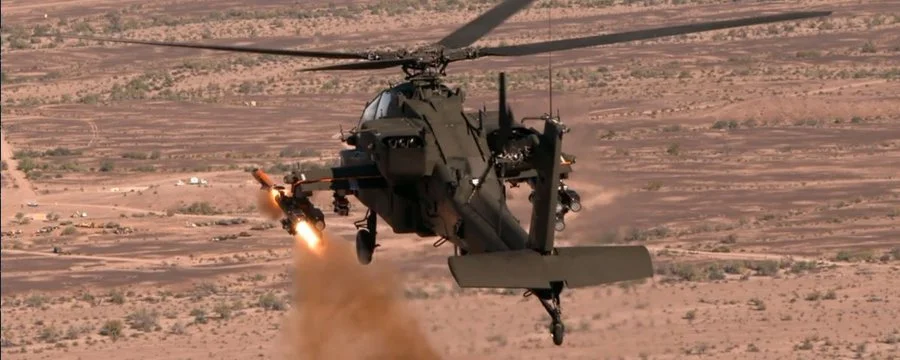

Geometry of the Kill Chain: Repositioning the Apache Inside the Distributed Fight
April 10, 2026 | 5 min brief
YUMA PROVING GROUND, Ariz. (April 6, 2026) — Following the integration of the ALTIUS-700 launched effect, the AH-64 Apache completed a February 2026 deployment of the system from the aircraft after a rapid six-month effort. Lt. Col. David Daniels, the Army’s Apache modernization lead, said the effort moved from requirement to demonstrated capability in under six months, despite a 43-day government shutdown during development and integration.
That speed is the signal. The Army doesn’t move that fast around legacy aviation unless the operational problem is already pressing. The test shows the Apache being pulled into a different role: less a cockpit-centered attack platform, more a crewed node inside a wider system of sensors, effects, and connections.
The shift follows FARA’s cancellation, as the Army moved toward uncrewed systems, distributed sensing, and scalable effects. Ukraine reinforced the same lesson. Reach, persistence, and survivability aren’t solved by adding another airframe. They are solved by extending the network.
That changes how the Apache creates value. Its relevance comes through what it can deploy, connect to, and coordinate beyond its own position. Launched effects push sensing and strike forward, allowing the aircraft to influence the fight without fully entering it. For the aviator, the mission shifts from surviving inside the engagement zone to managing effects at the edge of it.
“Control depends less on where the Apache sits in the fight and more on whether the connection survives contact.”
That reach is conditional.
The system only holds if the network does. Apache sensors, launched effects, data links, relay nodes, and command elements now carry the engagement together. The farther the effect operates, the more the mission depends on signal integrity, bandwidth, and timing inside a peer-contested electromagnetic environment where Russia and China have spent years building the ability to jam, disrupt, and fracture U.S. battle networks. If that layer degrades, the extended reach collapses back to the aircraft.
Operationally, this redraws the geometry of attack aviation. The Apache can hold outside initial threat envelopes, develop targets forward, and feed a broader kill chain that includes ground fires and long-range precision systems. Survivability becomes more than physical separation. It depends on whether the network can preserve a usable picture under pressure.
That pressure reaches the industrial base. Boeing is aligning Apache Version 6.5 with launched effects, open system interfaces, and expanded data architecture. The significance extends beyond the launch itself. The Apache’s software and systems architecture is beginning to support faster insertion of new capabilities across the fleet. This is part of a wider push toward systems that can integrate, scale, and adapt across formations. Demand shifts from building better helicopters to sustaining the networks and effects that make them relevant.
What comes next is scale under stress. Demonstration proves access. Deployment proves intent. The real test is whether launched effects can operate consistently in a degraded environment, integrate across platforms, and feed into long-range fires and joint command systems. If that holds, the Apache does not fade from modernization. It remains part of a distributed system where control depends on whether the connection survives the fight.
Key Takeaways
• Apache is being repositioned from a direct fires platform toward a node inside a wider kill chain
• Launched effects extend the aircraft’s reach, while increasing dependence on signal, timing, and data flow
• Survivability still depends on distance, but the network has to hold under pressure
• The electromagnetic layer is part of the fight, now shaping how operations are contested and controlled
• The Army is prioritizing integration, placing more weight on connected systems than standalone platforms
AH-64 APACHE CAPABILITY SHIFT
| Legacy Role | Emerging Role |
|---|---|
| Direct fires platform | Networked effects node |
| Close attack role | Sensing and strike extension |
| Pilot-centered engagement | Crew-managed distributed effects |
| Survivability through distance | Survivability through network integrity |
| Platform modernization | Systems integration |
TAGGED: AH-64 Apache, Launched Effects, Army Aviation
-

ANDRES CARDENAS | Lead Analyst
Modern Warfighter Defense Publication
/ STAY CONNECTED /