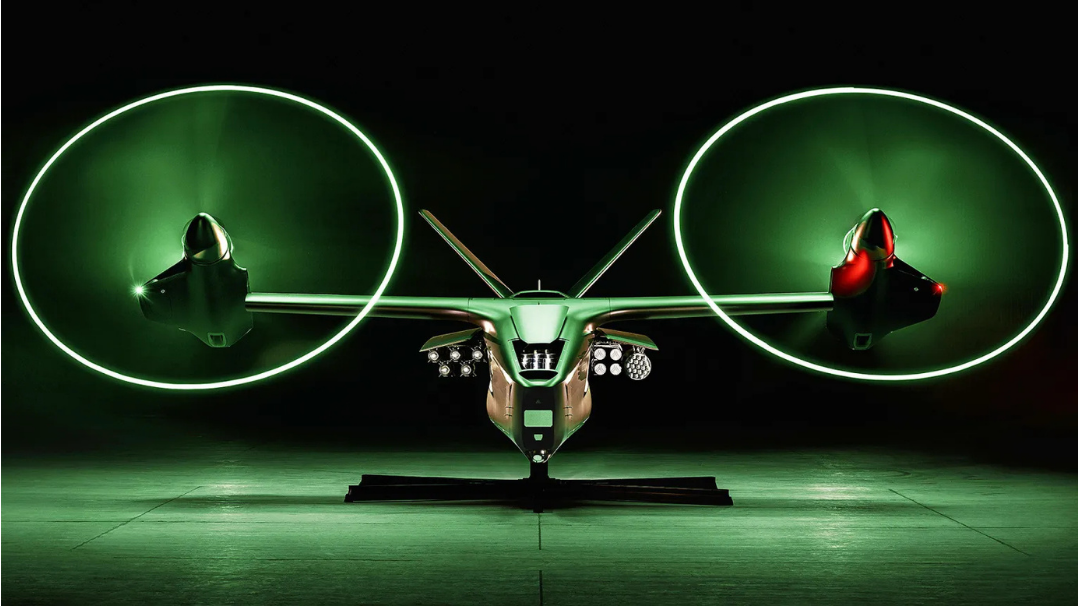

Anduril X Archer Unveil Thunder, an Autonomous Attack Rotorcraft for Future Army Aviation
July 21, 2026 | 5 min brief
FARNBOROUGH, England (July 20, 2026) — An attack helicopter crew today faces a battlefield that finds them before they find the enemy. Integrated air defenses and inexpensive loitering munitions have made low-altitude reconnaissance and strike among the most exposed missions in modern land warfare. Anduril Industries and Archer Aviation's answer is Thunder, an autonomous Group 5 attack rotorcraft built to perform those missions without placing another crew inside contested airspace.
Unveiled July 20 at the Farnborough International Airshow, Thunder is the first military aircraft produced through the companies' partnership. Designed for reconnaissance, strike, and electronic warfare, it is intended to operate alongside crewed formations as part of a broader attack aviation force.
Development has been underway for roughly three years, according to Anduril President Chris Brose, carrying forward engineering lessons from the company's YFQ-44A Fury collaborative combat aircraft into a vertical-lift platform. Although it shares manufacturing architecture with Archer Aviation's commercial aircraft, Thunder entered development as a military program from the beginning. Archer's role centers on aircraft engineering and production, while Anduril developed the autonomy software, mission systems, and weapons integration that define the aircraft's operational capability. That foundation shaped every major engineering decision that followed.
A MODULAR AIRCRAFT FOR MULTIPLE MISSIONS
Thunder is built around a series hybrid-electric powertrain and a dual-tiltrotor configuration that transitions from vertical takeoff to wing-borne cruise, providing the speed and range needed to accompany maneuver forces over greater distances than a conventional helicopter. Archer says the propulsion system varies rotor speed throughout flight to improve efficiency while reducing fuel consumption and acoustic signature during low-altitude operations. The aircraft also incorporates an internal modular payload bay designed to support multiple mission configurations without altering the airframe.
That payload architecture also defines much of Thunder's combat capability. Depending on mission requirements, Anduril says the aircraft can be equipped with Hellfire and JAGM missiles, air-launched effects, or 70 mm rockets. The same aircraft can then be configured for different mission profiles without requiring separate airframe designs.
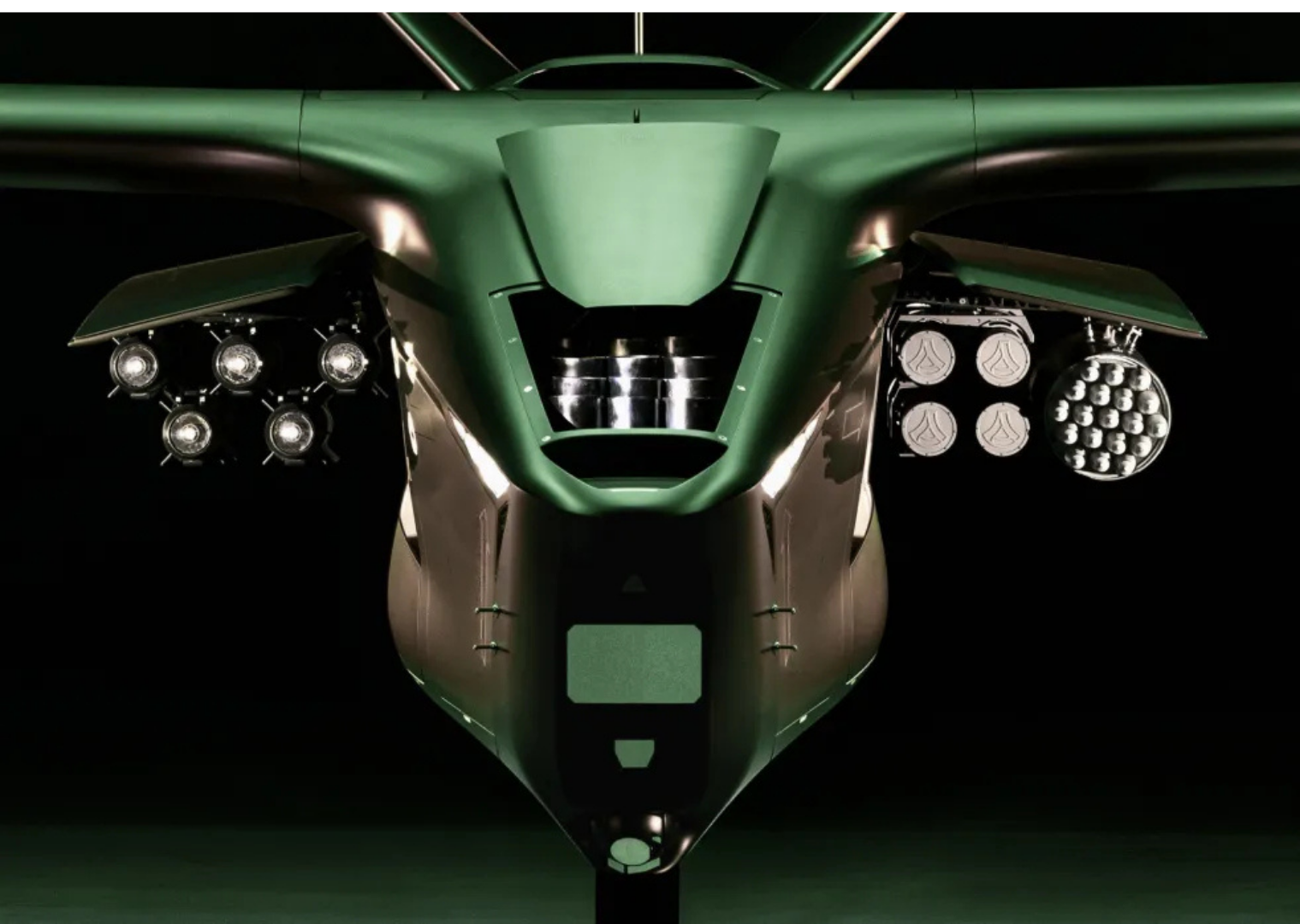
Digital render of Thunder illustrating the aircraft's modular payload architecture and mission systems.
Media: Anduril Industries
Each of those design choices addresses a different operational requirement. Vertical takeoff allows Thunder to operate without prepared runways, expanding where it can be launched and recovered. Autonomy removes the need to place another crew inside contested airspace at all. The result is an aircraft designed to support multiple mission sets while operating alongside crewed formations.
AUTONOMY DEFINES THE MISSION SYSTEM
Autonomy is fundamental to Thunder's design. The platform operates through Anduril's Lattice for Mission Autonomy, which the company says manages formation behavior, routing, tasking, timing, and deconfliction while allowing multiple aircraft to coordinate with minimal operator input. Anduril has also stated that a single AH-64 Apache teamed with three Thunder platforms could deliver roughly three times the available weapons load into a fight, shifting crews toward directing combat effects instead of flying every platform individually. The concept has yet to be demonstrated outside company testing, but it illustrates how Anduril envisions autonomous systems expanding the combat capacity of existing attack aviation formations.
WHAT FLIGHT TESTING STILL HAS TO PROVE
Development remains underway, with a first flight expected in 2027. Archer and Anduril have previously flown full-scale surrogate aircraft through their earlier partnership, but the production design has yet to begin flight testing. Many of its published characteristics, including range, endurance, acoustic performance, and autonomy, remain design objectives until they are demonstrated under operational conditions. The unveiling established what the companies intend to build. Prototype testing will determine how closely the design matches those expectations.
Sustainment remains an open question. Thunder's tiltrotor configuration introduces rotating nacelles, drivetrain components, and flight-control systems that add mechanical complexity beyond a conventional fixed-wing aircraft. The V-22 Osprey, the world's most widely operated tiltrotor, shows what that complexity costs in maintenance hours over decades of service, a data point, not a prediction, since Thunder removes the crew and cockpit systems that drive much of the Osprey's sustainment burden. Whether an uncrewed tiltrotor trades that burden away or simply relocates it into the autonomy stack and ground-support equipment is unanswered until flight testing begins. The aircraft's long-term maintenance burden remains one of the program's largest unknowns.
Integration raises another unanswered question. Thunder operates through Anduril's Lattice for Mission Autonomy, but public information has yet to establish how the system will connect with existing tactical datalinks and command-and-control networks. Those connections will determine how missions are assigned, sensor data is exchanged, and engagement decisions move between autonomous aircraft, crewed platforms, and ground commanders. As Thunder progresses through testing, interoperability may prove just as important as the aircraft's flight performance.
FOUR COMPANIES, FOUR APPROACHES
The competing proposals reflect different philosophies of autonomous attack aviation. Thales and Schiebel are building on the Camcopter S-100, already in operational service, with armed derivatives in development; the S-301 variant is designed to carry ten Martlet missiles when it enters service in 2027. BAE Systems has pursued its own sovereign approach, unveiling Brontanax, the UK's first British-designed Collaborative Combat Aircraft, at the same Farnborough show. Tekever's Project NYX applies the company's fixed-wing ISR and electronic warfare experience to a rotary "loyal wingman" platform designed specifically to team with Apache. Thunder takes a different approach, combining Archer's aircraft development and manufacturing capability with Anduril's autonomy software and mission systems in a clean-sheet tiltrotor platform.
Thunder moves beyond the traditional attack helicopter by exploring how autonomy, modular payloads, and distributed operations can reshape the role of combat aircraft within a formation. The concept is established. The next phase will determine whether the aircraft can translate that architecture into operational capability.
TAGGED: Army Aviation, Autonomous Systems, Military Aircraft, Force Modernization, Defense Industry
-

ANDRES CARDENAS | Lead Analyst
Modern Warfighter Defense Publication
/ STAY CONNECTED /