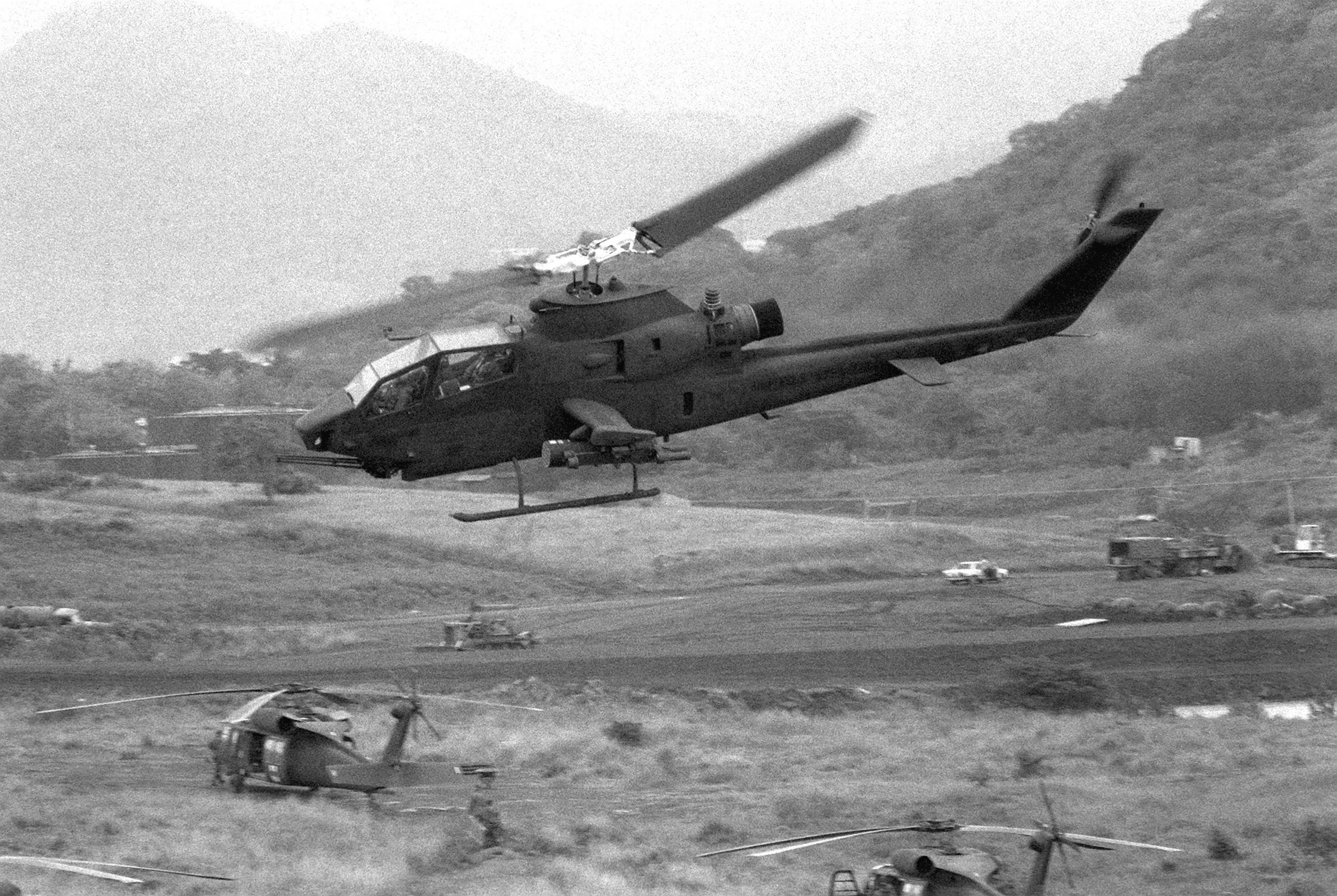
The Army built its anti-tank transition inside the Cobra fleet a decade before Apache unit training began. The harder test was sustaining combat power through the overlap.
August 27, 2026
AH-1 Cobra to AH-64 Apache: The Limits of Buying Time
THE SNAKE'S DECADE
In March 1976, the Army deployed the M65 TOW/Cobra system to Europe under Project Hand-off. Apache's first operational unit would begin training at Fort Hood in April 1986. Ten years separated those milestones.
That decade belongs at the center of this history. The Army rebuilt Cobra around an anti-tank weapon and capable fire control. Apache emerged from a separate development program as doctrine expanded the place of attack aviation in the combined arms battle. The transition was already under way inside the aircraft the Army owned.
THE ESCORT PROBLEM
Armed Hueys gave the Army firepower that could accompany an air assault, with the compromises of a utility helicopter. Vietnam created an immediate demand for a dedicated escort, even as the Army pursued a more ambitious advanced aircraft. Lieutenant General John J. Tolson's official history describes Cobra procurement as an interim answer to that wartime requirement.
Bell's prototype first flew on September 7, 1965. A narrow fuselage and tandem cockpit replaced the transport cabin. Underneath that new layout were Huey-derived power and rotor components. The design combined a dedicated attack configuration with machinery already serving the Army.
The AH-1G entered service and deployed to Vietnam in 1967. Rockets and turret weapons supported escort missions and fire close to ground troops. That established Cobra's immediate purpose. The anti-tank aircraft that followed required substantial changes.
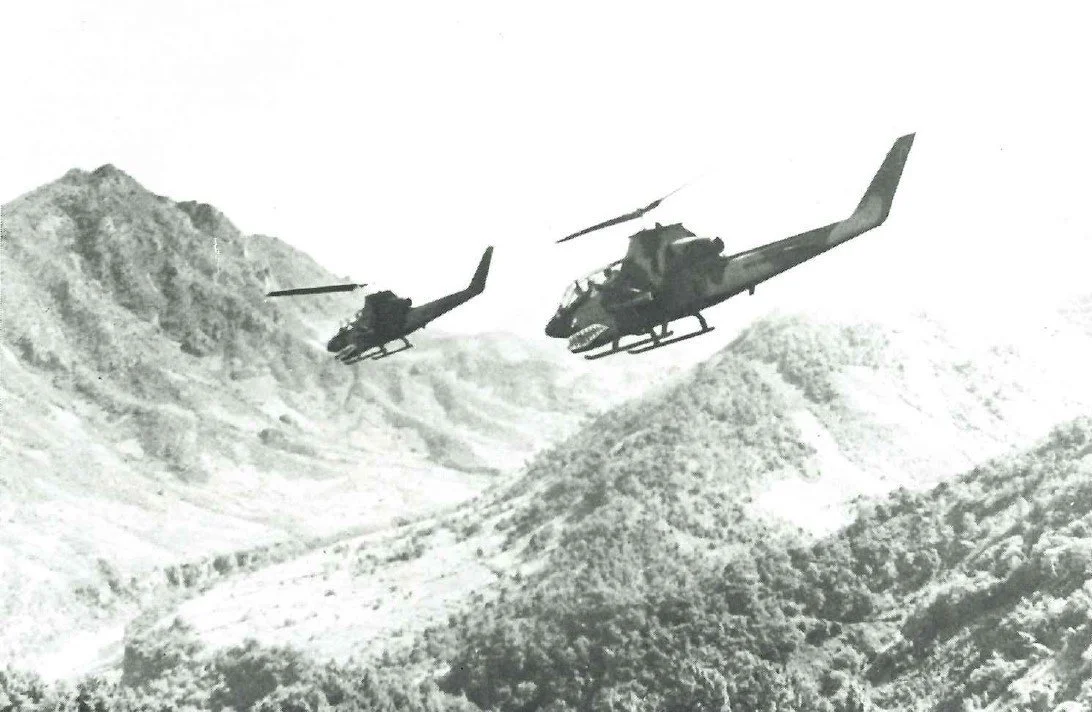
AH-1G Cobras of the 17th Cavalry fly over mountainous terrain during the Vietnam War.
Image: U.S. Army
THE TRANSFORMATION INSIDE COBRA
Studies for the XM65 TOW installation on Cobra began in 1970. The Improved Cobra Armament Program followed in March 1972. The urgent combat demonstration that spring used two UH-1Bs carrying the XM26 system. On May 2, 1972, the 1st Combat Aerial TOW Team entered combat, demonstrating helicopter anti-tank firepower against North Vietnamese armor. AMCOM's history identifies night and limited visibility as the system's largest operational impediment.
The Cobra installation paired a telescopic sight with TOW missiles. Initial M65 fielding began with Training and Doctrine Command in November 1975, followed by the March 1976 Europe deployment.
Power was the constraint that shaped everything after. The modified AH-1S carried a T53-L-703 rated at 1,800 shaft horsepower, a substantial increase over the AH-1G's T53-L-13. The aircraft could not use most of it. The operator's manual, TM 1-1520-236-10, paragraph 2-17, records that the engine is derated by the transmission's limits to 1,290 shaft horsepower for thirty minutes and 1,134 for continuous operation at 100 percent rotor speed. More than a third of the engine's rated output was unavailable in sustained flight because the dynamic system beneath it descended from a utility helicopter designed in the 1950s. The Army could buy a bigger engine faster than it could redesign a drivetrain, and every capability added after 1976 had to fit inside that margin.
One surviving aircraft makes the sequence tangible. The MAPS Air Museum's Cobra, serial 70-16084, began as an AH-1G. Bell converted it to AH-1Q in February 1976. It deployed to Germany in July 1977 and became an AH-1S at Corpus Christi Army Depot in March 1978. This was an operational aircraft undergoing successive rebuilds, years before Apache reached unit training.
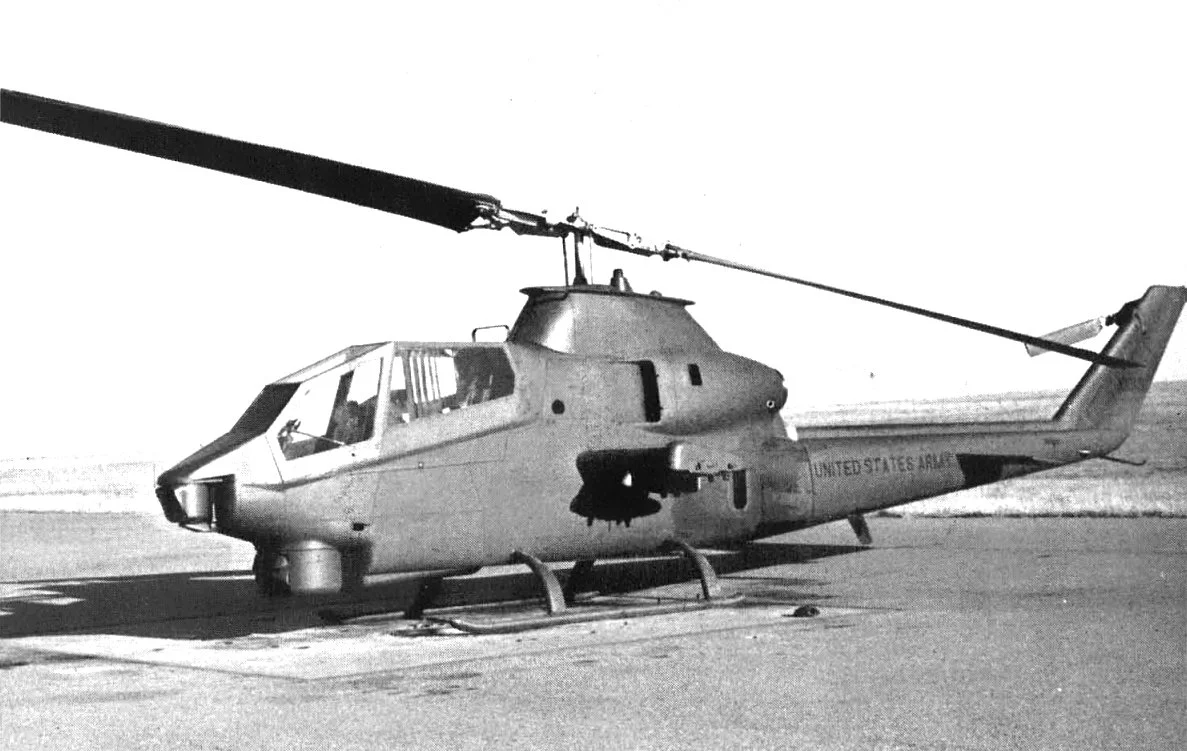
An AH-1Q TOW Cobra, pictured in the November 1976 issue of U.S. Army Aviation Digest.
Image: U.S. Army Aviation Digest
The S designation covered several configurations. In the October 1979 issue of Army Aviation Digest, Cobra project manager Colonel Jay W. Pershing described the phased program. New-production AH-1S deliveries began in March 1977. An angular canopy was designed to reduce reflections, and redesigned instrument panels supported low-level flight.
The Enhanced Cobra Armament System entered production in September 1978, introducing a new turret and stores-management equipment. Its centerpiece was the three-barrel M197 20mm cannon on the M97A1 armament subsystem, replacing the earlier minigun and grenade launcher turret. An improved Kaman rotor blade entered production in April 1979 on the 149th new-production AH-1S.
Computerized fire control changed how the crew used the weapons. A laser rangefinder supplied distance to a ballistic computer, which also used air data and aircraft attitude. The system corrected gun aiming and generated a rocket-aiming cue in the pilot's head-up display alongside flight information. The AH-1F operator's manual, printed p. 4-7, describes the integration. The laser measured range, but TOW retained wire guidance.
Redstone records modernized AH-1S deployment to Forces Command beginning in 1980. Later designations separated the configurations that had shared the S-model name. The Army's maintenance manual identifies production aircraft as AH-1P and ECAS aircraft as AH-1E. The fully modernized configuration became AH-1F.
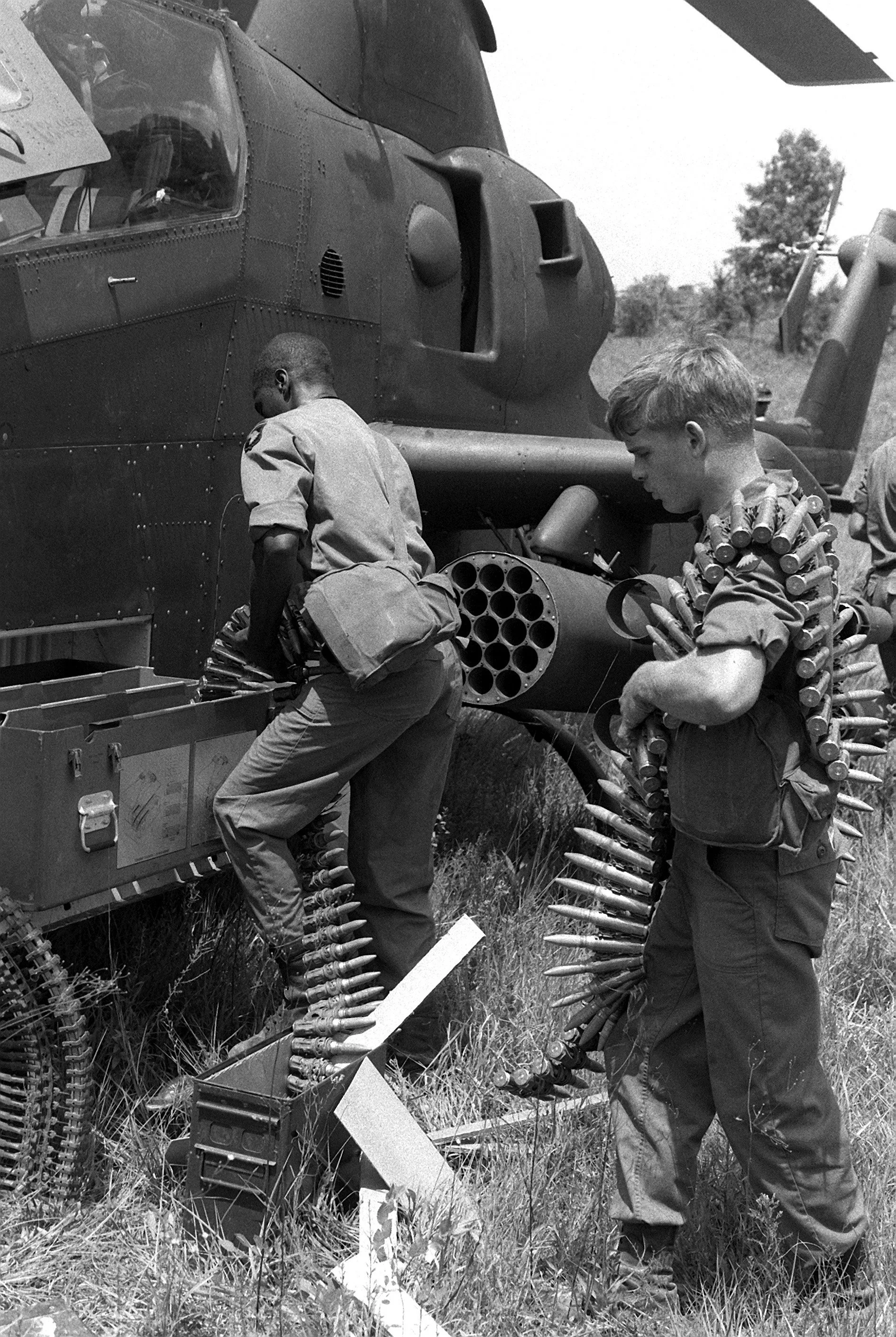
Soldiers from Company C, 229th Attack Helicopter Battalion, 101st Airborne Division, load 20mm ammunition into an AH-1S Cobra during Exercise Attack Eagle at Fort Campbell, June 21, 1982.
Image: National Archives.
The training system had to follow. Fort Rucker's first fully modernized AH-1S qualification course ended on October 6, 1981, according to U.S. Army Aviation Digest, November 1981, p. 18. The six-week course combined aircraft qualification with TOW instruction and used modernized Cobras throughout.
THE NIGHT GAP
The sight imposed a limit that engine and cockpit improvements could leave intact. The AH-1F operator's manual, printed p. 4-16, describes the baseline TOW subsystem as designed for daylight. It allows that night employment with flares could be effective, but identifies reticle glare and difficulty acquiring targets whose locations were unknown. A helicopter's ability to fly at night and its gunner's ability to find and engage armor in darkness were separate capabilities.
In January 1984, the Army established the C-NITE effort. Redstone dates delivery of the resulting telescopic sight to 1989, thirteen years after the European TOW/Cobra deployment and five years after initial Apache deliveries. That is a delivery milestone, with fleetwide installation and individual units' readiness requiring separate evidence.
C-NITE added forward-looking infrared and thermal missile tracking for TOW 2, giving modified aircraft thermal target acquisition at night and in obscured conditions. Upgrades preserved an anti-tank force. For thirteen years, the baseline sight left its night effectiveness dependent on illumination and the difficulty of finding targets. The Army gained a missile-equipped fleet faster than it gained a thermal means of finding armor after dark.
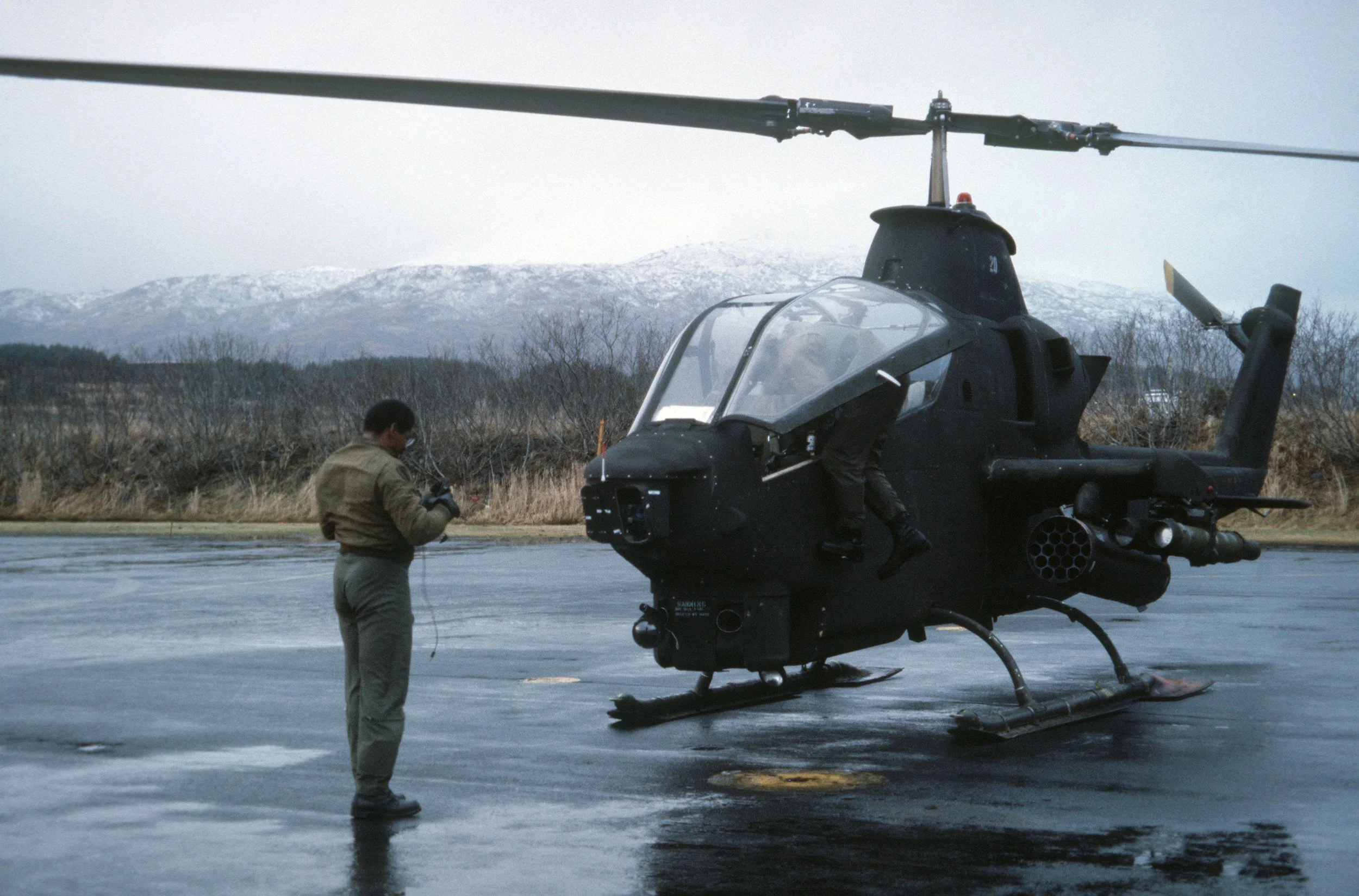
Ground crew work on a Cobra during Exercise Brim Frost, Kodiak Island, Alaska, January 1987. The first Apache unit had begun training nine months earlier. Cobras remained in the force for another twelve years.
Image: National Archives
A NEW AIRCRAFT, DEVELOPED IN PARALLEL
The AH-56 Cheyenne program ended in 1972. The Defense Department's fiscal 1974 report described a smaller and less complex Advanced Attack Helicopter and requested $64 million to begin Cobra TOW retrofits. Budget planning covered both the existing fleet and its successor.
The AAH solicitation went to industry in November 1972. Hughes' YAH-64 first flew on September 30,1975, and Hughes won the Phase 2 development contract on December 10, 1976. Bell lost that competition, but Cobra production and Army depot conversions continued.
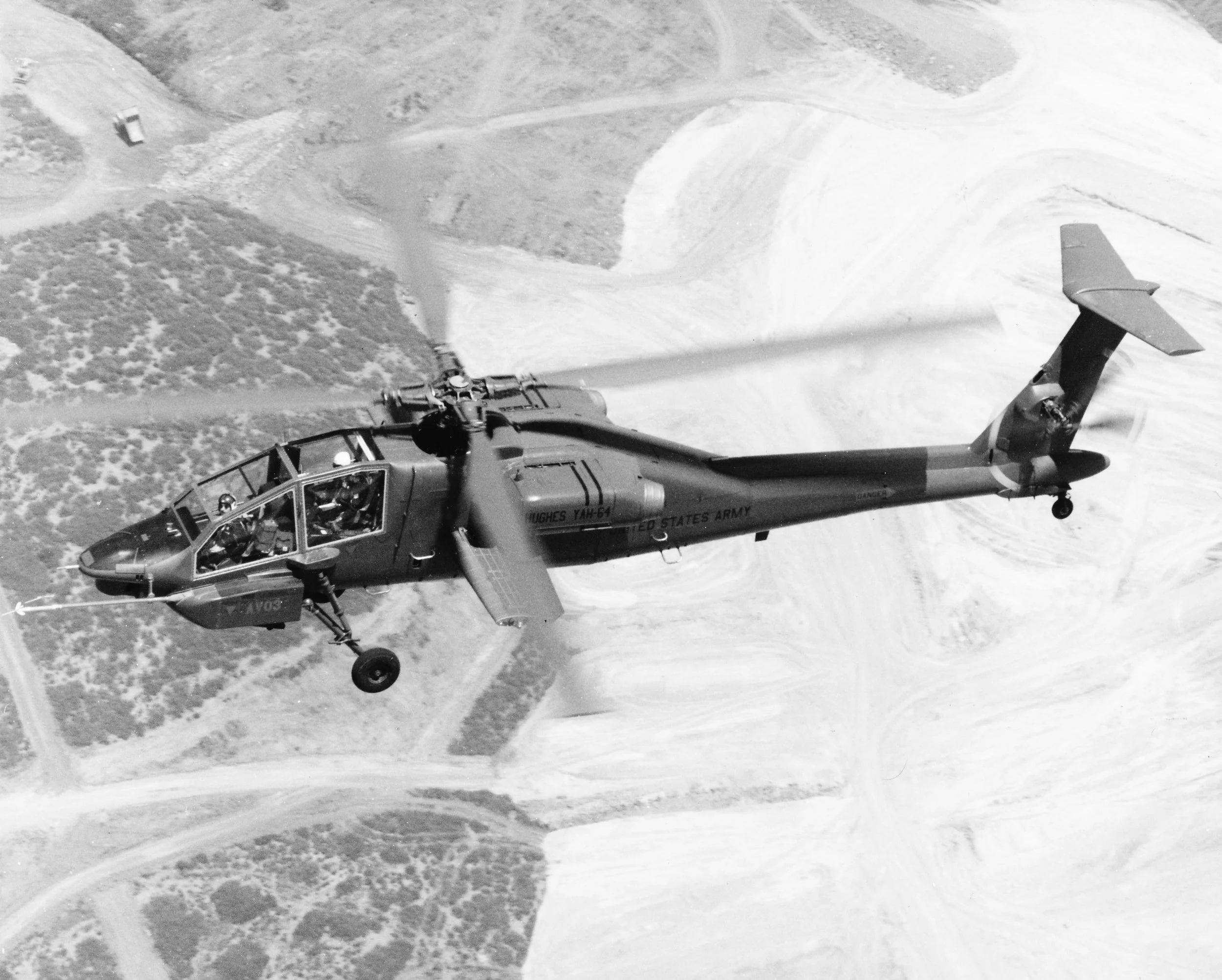
Hughes YAH-64 prototype during the Army's Advanced Attack Helicopter competition.
Image: Vertical Flight Society.
The Army sought twin-engine power and greater survivability, with improved night and adverse-weather performance. In February 1976, an acquisition review confirmed Hellfire in place of the planned TOW missile. Hellfire's semiactive laser seeker could use designation from the firing helicopter or another platform.
The gunner still needed to find the target, and the pilot needed a usable view for flying at night. The Target Acquisition Designation Sight and Pilot Night Vision Sensor, TADS/PNVS, divided those jobs between targeting equipment and a separate pilot system. Lockheed Martin dates original-system fielding to 1983. These were features of the original AH-64A, years before Longbow.
That integrated capability also concentrated development risk. In 1977, GAO warned that AAH depended on concurrent development of Hellfire and TADS/PNVS, and flagged development of 30mm ammunition. Production could begin before any of those systems had proven itself in sustained service.
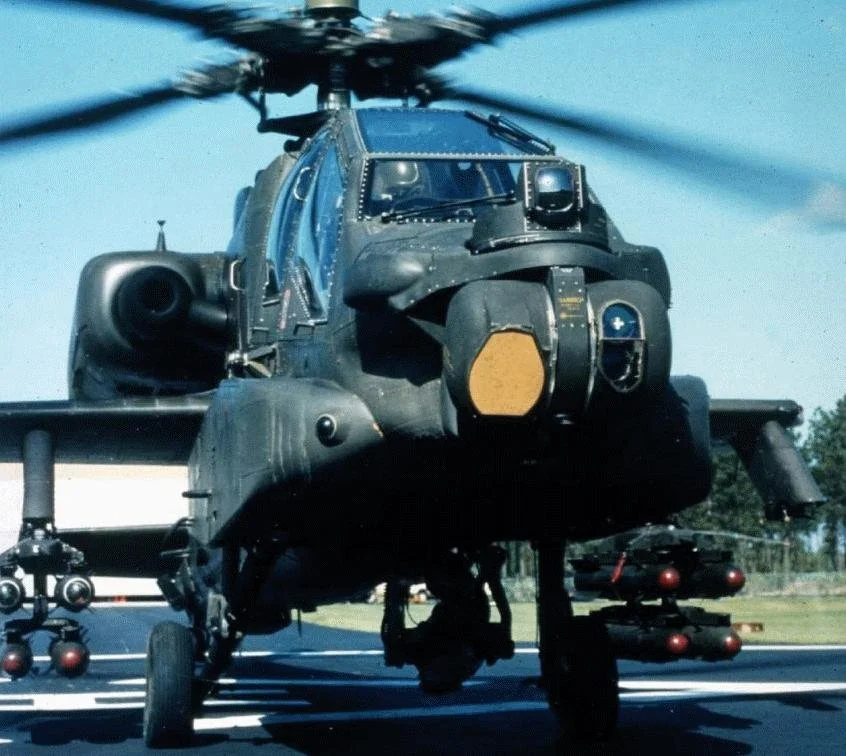
An AH-64A Apache with the TADS/PNVS sensor suite beneath the nose. TADS handled target acquisition and designation while PNVS provided the pilot’s night-flying view.
Image: Federation of American Scientists
DOCTRINE PRECEDED APACHE FIELDING
The July 1, 1976 edition of FM 100-5, Operations, set out Active Defense and already discussed AAH and Hellfire. In defense, helicopters could operate under engaged brigade or battalion commanders and arrive in relays to sustain the fight. Offensive tasks included protecting flanks and reinforcing against counterattacks. The manual also assigned attacks on enemy reserves, placing that role in doctrine six years before AirLand Battle appeared.
The August 20, 1982 edition organized AirLand Battle around initiative, depth, agility, and synchronization. Operations against uncommitted enemy forces were meant to affect the battle already being fought, "The deep battle is closely linked with the close-in fight."Apache development had begun a decade earlier. AirLand Battle sharpened the doctrinal role while Apache was still years from reaching an operational unit.
Army Aviation became a separate branch on April 12, 1983. The May 5, 1986 edition of FM 100-5, printed pp. 42–43, described a growing role for aviation in maneuver. It assigned attack helicopters anti-tank overwatch and counterattacks, along with raids and attacks against enemy flanks or rear areas. Because other combined arms elements still had to help suppress enemy air defenses, greater reach increased the importance of coordination across the force.
DELIVERY WAS THE START OF FIELDING
The first production AH-64A rolled out on September 30, 1983, and reached the Army in January 1984. The first operational unit began training at Fort Hood in April 1986, with operational deployments to Europe following in September 1987. Factory rollout, Army delivery, unit training, and overseas deployment marked different stages of a transition that still required the Cobra fleet.
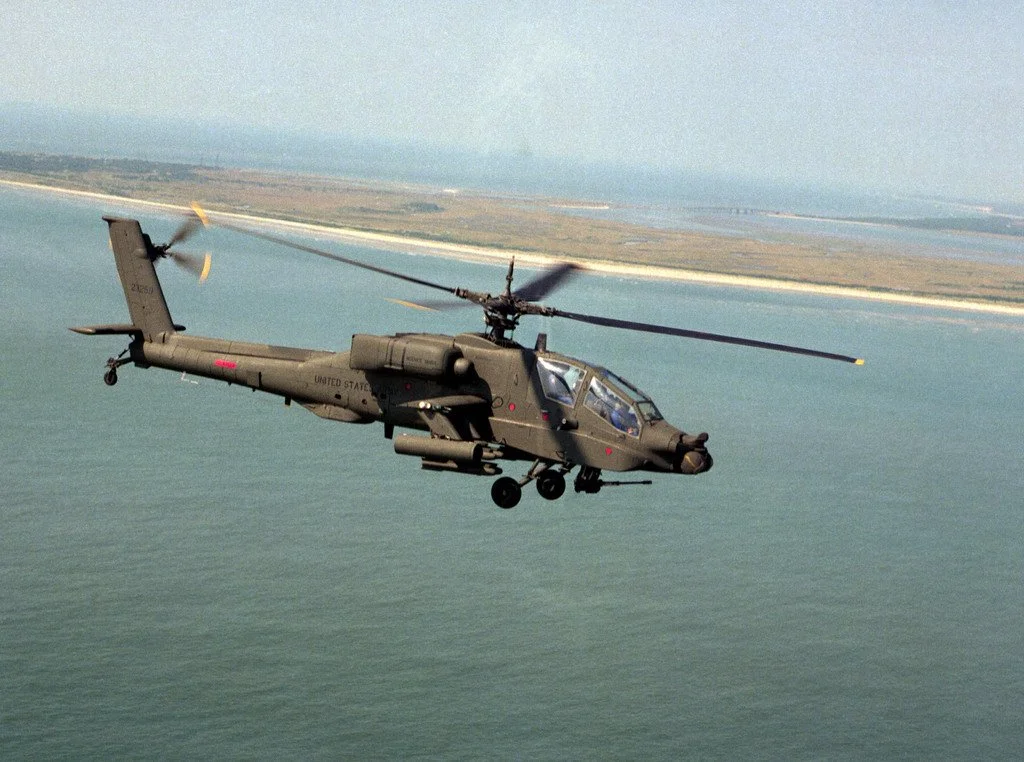
An AH-64A Apache in flight during the late 1980s. By then, attack aviation had moved from development into a more integrated role in Army maneuver.
Image: National Archives / PH1 Erickson
Technical maturity continued after those dates. In April 1990, GAO reported that Apache's fully mission capable rate had averaged 49 percent during 1989. That measured availability for all assigned missions, a different measure from simple ability to fly. Frequent component failures and heavy maintenance demands were compounded by support shortages. GAO also criticized unresolved design issues entering production after the program skipped a low-rate production phase and follow-on operational testing.
The gun system supplies a more specific follow-through on the earlier development warning. GAO's April 1993 report recorded failed endurance and reliability testing in 1984 and questioned whether 1992 testing established compliance with requirements. These findings concerned the 30mm weapon system as a whole, limiting what they establish about ammunition development alone. GAO's later recommendation record reports an Army 100,000-round test that achieved twice the required mean rounds between stoppages, evidence of subsequent improvement.
NORMANDY SHOWED THE CAPABILITY AND ITS DEPENDENCIES
Apache entered combat in Panama during Operation Just Cause in December 1989. The opening of the Gulf War showed how the attack helicopter could shape a larger air operation.
On January 17, 1991, Task Force Normandy's eight attacking Apaches struck two Iraqi early-warning radar sites. They came from 1st Battalion, 101st Aviation Regiment, 101st Airborne Division and flew as two teams of four. A ninth Apache was held as a spare.
Air Force MH-53J Pave Lows supplied the navigation needed to bring the Apaches to the objectives on time. Fuel requirements forced an external tank into a position otherwise available for a rocket pod. The Army University Press account makes the dependency visible: Apache supplied the attack capability, but the mission required another service's equipment and an exchange of weapons capacity for endurance. Destroying the radar sites opened a corridor for the air campaign.
HOW LONG THE OVERLAP LASTED
The transition interval has a measurable end. Cobra left active Army service on March 15, 1999, when 1st Battalion, 25th Aviation Regiment flew a final formation of AH-1Fs over Oahu and turned the mission over to OH-58D Kiowa Warriors.
The U.S. Space & Rocket Center dates reserve component Cobras continued into September 2001. Disposal ran longer still. An October 21, 2010 Army report described Fort Drum preparing its final four refurbished Cobras for shipment to Thailand. That report records a planned shipment, a different milestone from operational retirement.
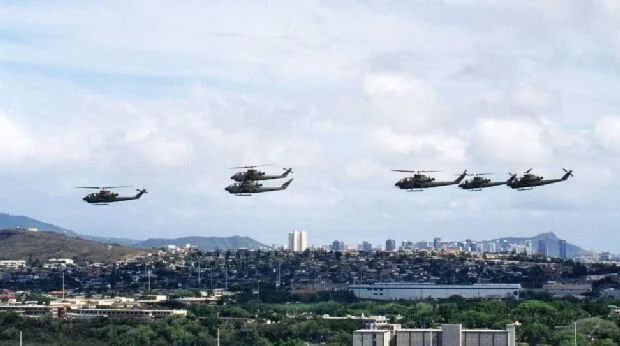
AH-1F Cobras of 1st Battalion, 25th Aviation Regiment fly over Oahu during the active Army’s final Cobra flight on March 15, 1999.
Media: Air Cav
Measured from the first Apache unit's training in April 1986, the active-force overlap lasted nearly thirteen years. Starting with first Army delivery in January 1984 produces more than fifteen years to active retirement, and more than seventeen to the reserve-component endpoint. Those intervals measure coexistence in the force. They establish neither equal fleet sizes nor equivalent capability, especially at night.
The Marine Corps followed a separate branch of the lineage. Bell delivered the first AH-1W on March 27, 1986, the year the Army's first Apache unit began training. The Marines retired the W-model in October 2020. Bell recorded 179 delivered aircraft and 933,614 fleet flight hours through August 2020, and described remanufactured W-models continuing as AH-1Zs. The W-to-Z path included a four-blade main rotor and new, performance-matched transmission, tackling the margin problem through a redesign of the lifting and drive system.
WHEN APACHE BECAME THE AIRCRAFT TO REBUILD
The AH-64A had already introduced twin-engine power and integrated night sensors. The Longbow program added mast-mounted fire-control radar and a radio-frequency seeker for Hellfire. Radar-equipped aircraft could acquire targets through conditions that constrained optical systems, and the missile's autonomous seeker reduced dependence on continued laser designation. The acquisition report tied rapid engagements to reducing the helicopter team's exposure. The Army distinguished AH-64Ds with and without the radar mission kit.
Much of that expansion came through aircraft already in the inventory. Boeing records 501 Army AH-64Ds remanufactured from AH-64As and delivered between 1997 and 2006. The program's Selected Acquisition Report records first production delivery in March 1997. The first unit was equipped in July 1998, with initial operational capability following that November. The last AH-64A, aircraft 451, left service on July 15, 2012, retiring from the Texas Army National Guard's 1-149th Attack Reconnaissance Battalion before being sent to Boeing's Mesa facility for conversion. Boeing received a follow-on contract that September to remanufacture the final 16 aircraft, with completion planned for December 2013.
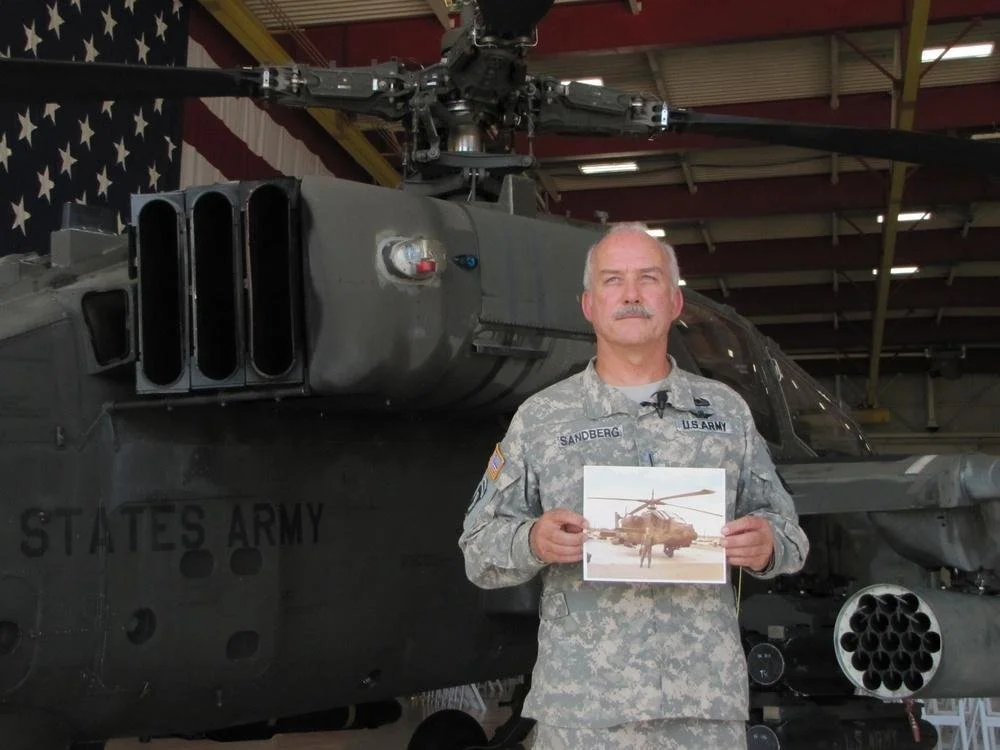
The Army’s last AH-64A at Ellington Field in July 2012, before being disassembled and sent to Boeing’s Mesa facility for conversion into an AH-64D Longbow.
Image: U.S. Army
The rebuild continued into the next generation. In April 2016, Boeing announced an agreement to remanufacture 117 AH-64Ds into AH-64Es. Crew trainers, logistical support, and spares accompanied the aircraft work.
THE STRATEGIC CONSEQUENCE
That remanufactured fleet is still moving through successive configurations. On November 18, 2025, the Army reported the 10th Combat Aviation Brigade's transition from AH-64Ds to AH-64E Version 6. On February 3, 2026, 1st Battalion, 101st Aviation Regiment transferred its first two E-model Version 4 aircraft to 1st Battalion, 149th Aviation Regiment, serving the Texas and Mississippi Army National Guards. The transfer helped prepare 1-101 to receive Version 6 aircraft.
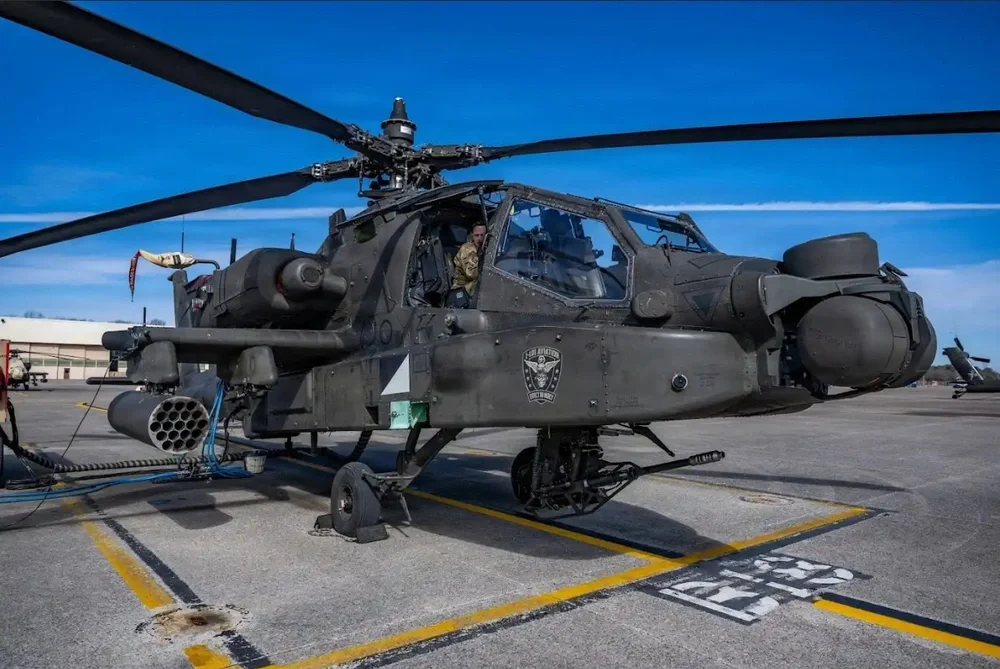
An AH-64E Version 4 assigned to 1st Battalion, 101st Aviation Regiment at Fort Campbell in February 2026. Earlier that month, the battalion transferred its first two Version 4 aircraft to 1st Battalion, 149th Aviation Regiment as 1-101 prepared to receive Version 6 Apaches.
Image: U.S. Army
In its June 2025 budget request for FY2026, the Army listed zero additional AH-64E remanufactures, compared with 31 in FY2025. The remanufacture line retained $1.669 million for production and airworthiness support. A separate line requested $125.236 million for Apache modifications. These are request figures, distinct from enacted funding or deliveries under existing contracts. The fiscal 1974 budget that funded Cobra's TOW retrofit funded the AAH solicitation in the same document. No FY2026 line funds an Apache successor.
Within that total, the Army requested $20.146 million for processor work and $6.533 million for sensor modernization. Its program description connects mission-computer work to Version 6.5's goal of a common AH-64E hardware and software configuration, and describes MUMT-X manned/unmanned teaming software updates for cybersecurity and interoperability. Maintainer training devices accounted for another $15.867 million.
WHAT UPGRADE MONEY DOES NOT BUY
Reliability problems prevented the metallic tail-rotor blade from reaching its 6,404-hour design life, and the Army attributed the increase in modification funding to development and fielding of an improved blade. The blade problem establishes a reliability shortfall, without establishing an equivalent to Cobra's night-targeting gap.
C-NITE sight delivery came in 1989, five years after first Apache delivery, with fleetwide installation still a separate milestone. Cobra's successor was already entering the force while that limitation was still being corrected. Apache has no equivalent successor moving through the same transition.
That changes the risk. An upgrade schedule cannot set the date of the next war.
TAGGED: AH-1 Cobra, AH-64 Apache, Attack Aviation, Army Aviation, Acquisition, Doctrine
-

ANDRES CARDENAS | Lead Analyst
Modern Warfighter Defense Publication
/ STAY CONNECTED/